Every solar array in Ireland exports something. On a bright Saturday in May, when the house is empty and the immersion is already hot, a ground-mounted system in Longford or Carlow will be pushing most of what it makes out onto the network. The Clean Export Guarantee, usually shortened to CEG, is the mechanism that means you get paid for those units instead of giving them away.
It is a good scheme and a badly understood one. People ring us assuming export is where the money is, then get a surprise when the first credit lands on the bill. This article covers what the CEG actually is, what has to be in place before you are paid, how the rates behave, and why the units you use yourself are worth several times the units you sell.
Key takeaways
- The CEG obliges every electricity supplier to pay for exported units, but each supplier sets its own rate.
- You need an MPRN, a smart meter and a completed NC6 notification to ESB Networks before payments begin.
- Export rates change regularly, so check current supplier tariffs on the day you decide and again at renewal.
- A unit used in the house is usually worth two to three times the same unit exported.
- A battery plus timed appliance use can lift self-consumption from roughly a third to well over half.
What the Clean Export Guarantee actually is
The CEG comes out of the EU Renewable Energy Directive and was given effect here by the Commission for Regulation of Utilities, the CRU. In plain terms it places an obligation on electricity suppliers to pay micro-generators and small generators for the units they export to the grid.
That obligation sits with your supplier, not with ESB Networks. ESB Networks owns the wires and the meter and records what leaves your property. Your supplier is the company that sends you the bill, and it is the one that has to credit you for what you exported.
Every supplier in the domestic market has to offer a CEG tariff. They do not all have to offer the same one, and that is the single most important thing to understand about the scheme. The obligation is to pay. It is not an obligation to pay a set national rate.
Payment normally arrives as a credit against your electricity bill rather than as cash into a bank account, although some suppliers will release a payment once the credit passes a threshold. Read the terms rather than the headline before you decide anything on the strength of a rate.
What has to be in place before you get paid
Three things. An MPRN, a smart meter, and a completed NC6 notification to ESB Networks.
The MPRN is the Meter Point Reference Number for the property. It is printed on your electricity bill and it is how every party in the chain identifies your connection. If you are building, or connecting a yard or a shed that has its own supply, be clear from the start about which MPRN the array is attached to. We have seen arrays wired to the wrong meter on farms with two supplies.
The smart meter is what makes export measurable. An older meter cannot separate import from export in the way the CEG needs, so ESB Networks has to fit a communicating meter before export can be properly counted and paid. A large share of properties already have one from the national rollout. If yours does not, the exchange is arranged through ESB Networks and there is normally no charge for the meter itself.
The NC6 is the notification form for micro-generation and it is the installer's job to submit it. It covers systems up to 6 kW single-phase and 11 kW three-phase. Anything above that is a full connection application rather than a notification, which is a longer and more involved process. Allow typically a few weeks for the paperwork to move through, and note that the array can run and serve the house in the meantime.
How much you actually get paid, and why the rate moves
Rates differ by supplier and they change. That is not us being evasive, it is how the scheme is built. Suppliers set their own CEG tariffs, revise them, and sometimes attach conditions such as requiring you to be on a particular plan or to have signed up within a window.
Across the life of the scheme so far, published domestic export rates have generally sat somewhere between a few cent and around twenty cent per unit, with most suppliers sitting well below the top of that band at any given time. We are giving you a wide range on purpose. A narrow one would be wrong within months, and you would be entitled to be annoyed about it.
Check current rates on the day you are deciding. Go to the suppliers directly, or use the CRU information and the accredited price comparison sites, and check again at renewal. Switching supplier to get a better export rate is allowed and is reasonably common.
Compare like with like. A supplier with an eye-catching export rate and an expensive day rate or standing charge can easily leave you worse off across the year than one with a modest export rate and cheap units. Model the whole bill, not one line of it. For most households the import side is still much bigger than the export side.
Why self-consumption nearly always beats export
This is the part that should change how you use the system. A unit you consume in the house displaces a unit you would otherwise have bought at the retail day rate. A unit you export earns the CEG rate. The retail rate is almost always the larger of the two, frequently by a factor of two or three.
So every kilowatt hour you shift from export to self-consumption is worth more than the same kilowatt hour sold. On a typical Irish home with no battery and nobody in during the day, self-consumption often lands somewhere around 25 to 40 per cent of annual generation. Lift that figure and the payback improves noticeably, without spending anything on hardware.
The cheap moves come first. Put the dishwasher and washing machine on a timer for the middle of the day. Heat the water with a solar diverter into the immersion rather than paying for it overnight. Charge the car at home on a Saturday afternoon rather than a Tuesday night. On a farm, run the vacuum pump, the milk cooling or the meal bin motor in daylight hours where the routine allows it.
None of that is glamorous. It is worth more than arguing over a cent on an export tariff.
How a battery and load shifting change the split
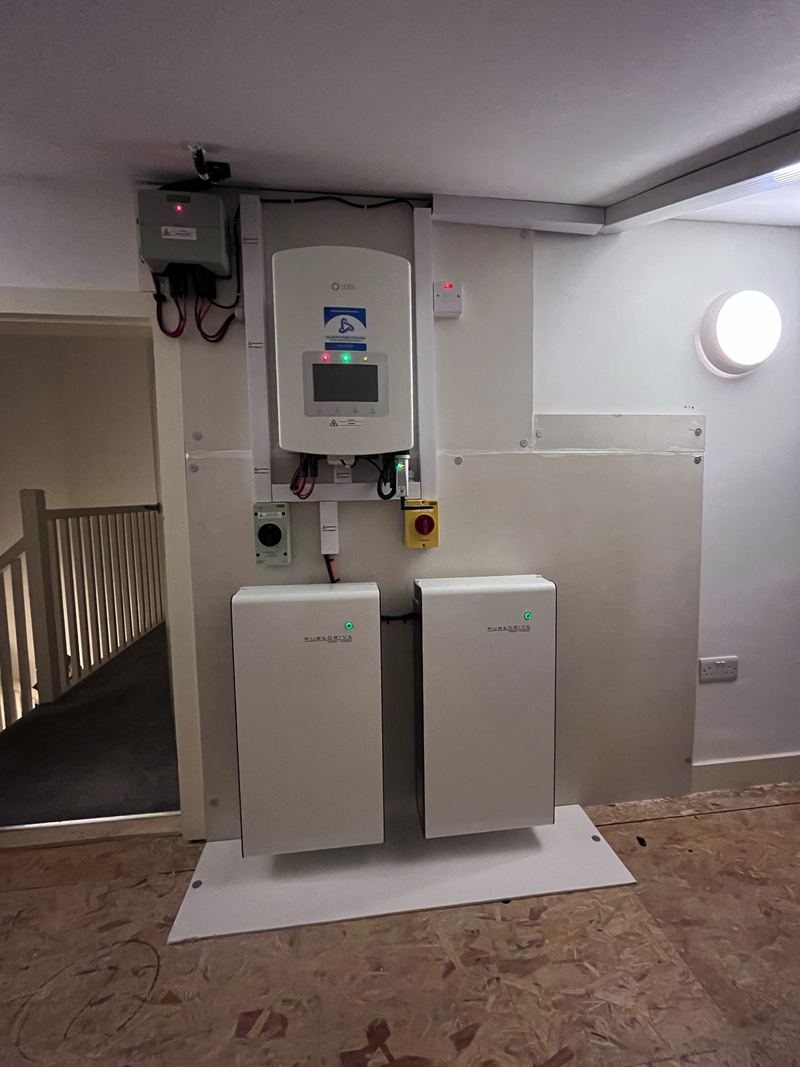
A battery moves generation in time. Surplus that would have gone out to the grid at midday is stored and used in the evening peak instead, which is exactly when the retail rate is highest on a time-of-use plan.
In practice, adding a properly sized battery to a ground-mounted array commonly pushes annual self-consumption from that 25 to 40 per cent band up towards 60 to 80 per cent, with the real figure depending on battery capacity, household load and the season. In June you will fill the battery by lunchtime and still export a good deal. In December you may not fill it at all on a dull day.
Batteries also open up cheap night-rate charging, which has nothing to do with the sun. On a plan with a low overnight window you can charge from the grid at the cheap rate and run the house off the battery through the expensive hours. That saving keeps working through a wet Irish January when the array is contributing very little.
Do not buy a battery on export figures alone. Size it against your evening load and your tariff structure, not against your midday surplus.
The micro-generation income tax exemption
Money received for exported electricity is, in principle, income. Recognising that taxing small household sums would create an absurd amount of administration for everybody involved, an income tax exemption for micro-generation profits was introduced for domestic micro-generators.
We are deliberately not quoting the threshold or the year it runs to. Both have already been changed since the exemption was first brought in and both can be changed again in any Finance Act. Check the current position on revenue.ie or with your accountant before you file, rather than relying on a figure you read in an article.
The exemption is aimed at householders. Where the array sits on a farm or a business and the export forms part of a trade, the treatment is different and you should take proper advice rather than assume the domestic exemption carries across. That is a conversation for an accountant, not for your installer, and we will say so on site.
Sizing a ground mount when export is part of the plan
A ground mount lets you size to the site rather than to a roof, and that freedom cuts both ways. It is tempting to keep adding panels because the field is there, but every panel beyond your ability to use the output is earning the export rate rather than displacing the retail rate.
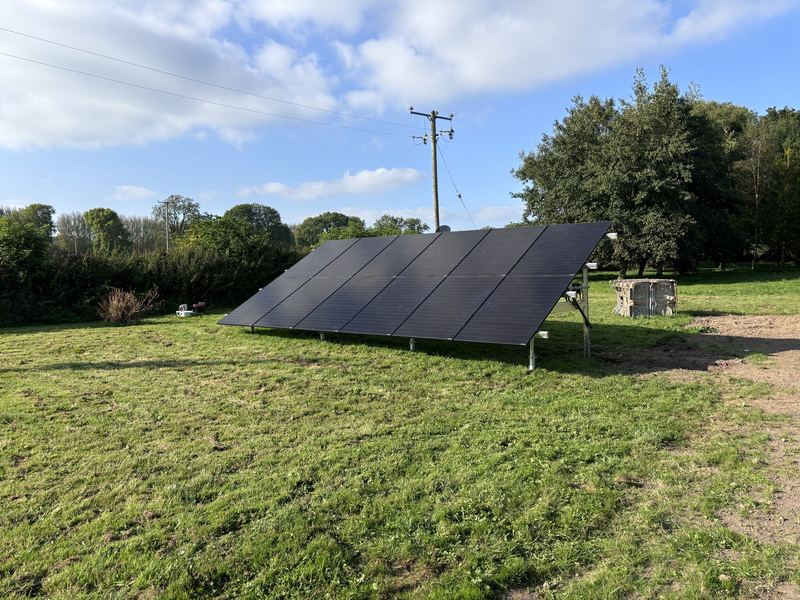
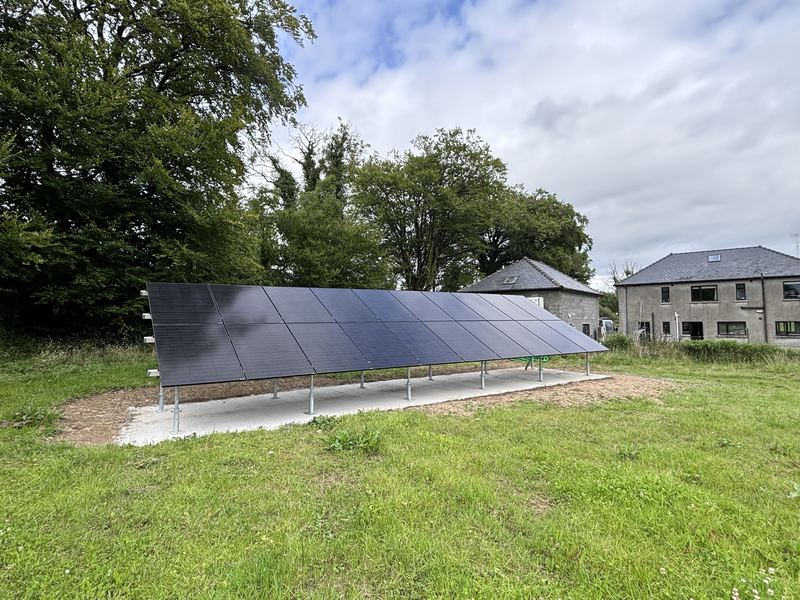
Under the NC6 route you are capped at 6 kW single-phase or 11 kW three-phase anyway. With the 440 to 500 W panels in common use, a 6 kWp array is about 13 or 14 panels. Allow roughly 8 to 10 square metres of ground per kWp for a single row, and more where the shape of the site forces multiple rows that have to be spaced to avoid shading each other.
For most homes, a system sized to cover annual consumption with a modest surplus is the sensible landing point. Going well beyond that only pays if you have a real plan for the extra output: an EV, a heat pump, a workshop, a battery, or a genuine intention to change when you use power.
Farms are a different calculation. Daytime load is often large, steady and unavoidable, so self-consumption can be very high with no behaviour change at all, and a larger system stacks up more easily.
Getting it right on your own site
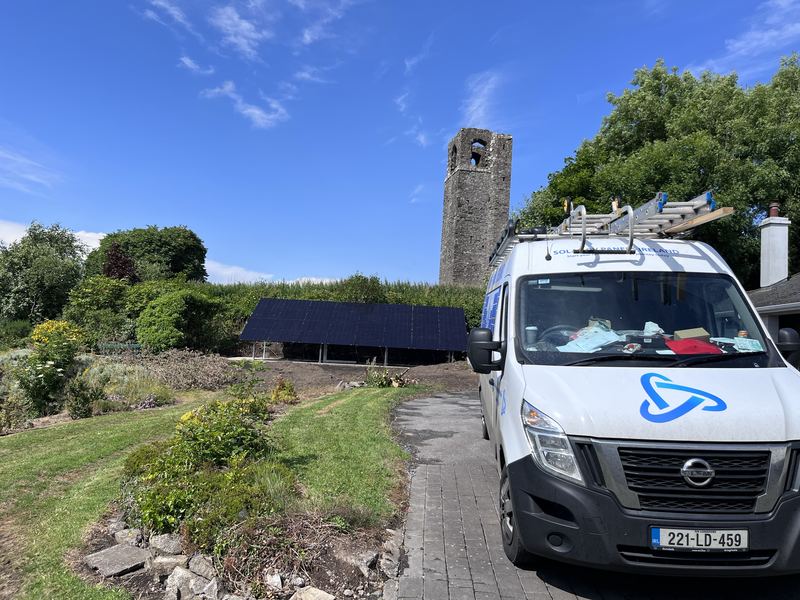
We handle the NC6 as part of the installation and we will give you an honest view of your likely export share before you commit to anything. That estimate depends on your occupancy pattern, how you heat the house and water, whether there is an EV in the drive, and the pitch and orientation we can actually achieve on your ground.
A ground-mounted array at 30 to 35 degrees facing true south typically produces in the region of 850 to 1,000 kWh per kWp per year in Ireland, varying by county. Because we can choose the pitch and the orientation rather than accept whatever the roof happens to offer, that is commonly 10 to 25 per cent ahead of the same panels on a compromised roof.
More generation means more of both, more to use and more to sell. The order of value does not change though. Use it first, store it second, sell what is left.
If you want the numbers run against your own consumption and your own field, ring us and we will do it properly rather than quoting an average at you.
Frequently asked questions
Do I need a smart meter to be paid for exported solar?
Yes, in practice. An older meter cannot separate the units you import from the units you export, so your supplier has no reliable figure to pay you on. ESB Networks arranges the meter exchange and there is normally no charge for the meter itself. Many homes already have one from the national rollout, so check your existing meter before assuming anything.
Who submits the NC6 form to ESB Networks?
Your installer does, as part of the job. The NC6 is a notification rather than an application, and it covers micro-generation up to 6 kW single-phase or 11 kW three-phase. Larger systems need a full connection application, which takes longer. Allow typically a few weeks for the notification to be processed. Your array can run and supply the house during that period.
Can I switch supplier purely to get a better export rate?
You can, and people do. Every supplier must offer a CEG tariff, so switching is a normal commercial decision. Just compare the whole bill rather than the export line alone. A high export rate paired with an expensive day rate or standing charge can leave you worse off across a year, particularly if you import far more than you export.
Is the money I get from the CEG taxable?
An income tax exemption for micro-generation profits exists for domestic micro-generators, which is why most householders have nothing to do. We are not quoting a threshold or an end date because both have already changed and can change again in a Finance Act. Confirm the current position on revenue.ie. If the array serves a farm or business, take advice from your accountant.
Will a bigger ground-mounted array earn me much more from export?
More panels do mean more exported units, but each of those units earns the CEG rate rather than displacing the higher retail rate. Under the NC6 route you are capped at 6 kW single-phase or 11 kW three-phase in any case. Size the system around what you can genuinely use, then treat export as the remainder rather than as the objective.