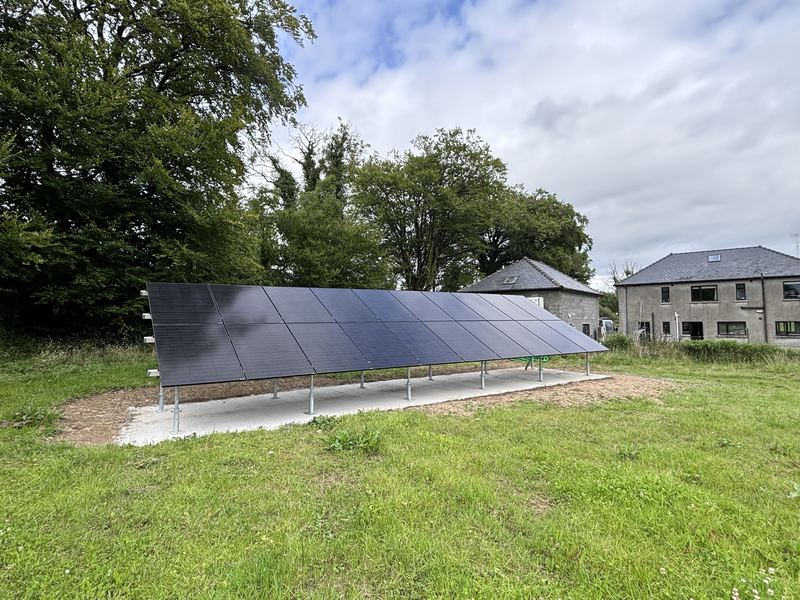
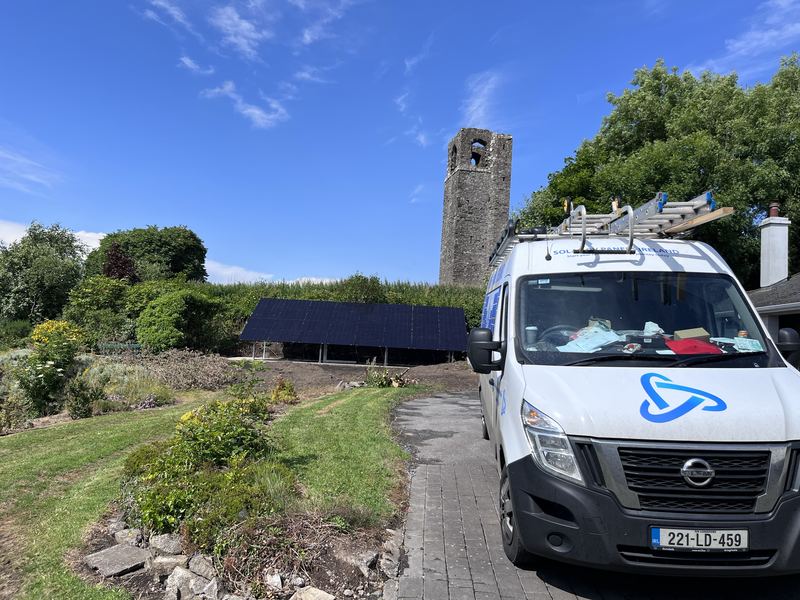
Optimum tilt, true south
Your frame sits at 30 to 35 degrees facing true south, typically giving 10 to 25 per cent more output than the same panels on a compromised roof.
Your roof does not decide how much electricity you make. Put the panels in the field or the garden at the perfect pitch, facing true south, and generate more from day one.
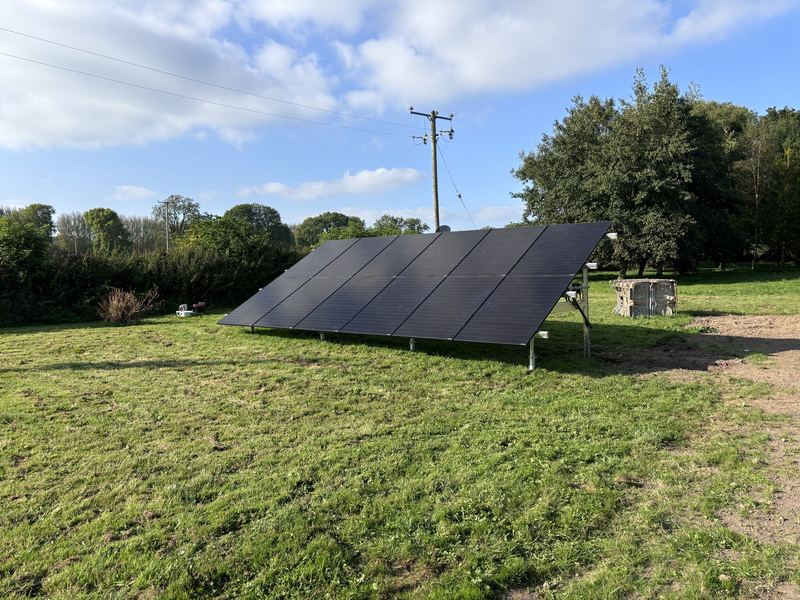
A roof was built to keep rain out, not to generate electricity. A ground mount is built for one job only, and it shows in the numbers.
Your frame sits at 30 to 35 degrees facing true south, typically giving 10 to 25 per cent more output than the same panels on a compromised roof.
Nothing is drilled through your slate, tile or shed sheeting. Your roof warranty stays intact and there is no fixing to leak or work loose over twenty-five years.
Every panel, clamp and cable is reachable from ground level with a brush and a step. No scaffold, no roof ladder, no waiting on dry weather to check a fault.
Add a battery, an EV charger or another row of panels later without touching the existing frame. We leave the ground layout and cable route ready for a second phase.
Air moves freely behind a ground mounted panel instead of being trapped against a roof. Cooler cells hold their efficiency better through the strongest hours of a summer day.
North-facing slopes, thatch, protected structures, fragile asbestos sheeting and shaded rooftops all rule out roof solar. A frame in the field beside the house does not care.
Ireland does not have one soil, it has dozens. Boulder clay in Meath drives beautifully. Limestone in Roscommon sits 400 mm below the sod. Blanket peat in Mayo will swallow a short pile and never give it back.
We probe before we price, so the frame that arrives on site is the frame the ground will actually hold. That is the difference between a quote and a guess.
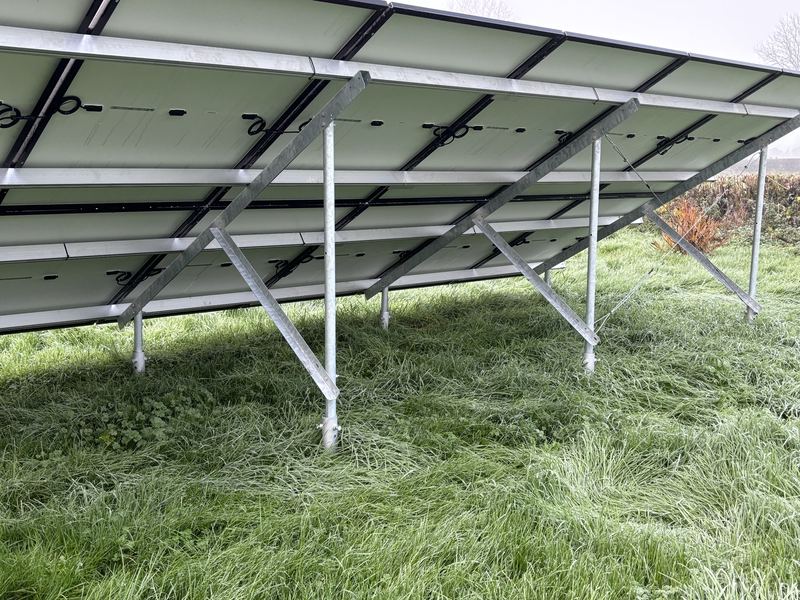
Galvanised frame and post detail, midlands install
Pick your county for local ground conditions, the planning authority that covers you, and an honest estimate of what an array will generate on that side of the country.
Every county has its own page with local ground conditions, planning notes and realistic yield figures.
Figures shown on each tile are the expected annual yield in kilowatt hours per kWp installed, for a well-oriented ground mounted array in that county.
Five stages, one team. No sub-contracted crews turning up unannounced.
We walk the ground, log the skyline in every direction, probe the soil for depth and rock, check access for the rig, and measure the distance back to the consumer unit.
You get a layout, a tilt, a row spacing and a modelled annual output. We handle the ESB Networks NC6 notification, or a full connection application on larger systems.
Piles, screws, rock anchors or ballast go in according to the probe results, then the galvanised frame is set, levelled and checked square before a single panel is lifted.
Panels are mounted and strung, the DC run is trenched back to the inverter, and the AC side, isolators, earthing and any battery or EV charger are wired in.
We test, commission and register the system, set up your monitoring app, walk you through the readings, and hand over certificates and the paperwork for your BER assessment.
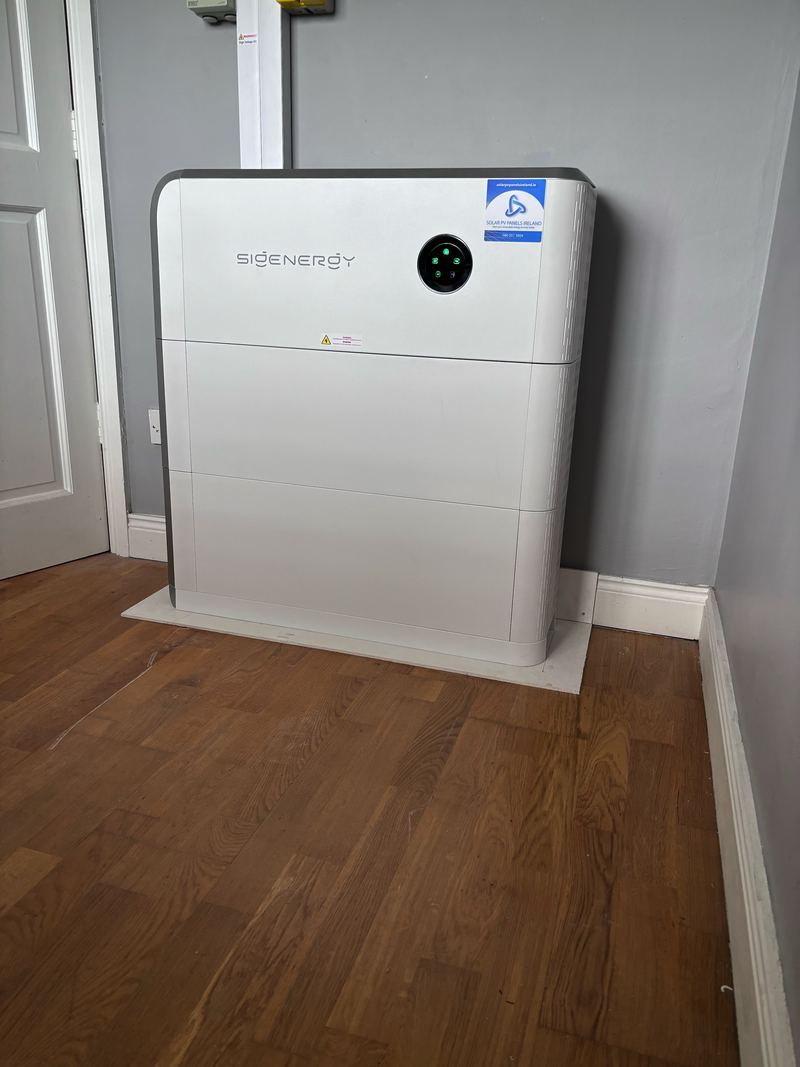
A ground mount usually makes its biggest surplus in the middle of the day, when a lot of houses are empty. Battery storage moves that surplus to the evening, and the Clean Export Guarantee pays you for whatever still goes back down the line.
We size the battery to your actual consumption pattern rather than to a round number, and we handle the ESB Networks notification so the export side is live from the start.
Neat work, done on time, by people who answer the phone afterwards.
“The work was done very neatly, on time, and in one day. Everything works very well and left us with an electricity bill which is now in credit.”
“Joe and his team did an excellent job installing our panels and battery. Job was done in a day and everything was done neatly and to a high standard.”
“Claire in the office and Joe on site were a pleasure to deal with. I could not be happier with the install and the post installation results.”
A ground mount can be set at Ireland's optimum tilt and true south while a roof takes what the builder gave it. Here is what that is actually worth in kWh.
The SEAI grant mechanism does not change because your panels are in the paddock rather than on the slates, but several details around them do. Here is what we check first.
The solar exemption rules changed materially in 2022 and a lot of out-of-date advice is still circulating. Here is what the limits are, who they apply to, and when to apply.
It is better whenever the roof is compromised. A ground mount can be set at optimum pitch and true south, which typically gives it a 10 to 25 per cent advantage over the same panels on a roof with the wrong pitch, wrong orientation or shading. If your roof is already south facing, clear and correctly pitched, the roof may win on cost.
Allow roughly 8 to 10 square metres of ground per kWp for a single row. Multiple rows need spacing so the front row does not shade the one behind, and a row pitch of about 2.5 times the array height is a reasonable planning figure. A 6 kWp array is about 13 or 14 panels at 440 to 500 W each.
In general, no. The 2022 exempted development regulations, S.I. 493 of 2022, broadly allow free-standing arrays within the curtilage of a house subject to a 25 square metre aperture cap, a 2.5 metre height limit, no siting forward of the front wall, and a limit on private open space taken. Confirm with your local council before ordering.
It depends on what is under the field. Driven galvanised piles suit firm mineral soil and boulder clay. Ground screws suit softer or mixed ground and peat where they are long enough. Ballasted frames suit rock, deep peat and made ground. Rock anchors suit shallow limestone or granite. We probe the ground before we price the job.
The SEAI solar grant applies to homes generally built and occupied before 2021, with the work done by an SEAI-registered company and a post-works BER assessment required. Values are reviewed and stepped down periodically, so check seai.ie for the current figure. Farmers may instead use the TAMS III Solar Capital Investment Scheme at a 60 per cent grant rate.
Yes. Suppliers are obliged to pay for exported units under the Clean Export Guarantee. Rates differ from supplier to supplier and change over time, so compare current offers rather than relying on an old figure. A micro-generation income tax exemption also exists for qualifying households. Sizing the array to your daytime usage still beats exporting.
Micro-generation up to 6 kW single-phase or 11 kW three-phase is notified to ESB Networks using an NC6 form, which we complete and submit for you. Larger systems need a full connection application instead. Turnaround is typically a few weeks. We start the paperwork at design stage so it is not holding up your commissioning date.
Irish ground mounted arrays at 30 to 35 degrees typically generate roughly 850 to 1,000 kWh per kWp per year, varying by county. The sunny south east sits at the top of that band and the north west at the bottom. Orientation, tilt, terrain shading and how clean the panels are kept move the figure within it.
Send us the address and a photo of the field or garden. We will tell you what will fit, what it should generate, and what the ground work involves before you commit to anything.
We use essential cookies to make the site work. With your permission we would also like to set analytics cookies to understand how the site is used. Read our Cookie Policy.