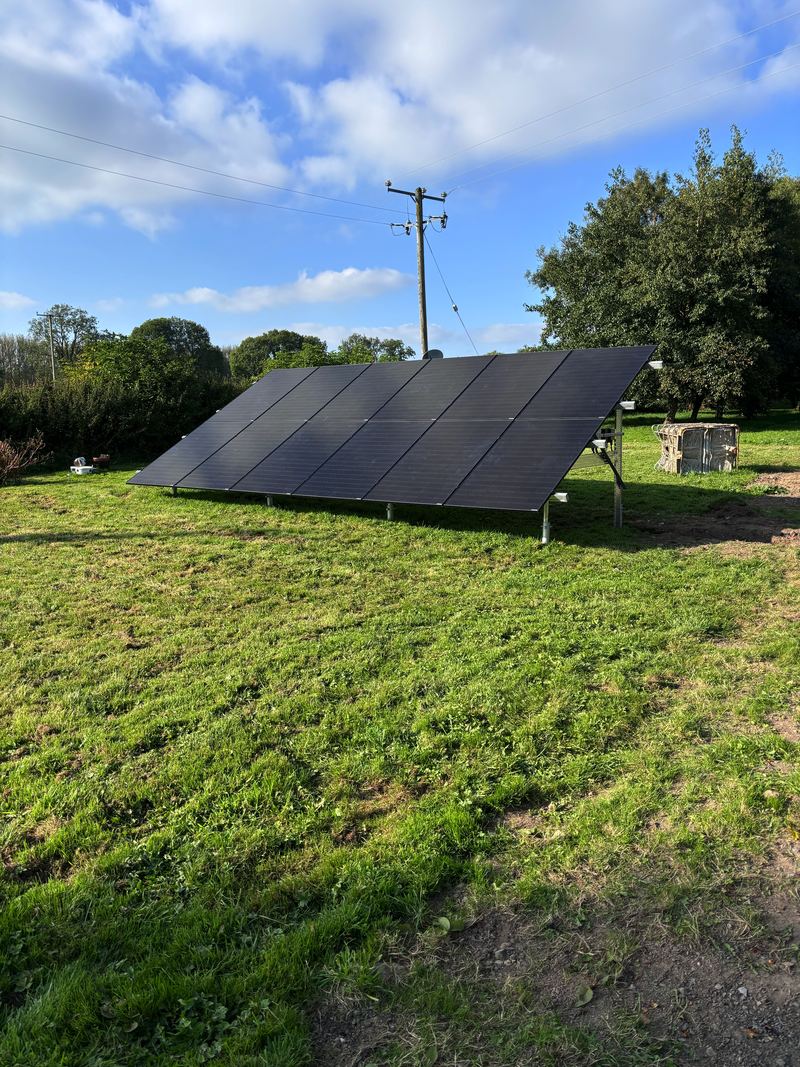
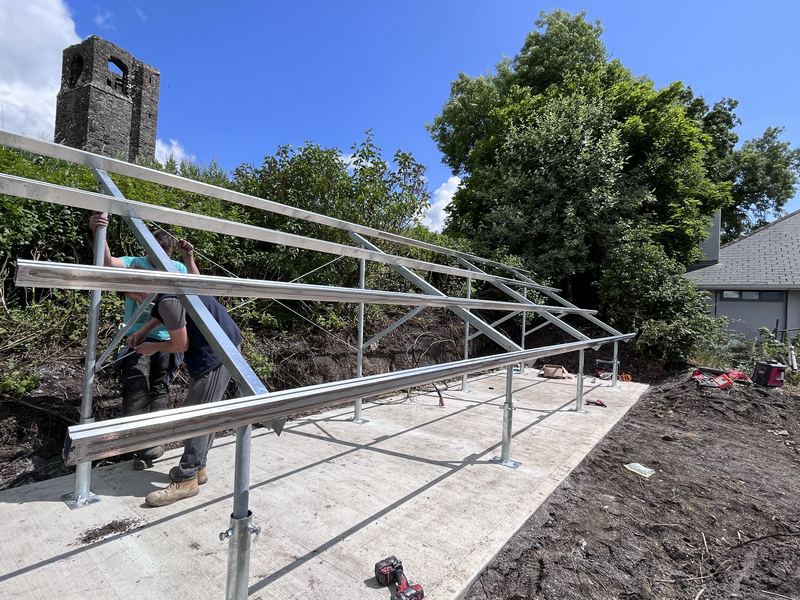
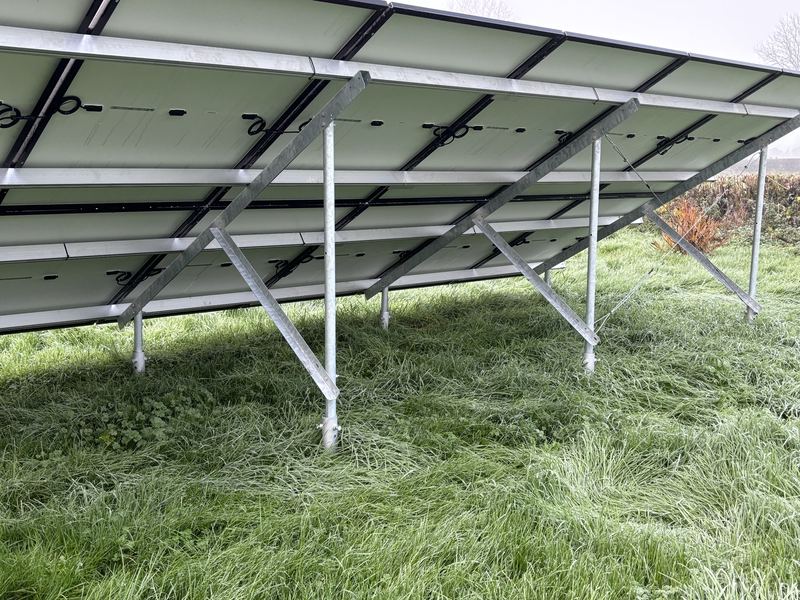
People assume a wet county must be a poor solar county. Kerry proves otherwise. Rainfall and irradiance are not the same measurement, and the long bright summer days along the Shannon estuary and the Laune valley put Kerry well up the Irish table for annual output.
The real work in Kerry is structural. Deep peat on the peninsulas, salt-laden air along hundreds of kilometres of coast, and serious wind loading on exposed ground all shape the design before a panel is chosen. Get the frame and the fixings right and the generation looks after itself.
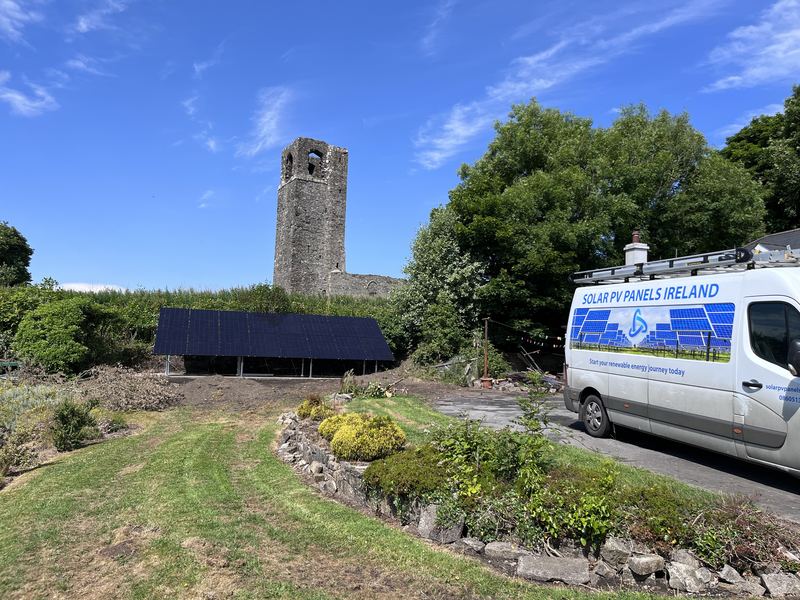
Expected generation, and why the rain is a red herring
Irradiance in Kerry runs to roughly 1,020 kWh landing on each square metre over a year, genuinely strong and comparable with counties on the east coast. A ground mount at optimum tilt and true south should deliver in the region of 930 kWh per kWp per year. The national spread for ground mounts stretches from about 850 at the low end to 1,000 at the high end per kWp, so Kerry sits in the upper half of it.
Rain affects a solar array much less than shade does. Panels keep working under bright cloud, and the frequent washing actually keeps them cleaner than a dusty inland site. What genuinely costs you output is a north-tilted roof slope, a hill on the southern horizon or a shelterbelt of mature trees, and those are the things we look at first.
Seasonality matters here as well. Most of the year's output arrives between spring and early autumn, so pairing the array with hot water diversion or storage turns more of it into something you genuinely use. Winter production is real but modest, and no Irish system should be sized on the assumption that December will carry it.
Peat, podzols and salt: building something that lasts
Foundations vary enormously across the county. Out on the Dingle and Iveragh peninsulas, and up on the Reeks ground, deep peat and podzols rule out driven piles, so ballasted frames and long helical screws carry the load instead. North Kerry is a different world: the brown earths around Listowel and through the Feale valley take driven piles cleanly and quickly.
Corrosion is the other Kerry factor. Anywhere near the coast, from Kenmare bay to the Tralee side, salt-laden air attacks ordinary fixings, so we move to higher-grade galvanising and stainless fasteners as a matter of course. It is a small cost at the build stage and it is the difference between a frame that lasts decades and one that streaks with rust inside five years.
Wind loading is designed in from the outset on exposed Kerry ground. Frame section, post embedment depth and ballast mass are all set for the terrain category the site actually sits in, rather than a national default figure.
The roof-versus-field decision on a Kerry farm
Farmhouses and outbuildings here were sited for shelter, which is exactly the right instinct for a house and exactly the wrong one for solar. Slopes that duck away from the prevailing wind very often duck away from the sun as well. That leaves a roof pointing north or west, sometimes both across a hip.
A ground array breaks that link between shelter and orientation. We can drop the frame into a sheltered pocket of a field while still aiming it due south at 30 to 35 degrees, which commonly puts output 10 to 25 per cent ahead of what those panels would give on a compromised roof. Dairy yards get a second benefit: the array sits beside the load, so generation goes straight into milk cooling and water heating rather than out to the grid.
- True south and optimum pitch regardless of how the buildings sit
- No load added to an older shed roof in a gale
- Cleaning and inspection done from ground level
- Room to extend the array later without touching the house
Planning permission and Kerry County Council
Your planning authority is Kerry County Council, whether you are in Tralee, Dingle or out the Kenmare road. Under the 2022 exempted development regulations a domestic free-standing array sits outside the planning process altogether, provided it stays within the stated limits.
For a house that means aperture area kept to 25 square metres, the top of the frame under 2.5 metres, the whole thing behind the building line rather than in front of it, and only a limited proportion of private open space used. Protected structures and Architectural Conservation Areas, which come up regularly in Killarney and in the older parts of Tralee, are treated differently, as are solar safeguarding zones near aerodromes. Ring the council and confirm your own situation before you order anything.
Sizing the array and the money side
Size the system around daytime consumption. Ground take runs at eight to ten square metres per kWp in one line, and rises where rows must be spaced to stop self-shading. At 440 to 500 W a panel, a 6 kWp domestic array is thirteen or fourteen modules, while a dairy operation with cooling and heating running through the day usually justifies a good deal more.
The SEAI grant can apply to ground-mounted work, though eligibility is always confirmed for your specific property first. Eligibility rests on the dwelling having been built and occupied before 2021 as a general rule, on registration with SEAI for whoever carries out the work, and on a BER assessment once the job is finished. The grant steps down periodically as well, so the number to work from is whatever seai.ie shows today. Farmers have a separate route: the TAMS III Solar Capital Investment Scheme, at 60 per cent and under an investment ceiling of its own.
Access on peninsula sites needs thought before the build week. Narrow boreens, soft verges after rain and gateways built for a tractor rather than a delivery lorry all slow a job down. We walk the route during the survey and, where it looks tight, split deliveries into smaller loads.
Towns and areas we cover in Kerry
We install right across the county, from Tralee and Killarney out to Kenmare and every townland in between. There is no travel surcharge for being at the far end of the county.
Ground mounted solar in Kerry: your questions
Does Kerry get enough sun to make solar worthwhile?
It does. Irradiance here is about 1,020 kWh to the square metre annually, and a well-sited ground mount returns near 930 kWh per kWp. Rain does not stop generation, and panels still produce well under bright overcast skies. Shading from hills, hedgerows and trees costs far more output than wet weather ever will.
How do you fix an array into peat on the Dingle peninsula?
By spreading the load instead of driving into it. Ballasted frames sit on the surface and take stability from weight, while long helical screws work where firm ground lies within reach beneath the peat. We probe across the array footprint first, since peat depth on the peninsulas changes sharply over short distances.
Will sea air damage the frame near the coast?
It will attack standard fixings, which is why coastal Kerry sites get higher-grade galvanising and stainless fasteners rather than the general-purpose specification. This applies from Kenmare around to Ballyheigue and anywhere the wind carries salt inland. The extra cost is modest and it protects the structure for the life of the panels.
Who handles planning for a solar array in Kerry?
Kerry County Council is the planning authority for the whole county. Most domestic free-standing arrays fall under the 2022 exempted development regulations, subject to the aperture, height, siting and open space limits. Protected structures and Architectural Conservation Areas, common enough in Killarney and central Tralee, need separate consideration, so confirm before ordering.
Is there a grant if I farm in north Kerry?
Yes. Within TAMS III, the Solar Capital Investment Scheme pays at 60 per cent for those who qualify, under its own ceiling on investment. A dwelling takes the SEAI path instead, which turns on pre-2021 occupancy, a registered installer and a BER done after the works. We will confirm which path fits your holding.
What happens with the electricity I do not use?
It exports to the grid and your supplier pays for it under the Clean Export Guarantee. Rates vary between suppliers and change from time to time, so compare current offers directly. A micro-generation income tax exemption applies to that income as well. Battery storage is another option where evening use is heavy.