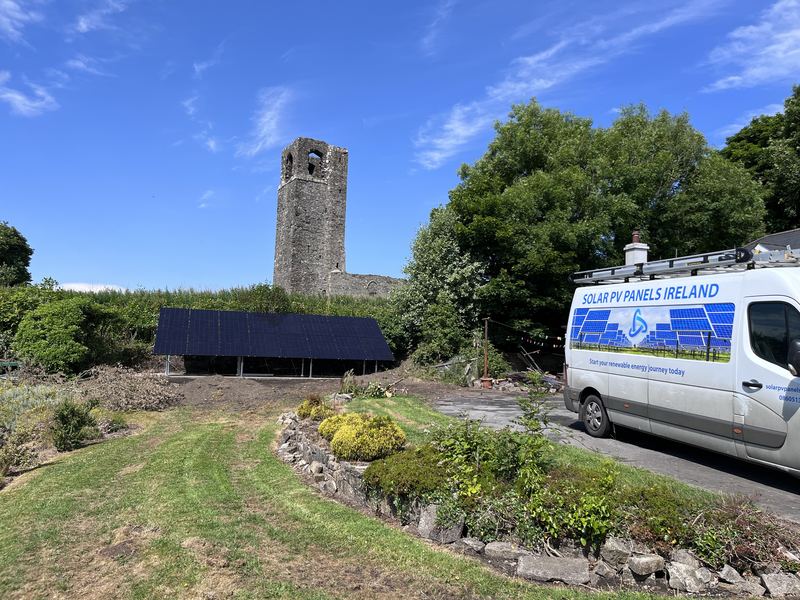
Dublin splits neatly in two for anyone thinking about a ground-mounted array. Inside the city and the older suburbs the constraint is space: a rotary line, a shed, a boundary wall and about six metres of usable lawn. North of Swords, on the tillage and market-garden ground around Rush, Lusk and Skerries, space stops being the issue entirely.
Both site types are worth doing and both need different answers. We measure the garden before quoting anything, because the exempted development allowance and the private open space test decide more Dublin jobs than the panel spec ever will. On the larger north county holdings the question is usually daytime load and grid capacity instead.
Why a garden array beats the roof on most Dublin houses
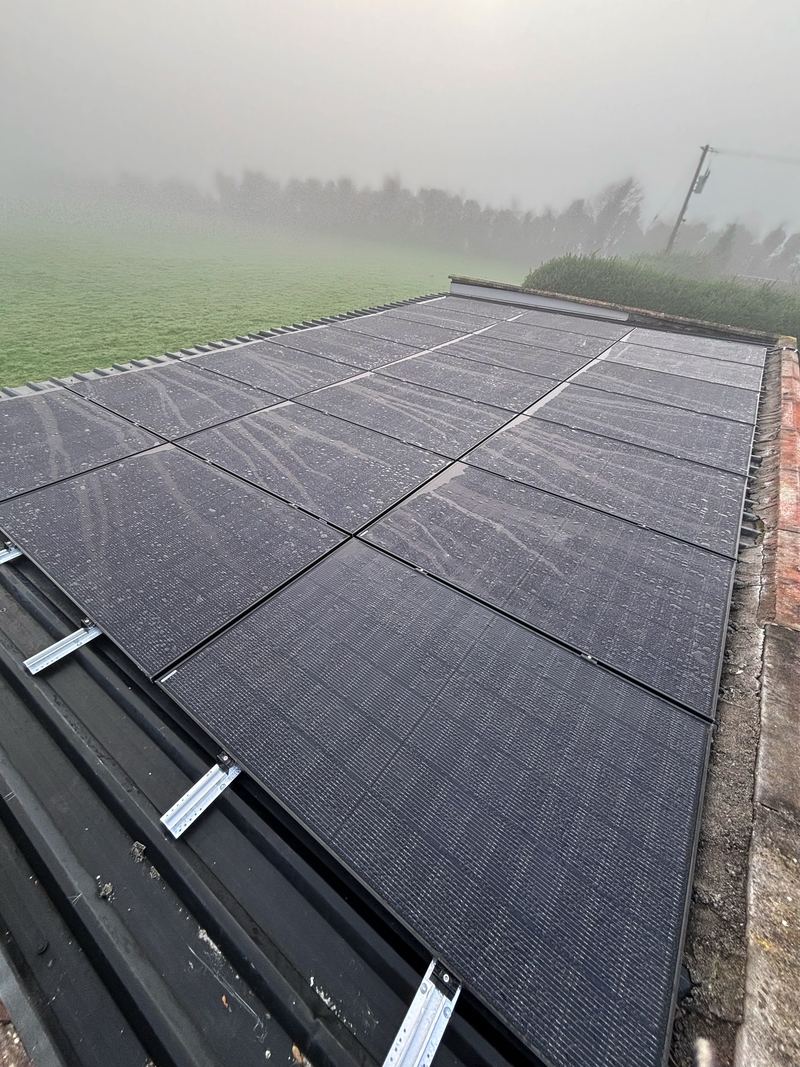
Estate housing in Tallaght, Blanchardstown and Lucan was laid out to a street line, not to a compass bearing. That leaves a great many roofs facing east and west, split across two shallow pitches, with a chimney or a dormer taking a bite out of whichever half was worth having. Panels on a compromised roof simply do less work every day of the year.
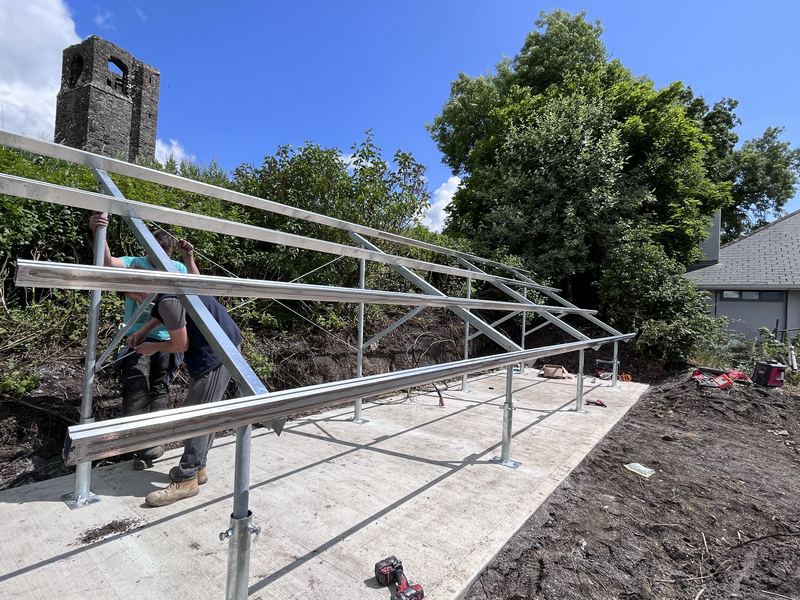
A free-standing frame is set at 30 to 35 degrees and pointed at true south no matter what the house is doing. In practice that is worth roughly 10 to 25 per cent more generation than identical panels on a poor slope. It also keeps every fixing off your slates, which matters on older Dublin stock where the covering is near the end of its life. Cleaning, inspection and any future battery work all happen standing on the grass.
Boulder clay, made ground and the north county soils
Most of the county sits on firm boulder clay over limestone. That is close to ideal driving ground: resistance is predictable, a galvanised post goes straight in, and there is no concrete and no spoil heap left behind. On the light worked soils of the north county belt the driving is quicker again.
Made ground is the exception. Parts of the inner suburbs and plenty of redeveloped sites carry fill, old foundations, buried services or capped material that nothing should be driven through. Those get a surface frame that takes its stability from weight rather than penetration. What we specify depends entirely on what the probe finds:
- Driven piles into boulder clay across most of the county
- Ballast where there is fill, capping or unknown buried services
- Ground screws in mixed or softer ground, and where a removable foundation suits
- Rock anchors where limestone comes up shallow in the foothills
Four planning authorities, one county
Dublin is unusual because your address, not the county name, decides who you deal with. It is Dublin City Council, Fingal County Council, South Dublin County Council or Dún Laoghaire-Rathdown County Council depending on where you live. Fingal covers Swords, Rush and Skerries, South Dublin covers Tallaght and Lucan, and Dún Laoghaire-Rathdown covers the south-eastern suburbs.
Under the 2022 exempted development regulations, S.I. 493 of 2022, a free-standing array within the curtilage of a house is broadly allowed without permission, subject to limits. In general those are an aperture area cap of 25 square metres for houses, a maximum height of 2.5 metres, a rule against placing the array forward of the front wall, and a cap on how much of the private open space it may occupy. Protected structures, Architectural Conservation Areas and the solar safeguarding zone near the airport are handled differently. Confirm your own position with the relevant council before anything is ordered.
What a Dublin array should generate
Dublin picks up in the region of 1,020 kWh per square metre a year, which places it in the better half of the country. Set a frame at optimum pitch and true south and the working figure is about 945 kWh per kWp per year. Irish ground mounts generally land between roughly 850 and 1,000 kWh per kWp, so Dublin sits near the top of that band without matching the sunniest south-eastern counties.
For sizing, allow roughly 8 to 10 square metres of ground per kWp in a single row. Modern panels are commonly 440 to 500 W, so a 6 kWp array is about thirteen or fourteen of them. Where a second row is unavoidable we space rows at around 2.5 times the array height, otherwise the front row shades the back one through the low winter sun.
How the job runs on site
Everything starts with the probe and the shading check. We look at trees, gable walls and neighbouring extensions across a full year, not just on the day we call, and we measure the cable route back to the board. On tight suburban sites that trench route often decides the array position as much as the sun does.
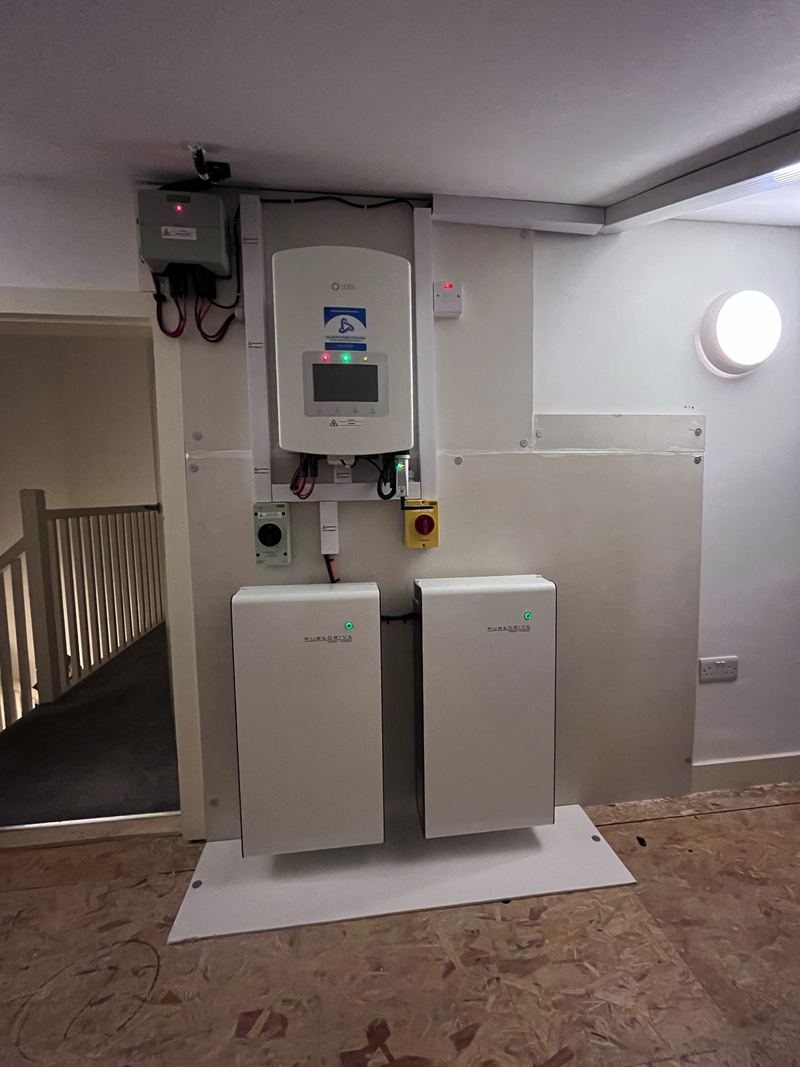
On piles the build itself is short: posts in, rails across, panels up, DC run to the house, inverter and isolators fitted, then commissioning and handover. On the grid side, systems up to 6 kW single-phase or 11 kW three-phase are notified to ESB Networks under the NC6 process, and anything larger needs a full connection application, which typically takes a few weeks longer. Reinstating a Dublin lawn is part of the job rather than an extra, so sod is lifted carefully and put back.
Most domestic builds here take a couple of days once the frame lands on site. Access is the item to settle in advance: a driving rig needs a way in through a side gate or a gap in a wall, and on terraced or mid-link houses that can be the deciding factor. We check it at survey stage so nobody discovers it on the morning of the build.
Towns and areas we cover in Dublin
We install right across the county, from Dublin City and Swords out to Skerries and every townland in between. There is no travel surcharge for being at the far end of the county.
Ground mounted solar in Dublin: your questions
Do I need planning permission for a ground mounted array in Dublin?
In general no. The 2022 regulations broadly allow a free-standing array within the curtilage of a house, subject to a 25 square metre aperture cap, a 2.5 metre height limit, a rule against going forward of the front wall and a private open space test. Confirm it with your own council first, because Dublin has four of them.
Which of the four Dublin councils applies to me?
It follows your address. Dublin City Council covers the city area, Fingal County Council takes in Swords, Rush and Skerries, South Dublin County Council covers Tallaght, Lucan and Clondalkin, and Dún Laoghaire-Rathdown County Council covers the south-eastern suburbs. If your house sits near a boundary, ring the one you think applies and get it confirmed before ordering.
My garden is small. Is a ground mount still worth doing?
Often it is, though the private open space rule decides it. Allow roughly 8 to 10 square metres per kWp, so a 6 kWp array of about thirteen panels needs a strip of lawn rather than the whole garden. We measure the usable area on site and will say plainly if the space does not stack up.
What foundation would you use on a north county Dublin holding?
Around Rush, Lusk and Skerries the boulder clay and worked market-garden soils drive very well, so galvanised posts go in directly with no concrete and no reinstatement of a pad afterwards. Where a site carries fill or made ground, which happens on redeveloped land closer to the city, we move to a ballasted frame that sits on the surface.
Is the SEAI grant available for a ground mounted system?
Ground-mounted arrays can qualify, but eligibility is confirmed for your specific property before you commit to anything. The home generally needs to have been built and occupied before 2021, the work must be carried out by an SEAI-registered company, and a post-works BER assessment is required. Grant values are reviewed and stepped down periodically, so check current figures on seai.ie.
Will I be paid for the electricity I export?
Yes. Suppliers are obliged to pay for exported units under the Clean Export Guarantee. Rates differ between suppliers and change over time, so compare current offers rather than trusting a figure you read last year. A micro-generation income tax exemption also applies to that income. Your export metering is arranged after the system is commissioned.