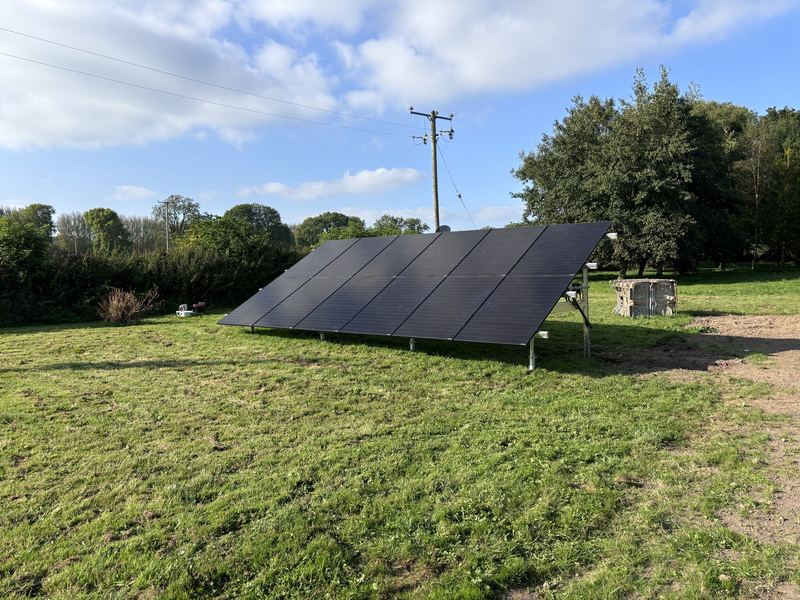
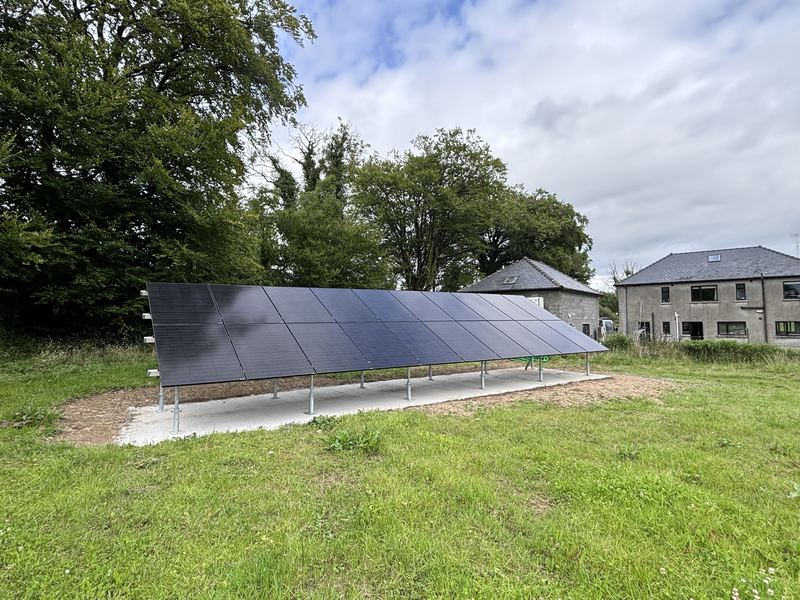
Mayo takes in roughly 950 kWh per square metre of solar irradiance in an average year, and a properly built ground-mounted array here will return in the region of 880 kWh per kWp. Against the Irish spread of about 850 to 1,000 kWh per kWp, that puts the county in the lower half. It is still a number worth having, and a ground mount is the way to collect all of it, because the frame sits at the pitch and the bearing we choose rather than the one a builder settled on decades ago.
Our crews work the whole county, from the Moy valley at Ballina south to Ballinrobe and west onto the Erris road for Belmullet. The weather here is predictable enough. The ground is not. In Mayo the foundation is most of the engineering, and the honest way to price one is to probe the field first.
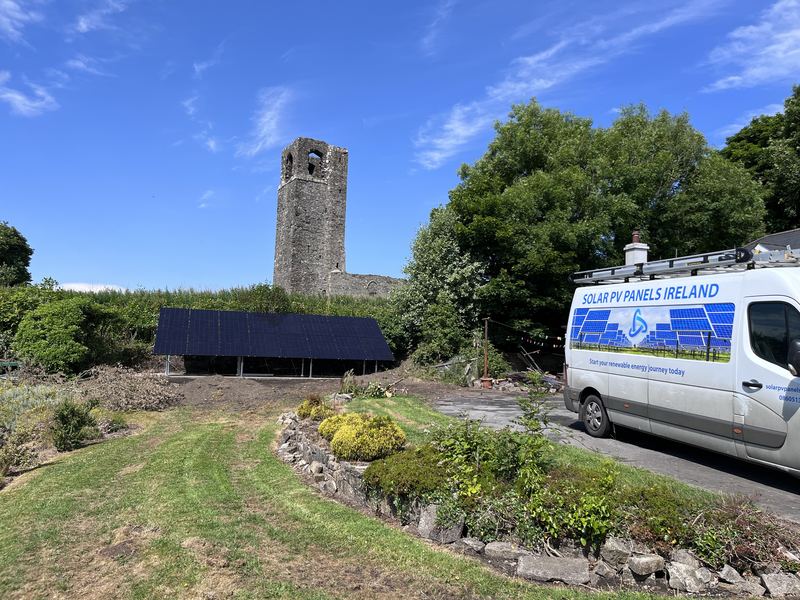
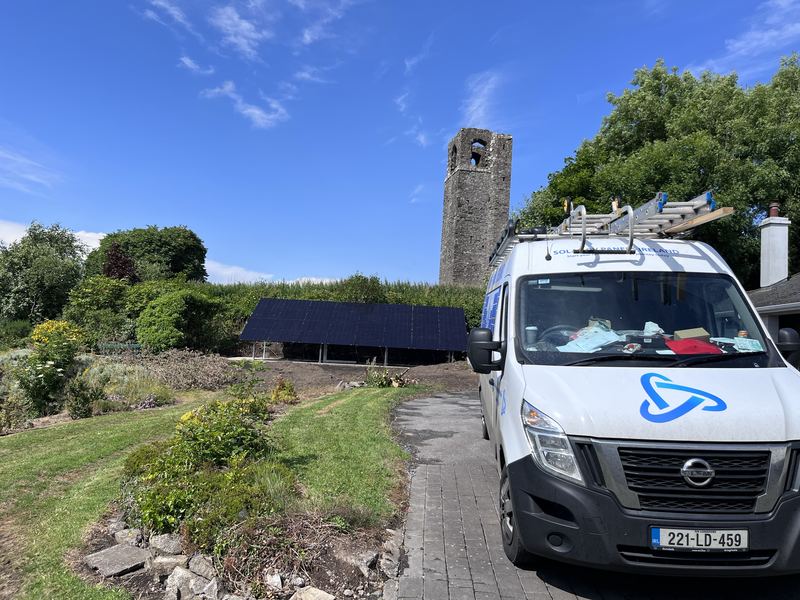
Peat depth decides the foundation in Mayo
Blanket peat covers much of north and west Mayo, and some of it on the Erris and Nephin ground is as deep as anything in Europe. East around Claremorris and Ballinrobe the picture flips to limestone with thin soils over it. Between those two extremes sits every combination, and depth can change by a metre inside one field, which is why we probe on a grid rather than at a single corner.
What the probe finds decides the frame:
- Driven piles where firm mineral soil or boulder clay runs deep enough, the fastest and cheapest option and no concrete needed.
- Ground screws wound down through softer or mixed ground, long enough to pass through peat and take hold underneath.
- Ballasted frames on deep peat or made ground, where nothing should be penetrated at all.
- Rock anchors resin-fixed into shallow bedrock, which turns up more often than people expect in east Mayo.
Access counts for as much as ground. A driving rig needs a route in, and plenty of Mayo holdings sit at the end of a long private lane.
Why the field outperforms the roof here
Farmhouses and cottages around Castlebar and Westport were built to shed rain and stand up to wind, not to carry solar. Roof planes end up facing east and west, pitches run shallow or steep by turns, and slate that has done fifty years is not something we like to drill. A ground frame avoids all of that.
Set at 30 to 35 degrees and turned true south, the same panels typically give 10 to 25 per cent more than they would on a compromised roof. On an exposed Mayo site that gain is worth engineering for properly, so the frame is designed to the wind loading the location actually sees rather than to a national average. Panels also stay within reach, so cleaning, string checks and any later battery or EV charger work happen from ground level with no scaffolding.
Planning permission and Mayo County Council
Since the 2022 exempted development regulations, S.I. 493 of 2022, free-standing solar arrays within the curtilage of a house are broadly exempt from planning permission, subject to limits. In general those limits are an aperture area of 25 square metres for a house, a maximum height of 2.5 metres, no part of the array forward of the front wall, and a cap on how much of your private open space it may take up.
Confirm the detail with Mayo County Council before you order anything. Protected structures and Architectural Conservation Areas are treated differently, and the county towns contain both, while sites near an aerodrome such as Ireland West Airport Knock can fall inside a solar safeguarding zone where glint and glare are assessed. An array out in a field rather than in the curtilage is normally a planning application, and farm-scale schemes almost always are.
Sizing, grants and export payments
Allow roughly 8 to 10 square metres of ground per kWp for a single row, and more where rows have to be spaced so they do not shade each other, with a row pitch of around 2.5 times the array height as a planning figure. Panels in common use are 440 to 500 W, so a 6 kWp array is about 13 or 14 of them.
The SEAI grant is reviewed and stepped down periodically, so check the current position on seai.ie rather than any figure quoted on a website. The home generally needs to have been built and occupied before 2021, the work must be carried out by an SEAI-registered company, and a post-works BER assessment is required. We confirm eligibility for a ground-mounted array on your specific property before you commit to anything. Farmers should look at TAMS III, where the Solar Capital Investment Scheme carries a 60 per cent grant rate for eligible applicants under its own investment ceiling. Exported units are paid for under the Clean Export Guarantee, at rates that vary by supplier and change over time, and a micro-generation income tax exemption applies to that income.
What the install looks like on a Mayo site
A survey comes first: probe grid, a look at the consumer unit, the cable route back to the house and a horizon check for the hill or shelterbelt that will take an hour off a winter afternoon. Long lanes are common in this county, so we size the DC and AC runs for the distance and keep voltage drop where it belongs.
Foundations usually go in inside a day. The frame follows, then panels, then the cable pull and the inverter, with battery storage wired in at the same time if it is part of the job. Stock proofing is not optional where cattle or sheep have the run of the field. Grid notification is an ESB Networks NC6 for micro-generation up to 6 kW single-phase or 11 kW three-phase, and anything larger takes a full connection application, which typically runs to a few weeks.
Towns and areas we cover in Mayo
We install right across the county, from Castlebar and Ballina out to Belmullet and every townland in between. There is no travel surcharge for being at the far end of the county.
Ground mounted solar in Mayo: your questions
How much electricity will a ground mounted array generate in Mayo?
Plan on roughly 880 kWh per kWp per year from a well-oriented array in Mayo, against a national spread of about 850 to 1,000. A 6 kWp system therefore lands near 5,300 kWh in a normal year. Shading, tilt and how much of your usage falls in daylight then decide what that output is actually worth to you.
Can you install on peat ground out in Erris or under Nephin?
Yes, with the right foundation. Deep peat rules out short driven piles, so we use long ground screws that reach competent material underneath, or a ballasted frame that sits on the surface and penetrates nothing. The decision comes from probing on a grid across the array footprint, because peat depth in Mayo can change by a metre within twenty paces.
Do I need planning permission from Mayo County Council?
For an array inside the curtilage of your house, usually not, provided it stays within the exempted development limits on aperture area, height, position relative to the front wall and private open space. Confirm your own case with Mayo County Council first. Protected structures, Architectural Conservation Areas and any array sited out in a field are handled differently.
How far from the house can the array sit?
Further than most people assume, which suits the long lanes and scattered yards around Ballina and Belmullet. Distance costs money in cable and in losses, so we size the conductors for the run and check volt drop before quoting. Past a certain length it becomes cheaper to move the array closer than to keep upsizing the cable.
Is the SEAI grant available for a ground mounted system?
Ground-mounted arrays can qualify, but eligibility depends on the property and on the scheme rules in force at the time, so we confirm it for your address before you commit. The home generally must have been built and occupied before 2021, the installer must be SEAI-registered, and a post-works BER assessment is needed. Current grant values are published on seai.ie.
Will a frame stand up to Atlantic wind on the west Mayo coast?
It will if it is designed for the exposure rather than to a generic figure. Sites out towards Belmullet and the Erris coast get treated as a higher terrain category, which means deeper embedment, heavier sections and more fixings. Salt-laden air also pushes us towards better galvanising and stainless fasteners on any coastal job.