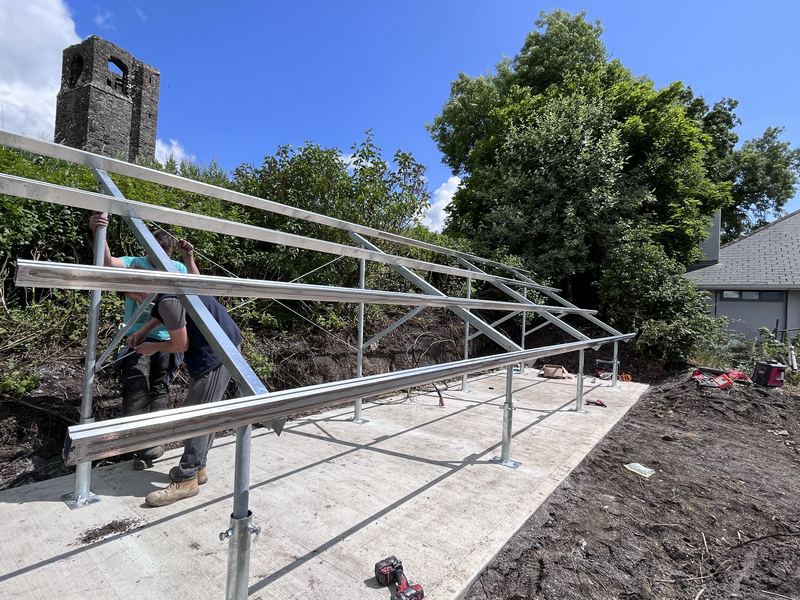
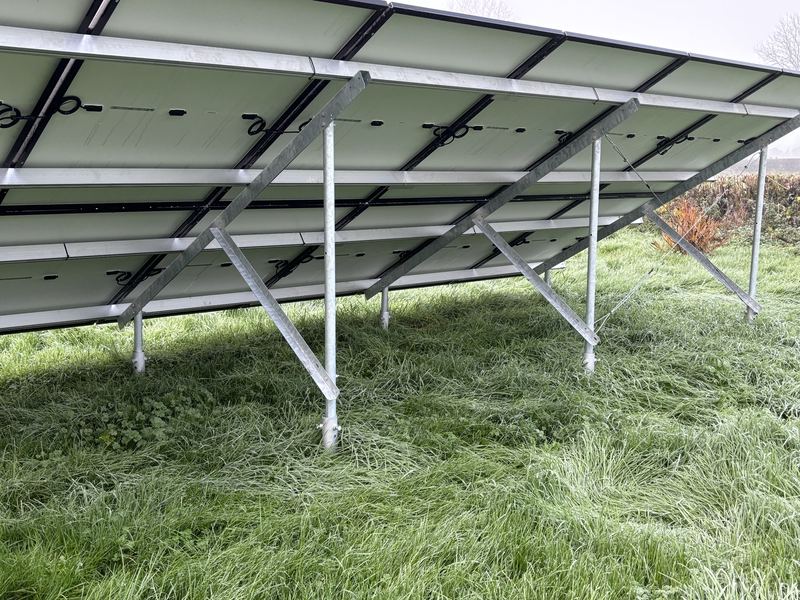
Wicklow is a strong solar county with one complication. The county sees roughly 1,030 kWh per square metre of irradiance a year, and a well-oriented ground mounted array here returns about 950 kWh per kWp, near the top of the Irish range of roughly 850 to 1,000 kWh/kWp. The complication is the hills.
We are the ground-mount arm of Solar PV Panels Ireland, and we build frames in fields, paddocks and back gardens from Bray and Greystones down to Arklow and west to Blessington and Baltinglass. Nothing is fixed to your roof. The panels sit at optimum tilt facing true south, on the part of your site the sun actually reaches.
Why a ground mount usually beats a Wicklow roof
Plenty of Wicklow houses have a roof that solar does not suit. Bray and Greystones have long terraces and older slate with hips and dormers that cut a usable plane into fragments. Rural bungalows in west Wicklow often sit east to west, so one full side faces north. Farm sheds were built for machinery, not for a 25-year panel load.
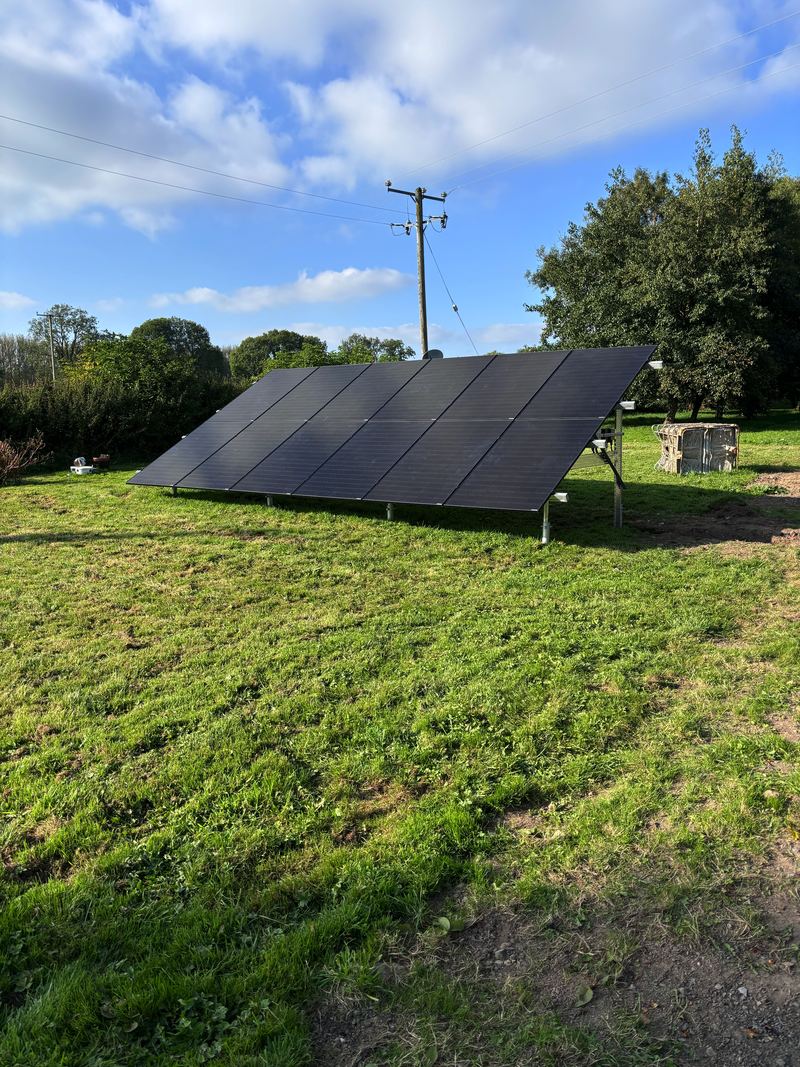
A ground mounted array sidesteps all of that. We set the frame at 30 to 35 degrees and point it at true south, which typically gives it a 10 to 25 per cent advantage over the same panels on a compromised roof. There are no penetrations through your slate or your shed sheeting, and no argument with a roofer in ten years' time.
Space is the trade. Allow roughly 8 to 10 square metres per kWp for a single row, more if the layout needs a second row spaced back to avoid self-shading. With the 440 to 500 W panels in common use, a 6 kWp array is about 13 or 14 panels, which fits a corner of most Wicklow sites.
Terrain shading, and the slope that decides your yield
The Wicklow Mountains create the most severe terrain shading in Leinster. A granite ridge on your southern horizon does not just clip an hour off one December afternoon, it takes that hour every day through the winter, and the shortfall lands in the months you most wanted to cover.
The other side of that coin is that Wicklow has some of the best ground-mount slopes in the east. A south-facing valley slope here is close to ideal: the fall of the land adds to the frame tilt, the array picks up sun from mid-morning, and cold air drains away downhill. A north-facing slope on the very same holding can be a poor investment. Site selection swings annual yield by 15 per cent or more inside a single townland.
So we model the horizon, not just the roofline. Before we price a Wicklow job we walk the ground with a compass and an inclinometer, log the skyline in every direction, and work out what the ridge does at the winter solstice. That is a morning's work, and in this county it is the most valuable thing we do.
Granite, schist and the coastal brown earths
Wicklow ground changes quickly. The uplands are granite and mica-schist with thin, acidic soils and rock near the surface. The coastal strip from Greystones through Wicklow Town to Arklow, and the west Wicklow river valleys, carry deeper brown earths. Two sites a few kilometres apart can need different foundations.
These are the options we work with:
- Driven piles - galvanised steel posts driven straight into firm mineral soil or boulder clay. Fastest and cheapest, no concrete, but they need consistent ground and room for the driving rig.
- Rock anchors - resin-fixed anchors drilled into shallow bedrock. The usual answer on Wicklow granite, where cover over rock can be very thin.
- Ground screws - helical screws wound into softer or mixed ground, and into peat where they are long enough. They can be wound back out if the field is ever needed clear.
- Ballast - surface-mounted frames weighted with concrete, used on exposed rock, deep peat, made ground, or anywhere nothing may be penetrated.
We probe before we price. A quote built on driven piles that turns into a rock-drilling job on the morning helps nobody, and in Wicklow that risk is live on most upland sites.
Planning and grid connection in Wicklow
Under the 2022 exempted development regulations (S.I. 493 of 2022), free-standing solar arrays within the curtilage of a house are broadly allowed without planning permission, subject to limits. In general those limits are an aperture-area cap of 25 square metres for houses, a maximum height of 2.5 metres, a rule against placing the array forward of the front wall of the house, and a cap on how much of your private open space it may occupy.
Confirm your own position with Wicklow County Council before anything is ordered. Protected structures and Architectural Conservation Areas are treated differently, as are solar safeguarding zones near aerodromes, and a good deal of this county sits in sensitive upland and coastal landscape. Farm and commercial arrays outside a house curtilage follow a separate route again.
On the grid side, micro-generation up to 6 kW single-phase or 11 kW three-phase is notified to ESB Networks on an NC6 form, which we complete on your behalf. Anything larger needs a full connection application. Turnaround is typically a few weeks, so we start the paperwork at design stage rather than after commissioning.
Grants, export payments and the numbers that matter
The SEAI solar grant is reviewed and stepped down periodically, so check the current value on seai.ie rather than trusting a figure in an advert. In general the home must have been built and occupied before 2021, the work must be carried out by an SEAI-registered company, and a post-works BER assessment is required. We confirm that a ground-mounted array qualifies for your specific property before you commit to anything.
Farmers have a second route. The TAMS III Solar Capital Investment Scheme offers a 60 per cent grant rate to eligible farmers under a separate investment ceiling. That suits the sheep, tillage and dairy holdings around Baltinglass and Blessington, where there is usually land sitting beside the load and a shed roof pointing the wrong way.
Units you export are paid for under the Clean Export Guarantee. Rates differ by supplier and change, so compare current offers before you sign, and note that a micro-generation income tax exemption exists for qualifying households. At Wicklow's 950 kWh per kWp the arithmetic on a well-sited array is straightforward, but it only holds if the site was chosen properly to begin with.
Towns and areas we cover in Wicklow
We install right across the county, from Bray and Wicklow Town out to Baltinglass and every townland in between. There is no travel surcharge for being at the far end of the county.
Ground mounted solar in Wicklow: your questions
Will the Wicklow Mountains shade my solar array?
They might, and it is worth checking properly. A granite ridge on your southern horizon costs you low winter sun every day, not just occasionally. We survey the skyline in every direction and model the winter solstice before quoting, then site the frame where the horizon is lowest. On many Wicklow holdings that means moving the array a field over.
Do I need planning permission for a ground mounted array in Wicklow?
In general, no. The 2022 exempted development regulations broadly allow free-standing arrays within a house curtilage subject to a 25 square metre aperture cap, a 2.5 metre height limit, no siting forward of the front wall, and a private open space limit. Confirm your own case with Wicklow County Council first, especially for protected structures or Architectural Conservation Areas.
What foundation do you use on Wicklow granite?
Usually resin-fixed rock anchors drilled into the bedrock, because cover over granite and mica-schist in the uplands is often very thin. On the coastal strip and in the west Wicklow valleys the brown earths take driven piles well. We probe the ground on a grid before pricing, so the foundation is decided by test results rather than guesswork.
How much electricity will a ground mount generate in Wicklow?
Wicklow irradiance runs around 1,030 kWh per square metre a year, and a correctly oriented array at 30 to 35 degrees returns roughly 950 kWh per kWp. That sits near the top of the Irish range of about 850 to 1,000 kWh/kWp. Terrain shading is the variable that moves it, which is why slope choice matters so much here.
How much ground does a ground mounted system take up?
Allow roughly 8 to 10 square metres per kWp for a single row of panels. Where the array needs two or more rows, they must be spaced to stop the front row shading the one behind, and a row pitch of about 2.5 times the array height is a reasonable planning figure. Sloping sites need their own layout.
Which parts of Wicklow do you cover?
All of it. We install ground mounted arrays in Bray, Greystones, Wicklow Town, Arklow, Blessington and Baltinglass, and across the rural townlands in between. Coastal sites get corrosion-appropriate fixings, upland sites get uprated wind design and rock anchors. The survey is free and it tells you what your particular field or garden will actually do.