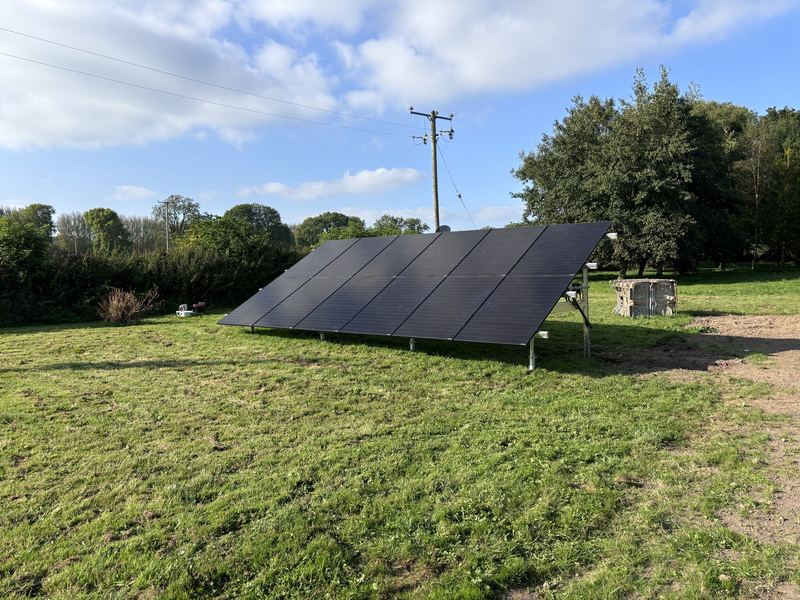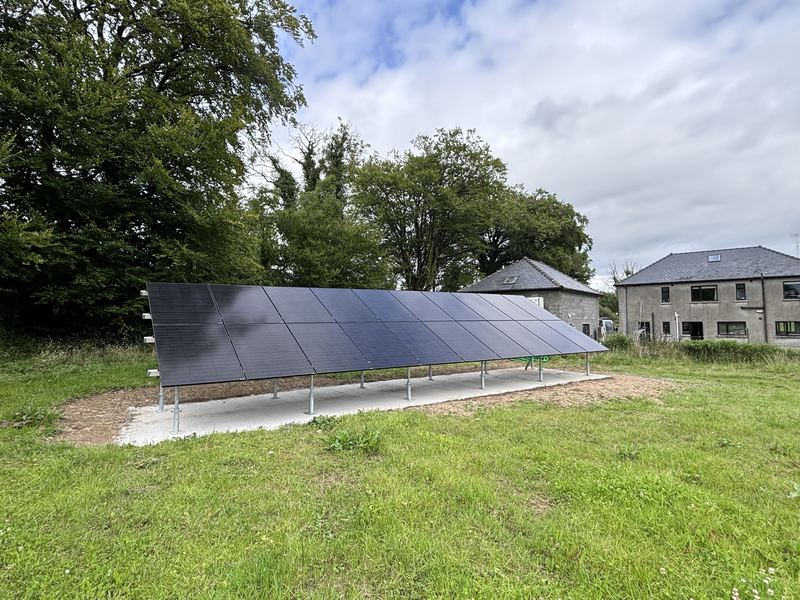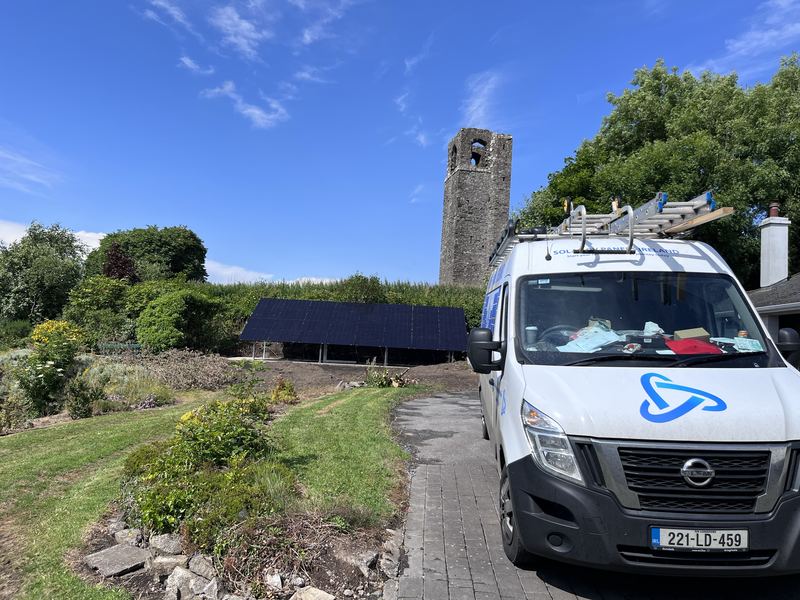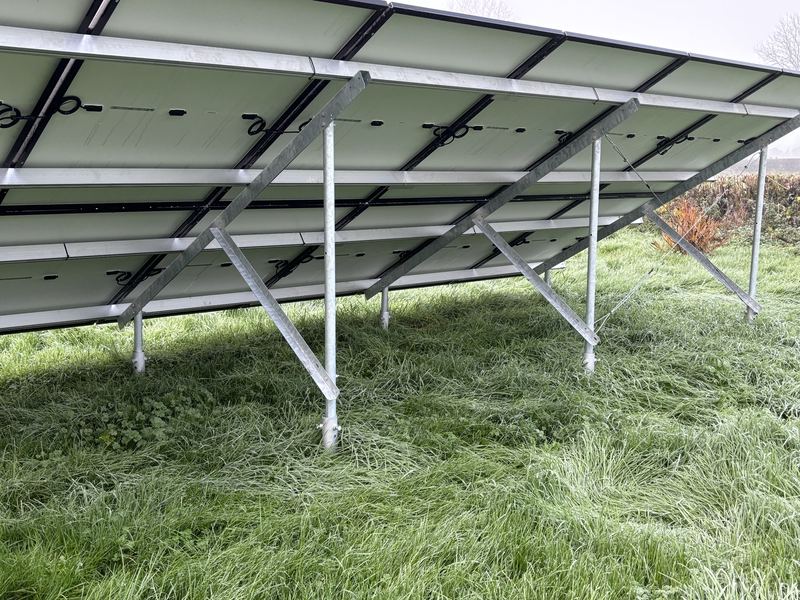
We get asked for a price per kilowatt on the phone most weeks, and a ground mount does not work like that. Two 10 kWp arrays twenty kilometres apart in Westmeath can land at very different totals, and the panels are the same panels.
What changes is the ground, the distance and the electrical design. This article sets out where the money actually goes on a ground mounted system in Ireland, and what shortens or stretches the payback, without quoting figures that would be out of date by the time you read them.
Key takeaways
- On a ground mount, foundations, trenching and cable typically take a larger share of cost than the panels do.
- Foundation cost rises broadly from driven piles to ground screws to rock anchors to ballasted concrete frames.
- Trench length drives excavation, cable size and reinstatement, so siting the array near the board saves real money.
- Ground mounts avoid scaffolding and roof risk but add excavation, foundations, fencing and reinstatement to the scope.
- Payback commonly falls around six to ten years, shortened by daytime self-consumption and stretched by long cable runs.
Where the money actually goes
On a roof job the largest single cost is usually the panels and the labour to fix them. On a ground mount the balance shifts noticeably.
Broadly, expect the array itself, panels and inverter, to take a smaller share of the total than you would assume, with the frame, the foundations, the groundworks and the cable run taking a much larger share between them.
The consequence is that two quotes for the same kWp can differ substantially and both be perfectly honest. The difference is nearly always sitting in the trench and the foundations rather than in the panels.
So compare quotes on the groundworks scope, line by line. Trench length, trench depth, reinstatement, foundation type and fencing are where the real differences appear, and they are the lines most often left vague.
A quote that prices the panels in detail and covers the groundworks in a single line is a quote with a variation waiting inside it. Ask what happens if the trial holes come back badly, and ask who carries that cost. A straight answer at quotation stage is worth more than a low headline figure.
Frame and foundation: the biggest single variable
Driven galvanised piles are the fastest and lowest cost foundation. No concrete, no curing, and the frame goes up behind the rig the same week. They need consistent firm ground, boulder clay or mineral soil, and access for the machine.
Ground screws cost more per fixing but work in softer and mixed ground, and in peat where they are long enough. They also come back out again, which matters on rented land or where reinstatement is a condition of the arrangement.
Rock anchors, resin fixed into shallow bedrock, are common on limestone and granite. Drilling is slower and the cost is driven by how hard the rock is and how deep you have to go.
Ballasted frames are the heaviest option in materials and haulage, and they are used where nothing may be penetrated, over services, on deep peat, on made ground or on rock sitting too close to the surface. The order of cost, low to high, is broadly piles, then screws, then anchors, then ballast.
Ground conditions and why we dig before quoting
The foundation choice is a finding rather than a preference. We dig trial holes, and on larger arrays we dig more than one, because ground changes across a field more than most owners expect.
Peat depth is the usual surprise through the midlands and the west. A metre of peat over firm subsoil is manageable with longer screws. Three metres of peat is a different design and a different budget.
Rock near the surface catches people the other way. Shallow limestone in Galway, Clare or north Roscommon can stop a pile at 400 mm, which means anchors or ballast instead.
Access counts as a ground condition too. If the piling rig cannot reach the location because of a soft approach, a narrow gateway or a bridge with a weight limit, the method changes and the cost changes with it.
Drainage is worth a look at the same time. Ground that holds water through the winter is harder to work, harder to reinstate and harder to mow afterwards. Sometimes the answer is a different corner of the same field, and it costs nothing to establish that before the order goes in.
The trench: metres are the number that matters
The most controllable cost on a ground mount is how far the array sits from the board. Every metre is excavation, duct, warning tape, cable, backfill and reinstatement.
A short run across a lawn to a house consumer unit is straightforward work. A run of over a hundred metres from a far field to a dairy switch room, crossing a yard and a farm roadway on the way, is a materially different job.
Depth changes with what the trench crosses. Deeper under roadways and machinery routes, and dug carefully or by hand where it passes services, a water main, a slurry line or a percolation area.
Reinstatement is not free either. Grass goes back cheaply. A concrete yard, tarmac, a gravel avenue or a stone wall crossing all cost real money to put back properly, and they should be priced rather than assumed.
Cable sizing, voltage drop and the DC versus AC decision
Distance forces cable size. Voltage drop has to be held within limits, and the way you do that over a long run is with a larger conductor, which is where copper shows up on your quote.
There are two ways to cross the distance. Run DC from the array to an inverter at the house or switch room, or run AC from an inverter mounted out at the array. Each carries consequences.
DC runs at higher voltage, so the drop over distance is proportionally smaller and the cable can often be lighter for the same loss. It puts the inverter somewhere dry and accessible, and keeps isolation and monitoring near the board where you can see it.
AC runs put the inverter at the array, which shortens the DC cabling but needs a weatherproof enclosure, its own earthing arrangement and a cable sized for full current at 230 or 400 volts. On very long runs, and on three-phase farm systems, that can still work out better. It is a design decision, and the reasoning should be visible on your quote.
Inverter, battery and the rest of the electrical package
Inverter choice moves cost more than most people expect. Single-phase or three-phase, hybrid or plain string, the number of MPPT inputs needed for a split array, and whether you want a unit that will accept a battery later.
A hybrid inverter costs more upfront and saves money if storage is coming within a few years. If a battery is definitely not coming, do not pay for the capability.
Storage is the largest optional cost in most systems and it scales fairly evenly with usable capacity. It buys evening self-consumption, which is the thing that genuinely shortens payback, so it is worth modelling properly rather than dismissing on sticker price.
Then add the small items that get forgotten. Isolators, surge protection, a generation meter, monitoring, an upgraded board where the existing one is full, and the earthing arrangement for a metal structure standing out in a field.
Monitoring is the item worth insisting on. A ground array is out of sight, and without per-string monitoring a failed optimiser or a shaded row can go unnoticed for a full season. It is a small line on the quote and it protects the return for the whole life of the system.
What you avoid, and what you add
A ground mount removes costs a roof job carries. No scaffolding, no roof access, no working at height, no broken slates or tiles and no roof to make good afterwards. On a two storey house or a tall farm building that is a substantial saving.
It adds groundworks in their place. Excavation, foundations, reinstatement and machine time on site, all of which are real and none of which appear on a roof quote.
Then there are site specific extras. Stock fencing or a post and rail line to keep cattle, horses and machinery off the frame is normal on a farm and is not optional. Deer fencing in parts of Wicklow or Kerry may be needed as well.
Grid work carries a cost too. An NC6 micro-generation notification is straightforward. A full connection application above the micro-generation thresholds carries an application fee and, depending on what the network requires, further costs that are set by ESB Networks rather than by your installer.
Payback: what shortens it and what stretches it
For a well sited Irish ground mount with strong daytime self-consumption, payback commonly lands somewhere in the region of six to ten years, and it can sit outside that range in either direction. That spread is not vagueness, it is the honest width of the variables.
Payback shortens when you use what you generate. High daytime consumption, an array set true south at 30 to 35 degrees, grant support reducing the capital, a decent export rate and a short cable run all pull the number down.
Payback stretches with long trench runs, difficult ground needing anchors or ballast, east or west orientation, shading from hedges or buildings, and a household or business that is empty all day and only draws load in the evening.
Panels typically carry long performance warranties and a properly galvanised frame will outlast them. The payback question is really about the first decade of a system that should run for twenty five years or more. Ask for the assumptions behind any payback figure you are given, and ask what happens to it if your usage pattern changes.
The assumptions worth checking are the unit rate used, the share of generation assumed to be self-consumed, the export rate applied, and whether grant support has been netted off the capital first. Change any one of those and the answer moves by years, which is why we run the numbers against your own bills.
Frequently asked questions
Why will you not quote a price per kW for a ground mount?
Because the panels are the part that does not vary. Foundations depend on what the trial holes show, the trench depends on how far the array sits from the board, and cable size depends on that distance. Two identical 10 kWp arrays can differ substantially in cost for those reasons alone. A survey costs nothing and produces a figure that will actually hold.
Which foundation type is the cheapest?
Driven galvanised piles, where the ground allows them. No concrete, no curing time and the frame follows the rig within days. They need consistent firm mineral soil or boulder clay and machine access. Ground screws come next, then resin fixed rock anchors, then ballasted concrete frames, which are used where nothing may be penetrated. The ground decides, not the budget.
Does a long cable run really make that much difference?
Yes. Every metre adds excavation, ducting, backfill, reinstatement and cable, and long runs force a larger conductor to hold voltage drop within limits. Crossing a concrete yard, a tarmac avenue or a farm roadway adds depth and reinstatement cost on top. Moving an array thirty metres closer to the board can change a quote more than changing the panel brand.
Is a ground mount cheaper than putting panels on the roof?
It depends on the roof and the site. A ground mount avoids scaffolding, working at height and any roof damage, which is a real saving on a two storey house or a tall shed. It adds foundations, excavation, reinstatement and often fencing. Where the roof is asbestos, badly oriented or structurally marginal, the ground option is usually both cheaper and better performing.
What payback period should I expect?
Commonly somewhere in the region of six to ten years for a well sited system with good daytime self-consumption, though it can fall outside that in either direction. High daytime use, south orientation, grant support and a short trench run shorten it. Long runs, difficult ground, shading and evening-only consumption stretch it. Ask for the assumptions behind any figure quoted to you.