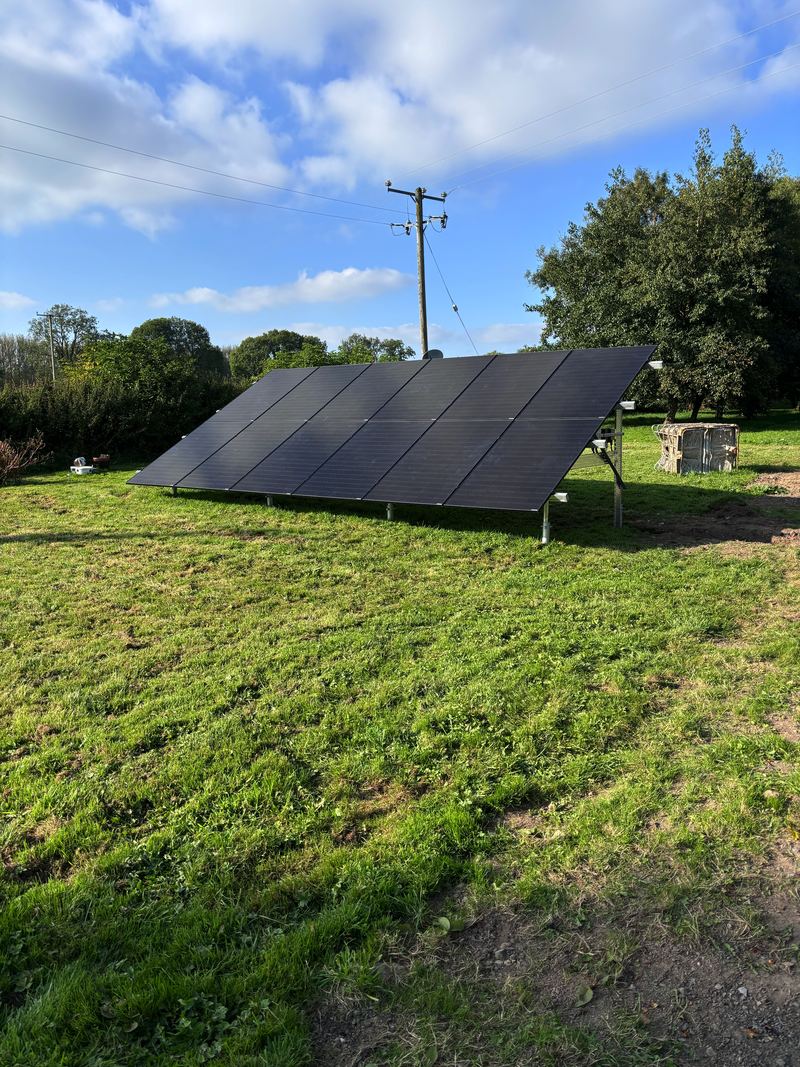
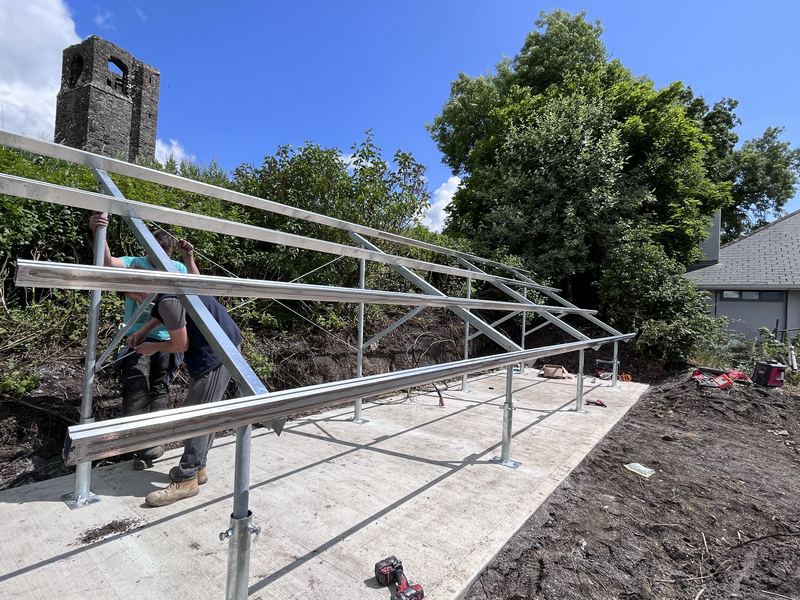
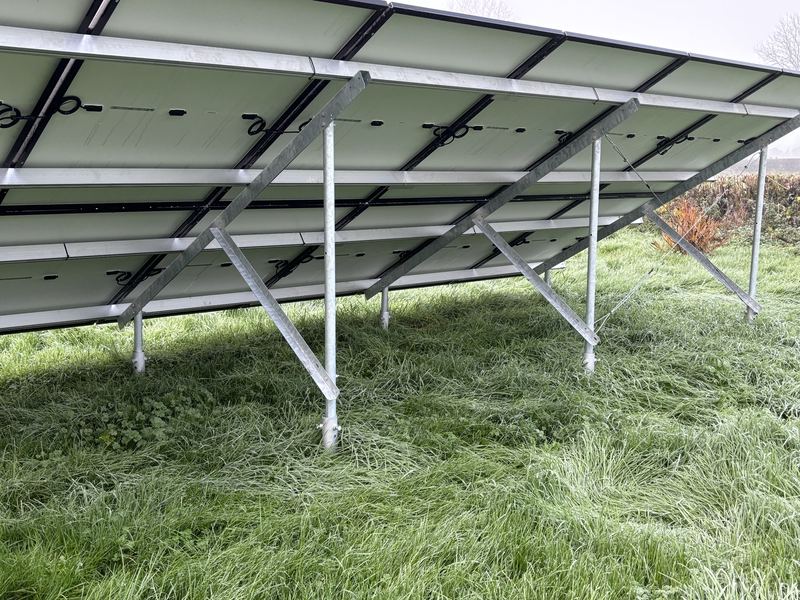
A ground mounted array is a solar system built on a steel frame in your garden, paddock or field rather than on the roof of the house. In Laois that distinction earns its keep, because the county is full of bungalows and farmyards where the roof faces the wrong way and the ground beside it faces due south. We survey, design and install these systems from Portarlington down to Rathdowney.
Laois picks up around 1,010 kWh per square metre of solar irradiation in an average year. Set a frame properly on that resource and you should see in the region of 940 kWh per kWp annually, which sits in the upper half of the Irish range of roughly 850 to 1,000 kWh per kWp.
Why a frame in the field beats the roof in Laois
Roof pitch in this county was chosen for shedding rain off slates, not for generating electricity in February. A ground frame is set at 30 to 35 degrees and turned true south, and that alone is usually worth 10 to 25 per cent more output than the same panels on a roof with the wrong angle, the wrong orientation or a chimney in the way.
Access is the other half of the argument. Every row sits at eye level, so isolators, cabling and panel connections can be checked without scaffold or a roof ladder. On a tillage farm outside Mountrath that turns a fault call into a half hour job rather than a day with a lift.
Older sheds around Abbeyleix and Mountmellick also carry roof sheeting that was never specified for the extra load and the extra fixings solar needs. Putting the array on the ground leaves the shed alone and keeps the panels where you can wash the dust off them.
Ground conditions from the central plain to the Slieve Blooms
Most of Laois sits on limestone till, and it is some of the more predictable driving ground in Leinster. Galvanised posts go in cleanly, resistance stays consistent across a field, and there is no concrete and no curing time. North of the county the picture changes completely once you cross the old Bord na Mona cutaway boundary.
We treat any site inside that boundary as a ballast first design until a probe proves otherwise. Peat compresses, it holds water, and a post that feels solid in July can move in a wet February. On the Slieve Bloom slopes the opposite problem appears: soil cover thins and rock turns up shallow, so drilled anchors do the work instead.
Foundation types we use around this county:
- Driven galvanised piles into firm limestone till on the plain
- Ground screws where soils are mixed, softer or wetter
- Ballasted frames on cutaway bog and made ground
- Rock anchors where Slieve Bloom bedrock is within reach
Planning permission and Laois County Council
The 2022 exempted development regulations, S.I. 493 of 2022, broadly allow a free standing solar array within the curtilage of a house without planning permission, subject to limits. In general those limits cover an aperture area of 25 square metres for houses, a height of 2.5 metres, a rule that the array must not sit forward of the front wall of the house, and a cap on how much of your private open space it may take up.
Broadly is the operative word. Protected structures, Architectural Conservation Areas and solar safeguarding zones near aerodromes are handled differently, and the open space test is a matter for the planning authority to interpret. Confirm your own case with Laois County Council in Portlaoise before anything is ordered.
Farm and commercial buildings sit under separate allowances, and a larger array meant to run a parlour or a workshop can fall outside the exemption entirely. We raise that at survey stage rather than after the steel is delivered.
Sizing, grants and export payments
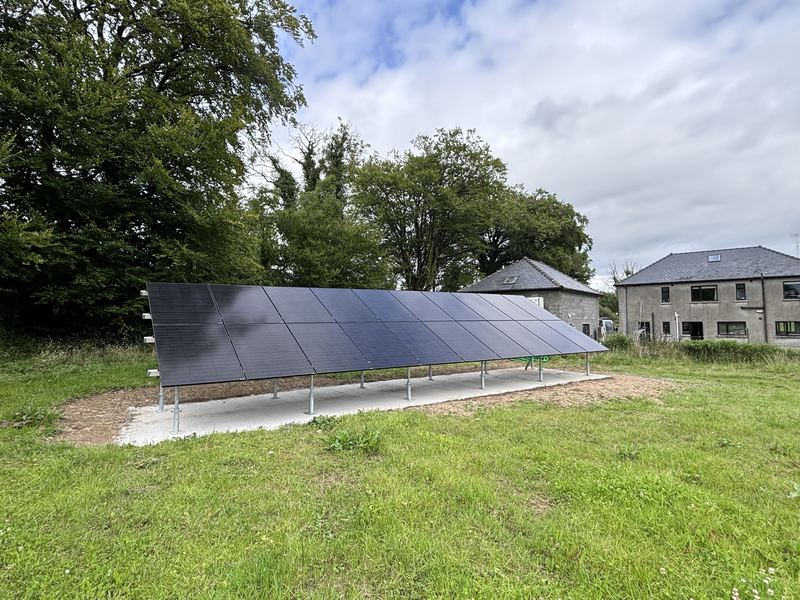
Allow roughly 8 to 10 square metres of ground per kWp for a single row, and more where rows must be spaced so the front one does not shade the row behind. A row pitch of about 2.5 times the array height is a fair planning figure. Panels are commonly 440 to 500 W, so a 6 kWp array is 13 or 14 of them.
The SEAI domestic solar grant is reviewed and stepped down periodically, so check the current value on seai.ie rather than on any installer's website. The home generally needs to have been built and occupied before 2021, the work must be carried out by an SEAI registered company, and a post works BER assessment is required. We confirm that a ground mounted array qualifies on your specific property before you commit.
Eligible farmers can look at the TAMS III Solar Capital Investment Scheme, which carries a 60 per cent grant rate under its own investment ceiling. Under the Clean Export Guarantee your supplier must pay for units you export, though rates vary between suppliers and change over time.
What the job looks like on a Laois site
It starts with a site visit. We walk the ground, read the horizon for shading from hedgerow ash and beech, probe the soil, measure the run back to the board and look at how a delivery lorry will get in. That visit decides the foundation, the frame specification and the cable route.
A normal domestic install takes two or three days on site. Posts or screws go in first, the frame is built and levelled, panels are fitted, then DC cabling is trenched back to the inverter and the system is commissioned and tested.
Grid paperwork runs alongside the build. Micro generation up to 6 kW single phase or 11 kW three phase is handled through an ESB Networks NC6 notification, which we submit for you and which typically takes a few weeks. Anything larger needs a full connection application, and you will hear that from us at quotation stage.
Towns and areas we cover in Laois
We install right across the county, from Portlaoise and Portarlington out to Rathdowney and every townland in between. There is no travel surcharge for being at the far end of the county.
Ground mounted solar in Laois: your questions
Do I need planning permission for a ground mounted array in Laois?
In general, no, provided the array stays inside the limits set out in S.I. 493 of 2022: 25 square metres of aperture area for a house, 2.5 metres in height, nothing forward of the front wall, and only a limited share of your private open space. Protected structures and conservation areas differ, so confirm your address with Laois County Council first.
How much electricity will a ground mount generate in Laois?
Laois averages about 940 kWh per kWp a year on a well oriented frame, so a 6 kWp array should land near 5,600 kWh annually. That figure moves with shading, tilt and how clean the panels are kept. It is above the low end of the Irish 850 to 1,000 kWh per kWp range, which reflects the county's decent central Leinster irradiation.
Can an array be installed on cutaway bog near Portarlington or Mountmellick?
Yes, but not with short driven piles. Bord na Mona cutaway behaves nothing like the limestone till a few kilometres south, so we probe for peat depth across the footprint and then choose between ballasted frames, spread footings or long ground screws. The design allows for a water table that rises well above the level you see on a dry survey day.
How much ground does a 6 kWp array take up?
Budget roughly 8 to 10 square metres per kWp for a single row, so around 50 to 60 square metres for 6 kWp including working space. If the layout needs two rows, add spacing of about 2.5 times the array height between them so the back row is not shaded in winter. Most rural Laois sites have that room easily.
Will I be paid for the electricity I export?
Yes. Under the Clean Export Guarantee your electricity supplier is obliged to pay for the units you send back to the grid. Rates differ from supplier to supplier and are changed from time to time, so check what yours is currently offering. There is also a micro generation income tax exemption that applies to this income.
Will livestock or machinery damage the array?
Only if the fencing is an afterthought. On a working farm we set the array back from gateways and machinery runs, and stock proof it with post and rail or sheep wire depending on what is grazing. Cabling is buried or run in conduit at height. Frames stand at eye level, which makes damage far easier to spot than on a roof.