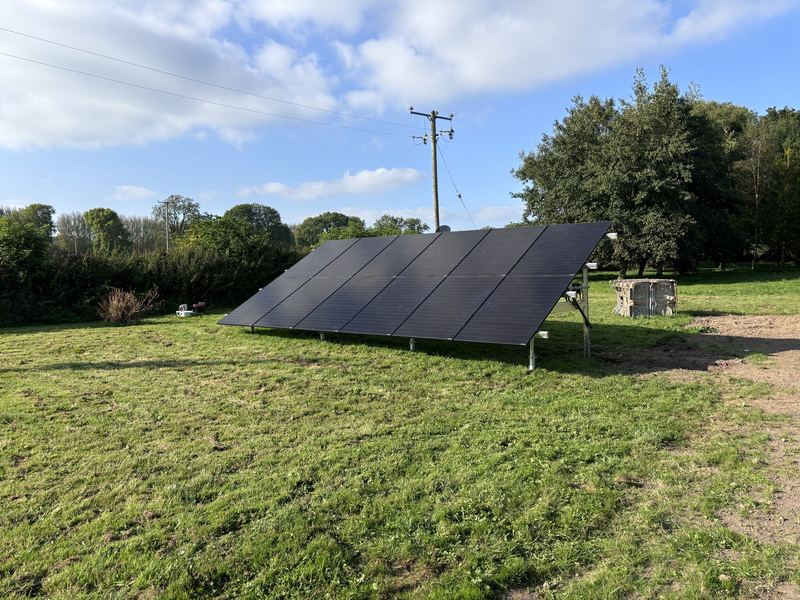
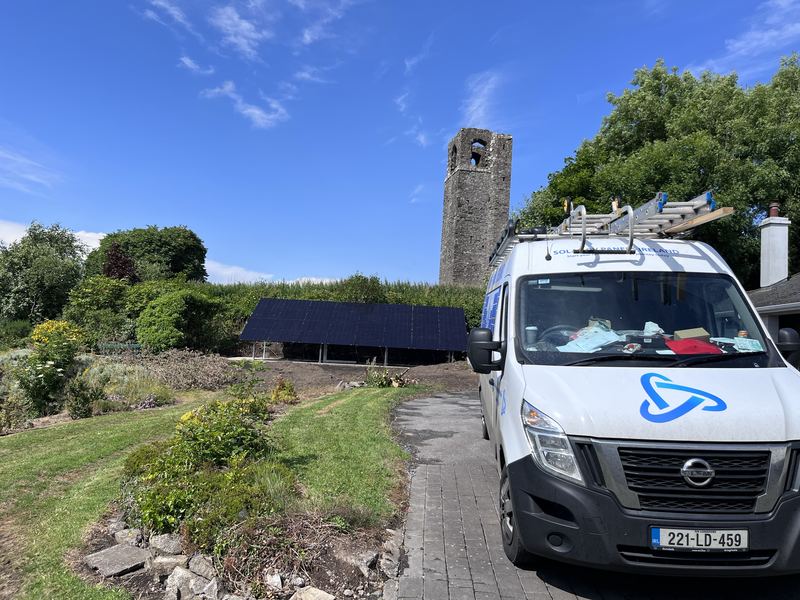
Offaly picks up around 1,000 kWh per square metre of irradiance in an average year, and a ground-mounted array here should deliver in the region of 935 kWh per kWp. Set against the Irish range of roughly 850 to 1,000 kWh per kWp, that is a strong midlands number, helped along by flat land, big skies and very little terrain shading.
The county also has more experience of solar on cutaway bog than anywhere else in Ireland. That works in your favour. The technology is familiar to the local authority and to the ESB Networks staff who deal with these connections week in, week out.
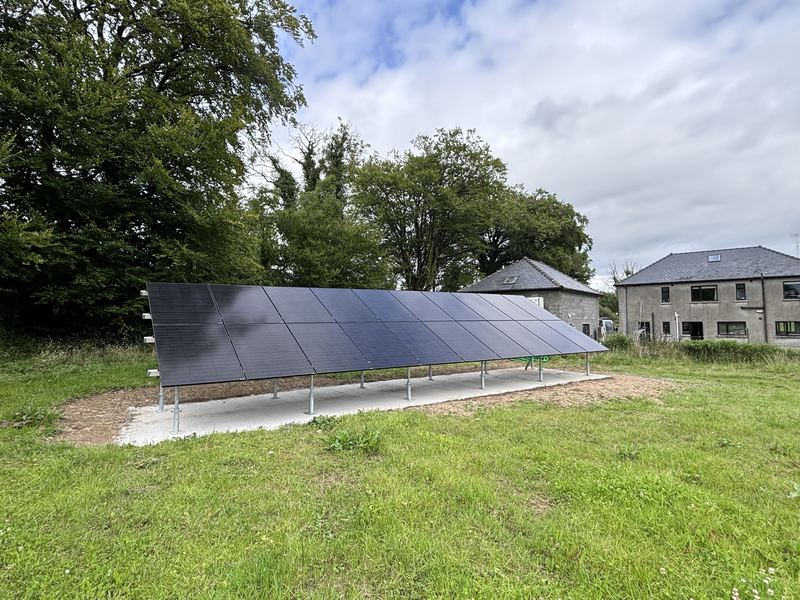
Esker gravel, limestone till and cutaway bog
Offaly ground is a patchwork. Esker gravels run through the county in long ridges and make superb foundations, firm and free-draining, ideal for driven piles. Limestone till behaves in much the same way. Then there are the raised bogs, the Bog of Allen, Boora and Clonad among them, where the rules change completely.
On cutaway the options are different:
- Long ground screws taken down to competent material below the peat.
- Ballasted frames sitting on the surface with concrete weight and no penetration.
- Piled rafts where loads need spreading across soft material.
Around Ferbane, Clara and the Boora ground a site can go from gravel to cutaway inside a few hundred metres. We probe every array footprint before quoting a foundation, and any land inside an old bog boundary is treated as a ballast-first design until the probe proves otherwise.
Why homes and farms here choose the field
Rural Offaly has space. Sites around Edenderry, Banagher and out the Birr road are typically big enough that a 6 to 12 kWp array can sit clear of the house without crowding anything. Roofs, meanwhile, come with the usual compromises: the wrong pitch, a hip cutting the useful area in half, or an oak that shades the southern slope from three in the afternoon.
Tilt the same panels to 30 or 35 degrees on a frame pointed true south and they will normally out-produce a compromised roof by 10 to 25 per cent. Expansion is easier as well. Adding a row to an existing frame is a straightforward job, where extending a roof array often means starting the structural conversation over again.
Access is the quieter advantage. A frame in a paddock can be washed down with a hose, no ladder is involved in checking a string, and running cable for a battery or an EV charger later means a trench to the board rather than a return trip onto the roof.
Sizing an array and reading the numbers
Ground area is the first constraint. Reckon on 8 to 10 square metres of ground for each kWp in a single row. Additional rows have to stand back from one another by roughly 2.5 times the array height, so the footprint grows quickly once you go past a single line of panels. Panels of 440 to 500 W are standard now, so a 6 kWp array is 13 or 14 modules and a 12 kWp array is double that.
Output follows from the county figure. At about 935 kWh per kWp, a 6 kWp array in Offaly is looking at somewhere near 5,600 kWh a year, though what that saves depends entirely on how much of it you use as it is generated. A battery shifts evening use onto daytime generation, and on farms with milking, grain drying or workshop loads the self-consumption share is already high before storage is considered.
Planning permission and Offaly County Council
Free-standing arrays within the curtilage of a house have been broadly exempt from planning permission since S.I. 493 of 2022 came in, provided they stay inside the limits. Four tests apply in general: aperture area capped at 25 square metres for a house, overall height capped at 2.5 metres, nothing built in front of the front wall, and only a limited share of the private open space given over to the frame.
Put your specific case to Offaly County Council before ordering. Buildings on the record of protected structures, and houses inside an Architectural Conservation Area, are handled separately, and the county has notable examples in Birr and Tullamore. Arrays outside the curtilage, or larger schemes on cutaway or farmland, generally need a planning application, and the council here is well used to assessing them.
How the install runs
The first visit is a survey, not a sales call. We probe the footprint on a grid, check peat depth wherever there is a question of it, look at the board and the supply, and set the cable route back to the house or the yard. Horizon shading is modelled, though across most of Offaly the land is flat enough that trees and buildings are the only obstructions worth worrying about.
Foundations go in, the frame is assembled and levelled, panels are fitted, then cabling, inverter and any battery. Commissioning covers testing, labelling and a walk through the monitoring. Grant support is worth settling early. SEAI values are reviewed and stepped down periodically, so seai.ie is the only reliable source for the figure of the day, and the usual conditions are a pre-2021 home, a registered installer and a BER assessment once the work is finished. We check that a ground mount qualifies at your address first. Farmers go through TAMS III and its Solar Capital Investment Scheme, grant aided at 60 per cent. Exported units are bought back under the Clean Export Guarantee at rates that vary between suppliers, with a micro-generation tax exemption on the income. ESB Networks takes an NC6 for micro-generation, the ceiling being 6 kW single-phase and 11 kW three-phase, and a full connection application above that.
Towns and areas we cover in Offaly
We install right across the county, from Tullamore and Birr out to Ferbane and every townland in between. There is no travel surcharge for being at the far end of the county.
Ground mounted solar in Offaly: your questions
Can solar panels be mounted on cutaway bog?
Yes, and Offaly has more of that experience than any other county. Short driven piles are useless in peat, so we specify long ground screws taken into competent material, a ballasted frame that sits on the surface, or a piled raft that spreads the load. Which one depends on the probe results across the whole footprint.
What output should I expect in Offaly?
Roughly 935 kWh per kWp a year, from irradiance around 1,000 kWh per square metre. Measured against the national spread, which runs from about 850 to 1,000 kWh per kWp, that is toward the upper end. Flat land and few hills mean sites here rarely lose anything to terrain shading, so the modelled figure and the real one stay close.
Is an esker site better than an ordinary field?
For foundations, yes. Esker gravel is firm and free-draining, so piles drive quickly and cleanly and the foundation element of the price drops. Limestone till performs similarly. The catch is that eskers are narrow, so the good ground may be a few fields away from where you pictured the array sitting.
Do I need planning permission from Offaly County Council?
Inside the curtilage of a dwelling most arrays are exempted development, provided the aperture area, the height and the siting all stay within the thresholds. Put your layout to Offaly County Council first. Arrays in a field beyond the curtilage, larger farm schemes and anything at a protected structure or in a conservation area need an application.
What grants apply in Offaly?
Homeowners go through SEAI, whose grant is reviewed and stepped down periodically, so take the current value from seai.ie. Conditions include a dwelling built and occupied before 2021, a registered installer and a BER assessment once work finishes. Farmers have TAMS III instead, with the Solar Capital Investment Scheme grant aided at 60 per cent.
What happens to the electricity I do not use?
It goes to the grid and your supplier pays for it under the Clean Export Guarantee. Rates differ between suppliers and are revised from time to time, so compare current offers rather than relying on a figure quoted last year. A micro-generation income tax exemption applies to that export income within the limits set out by Revenue.