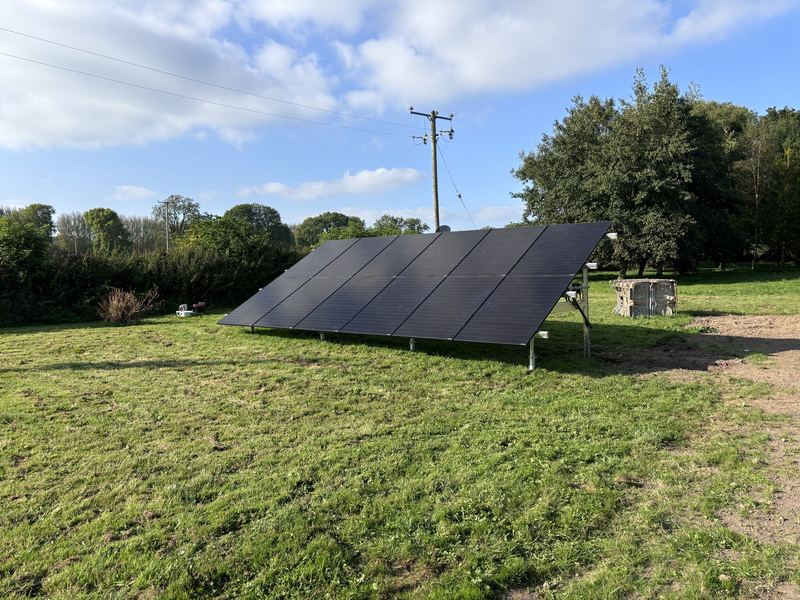
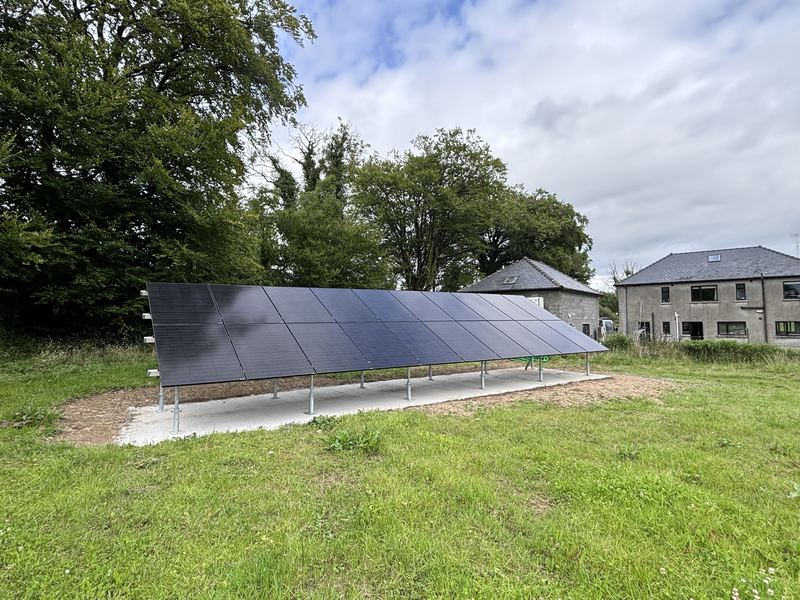
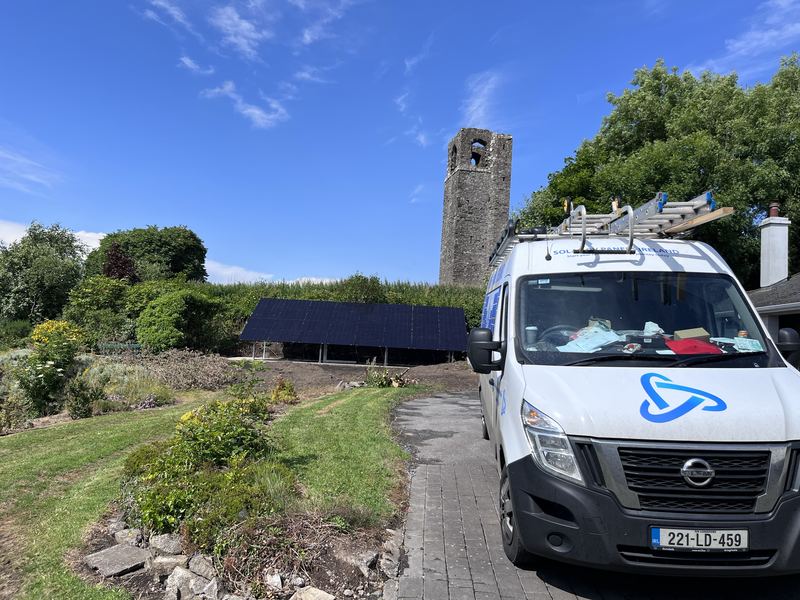
Cork is the largest county in Ireland and one of the busiest on our books. Irradiance runs at about 1,050 kWh per square metre a year, among the highest figures anywhere in the country, and a well built ground mount should return roughly 960 kWh per kWp annually. Ireland generally falls between 850 and 1,000 kWh per kWp, which puts Cork firmly at the upper end of the national picture.
This is dairy heartland, full of large holdings with sheds whose roofs were never designed to carry panels or to face anywhere useful. That is the plainest reason ground mounts do so well between Mallow, Fermoy, Midleton and Macroom, and equally down west around Bandon, Clonakilty and Youghal on the eastern coast.
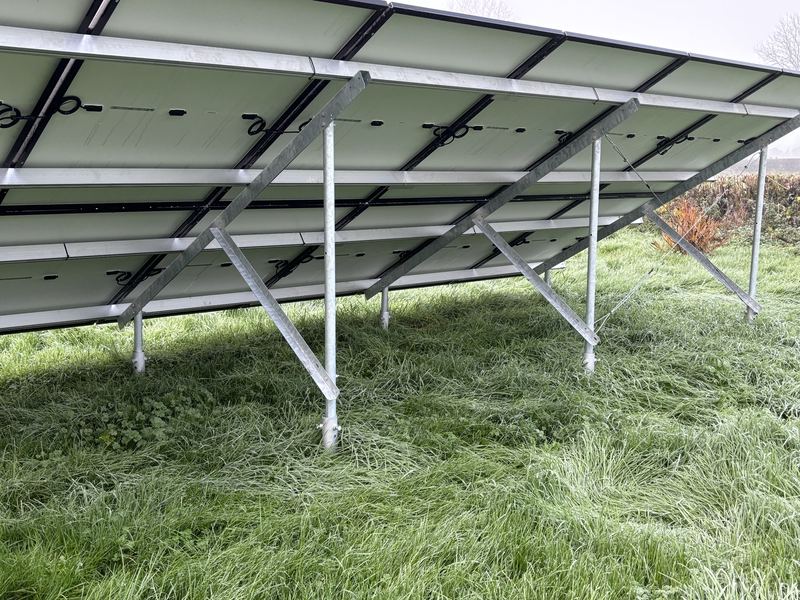
The free south-facing slope
Cork geology runs in Old Red Sandstone ridges and limestone valleys aligned roughly east to west. The practical consequence for solar is that an enormous number of fields already tilt towards the south. Put a frame on ground that slopes the right way and the panels reach optimum pitch with a shorter, cheaper, lower structure that is also easier to keep out of the wind.
We look for that aspect first on every Cork survey. Where it exists, a ground mounted array will beat a compromised roof by a wide margin, often the full 10 to 25 per cent advantage that correct pitch and true south orientation are worth. Where it does not, the frame simply does more of the work. Either way you are not stuck with whatever angle a builder chose forty years ago.
Foundations from the Blackwater valley to west Cork
Deep, well-drained brown earths fill the Blackwater and Lee valleys, and driven piles are the default across most of that ground. Galvanised posts go in fast, need no concrete and leave the field usable immediately. Thinner soils on the ridges can hit sandstone sooner than expected, and west Cork brings peat and exposed rock where screws or ballasted frames are the correct call instead.
Every Cork survey covers the same checklist before a price goes out:
- Probe depths taken across the array footprint, not at a single corner.
- Aspect, slope and true horizon measured from the proposed panel line.
- Distance and route from the array to the distribution board.
- Existing load profile and phase, single or three-phase.
- Machinery access for the driving rig, including gateway widths and overhead lines.
That checklist is why our foundation quote holds when we arrive, rather than turning into a variation on the day.
Grants, TAMS and income from exported units
For homes, the SEAI domestic solar grant applies. It is periodically reviewed and tapered downwards, so check seai.ie for what stands today rather than working off a figure a neighbour quoted last year. The conditions in general: the property built and occupied before 2021, an SEAI-registered contractor carrying out the work, and a BER assessment once the system is live. Ground mounts are not treated identically to roof systems in every case, so we get your property signed off before any money moves.
For farms, solar sits inside TAMS III under the Solar Capital Investment Scheme. The grant rate there is 60 per cent for eligible applicants and the investment ceiling is kept apart from other TAMS measures. Dairy holdings around Fermoy and Midleton, with heavy daytime demand from milking, cooling and water heating, tend to show the strongest case of all. Anything you do not use yourself is bought under the Clean Export Guarantee, at rates that differ from one supplier to the next and are revised periodically, and income from that export attracts a micro-generation tax exemption.
Planning permission, the council and the city boundary
Cork has two authorities, so start by establishing which one you are dealing with. Planning is handled by Cork County Council (and Cork City Council inside the city boundary), and the boundary has moved in recent years, so an address that was county a decade ago may now be city.
In general terms, the 2022 exempted development regulations (S.I. 493 of 2022) permit a free-standing array within a house's curtilage without permission, within limits: an aperture area cap of 25 square metres, a height cap of 2.5 metres, nothing sited forward of the front wall, and a ceiling on how much private open space is taken. Different rules apply to protected structures, to anything inside an Architectural Conservation Area, and to solar safeguarding zones near aerodromes. Confirm before ordering, and we will provide the layout and dimensions that enquiry needs.
How a Cork install runs
Survey comes first, including probing and a horizon check. Design and paperwork follow, then a date. On site, foundations go in on day one, the frame and rails follow, then panels, DC strings, inverter, AC connection and commissioning. Most domestic jobs take a few days. Larger farm arrays run longer because of trenching and switchgear rather than the panels themselves.
Grid notification depends on size. Anything inside the micro-generation thresholds, which are 6 kW where the supply is single-phase and 11 kW where it is three-phase, gets notified to ESB Networks on an NC6 form. Bigger arrays, which are common on Cork dairy holdings, need a full connection application and usually a few weeks more. On a county this size we plan routes and days sensibly, so a job at Macroom is not being serviced from a van that started the morning in Youghal.
Towns and areas we cover in Cork
We install right across the county, from Cork City and Mallow out to Midleton and every townland in between. There is no travel surcharge for being at the far end of the county.
Ground mounted solar in Cork: your questions
How much will a ground mounted array generate in Cork?
Around 960 kWh per kWp per year for a correctly oriented array, on county irradiance of roughly 1,050 kWh per square metre. Take the national spread of about 850 to 1,000 kWh per kWp and Cork lands at the strong end of it. A south-facing slope with a clear horizon can push a site to the top of that figure.
Which council do I contact about planning?
Planning is dealt with by Cork County Council (and Cork City Council inside the city boundary). The boundary was extended in recent years, so check which side of it your address now falls on before making the enquiry. We provide the array dimensions and site layout drawing you will be asked to submit either way.
Is west Cork ground harder to build on than the Blackwater valley?
It is different rather than harder. The Blackwater and Lee valleys give deep brown earths that take driven piles quickly. Towards Clonakilty, Bandon and the western peninsulas we meet peat and shallow rock, which call for ground screws or ballasted frames. Both produce a sound foundation, and the survey probe decides which you are getting.
Can a ground mount work alongside my TAMS application?
Yes. Under TAMS III, the Solar Capital Investment Scheme carries a grant rate of 60 per cent where the applicant is eligible, and its investment ceiling is held apart from other measures. We supply the specification, layout drawing and documentation your adviser will ask for. Hold off ordering equipment until approval is in place, because the timing of works against approval matters.
Do I lose the use of the field?
Only the footprint it stands on. A single row takes something in the order of 8 to 10 square metres for each kWp, so a 6 kWp array of 13 or 14 panels occupies a small corner of a field. Sheep can graze under and around a fenced array on a suitably raised frame. Cattle and machinery need to be kept out entirely, which the perimeter fence handles.
What size array suits a dairy farm?
It depends on your daytime base load. Milking, plate cooling, bulk tank refrigeration and water heating run during daylight, so a lot of generation is used on site rather than exported, which is where the value sits. We review your bills and interval data first, then size the array to the load instead of to the available space.