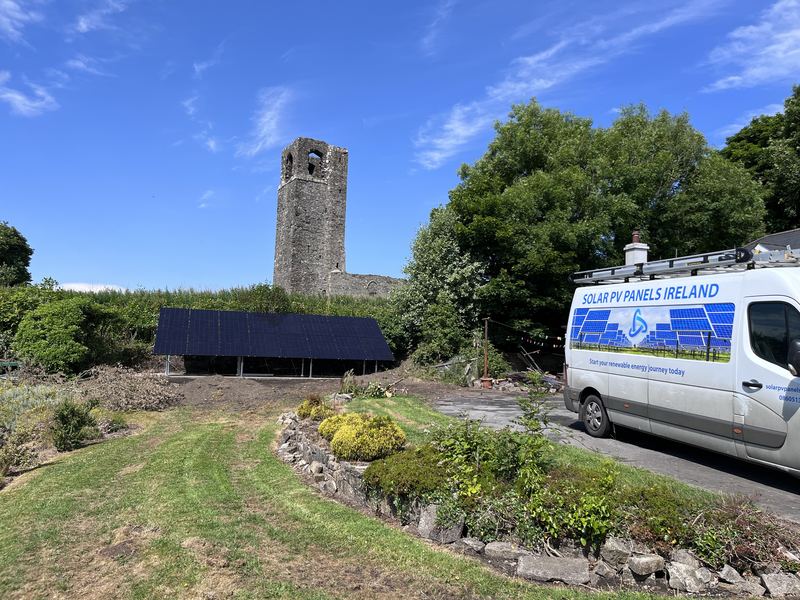
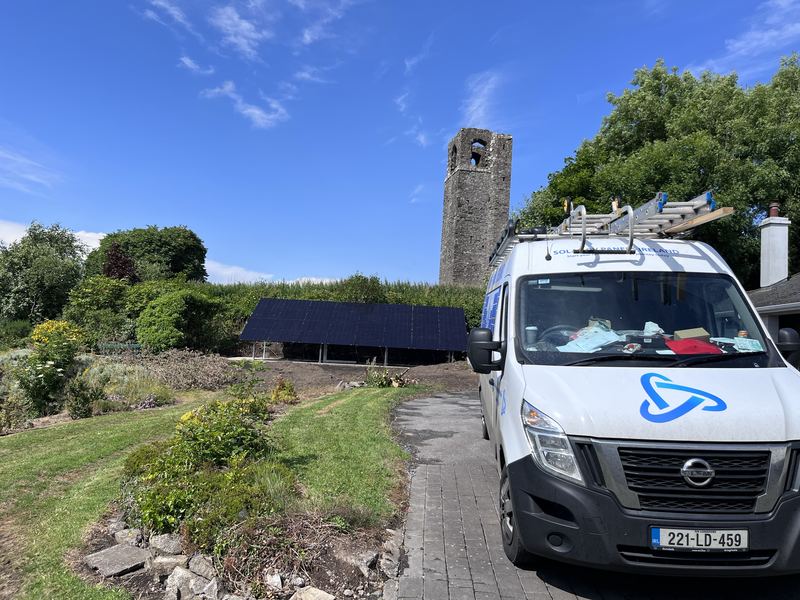
Sligo is not the sunniest county in Ireland and we will not pretend otherwise. What it has is room. Nearly every holding we survey between Ballymote and Collooney has a corner of a field that faces south and sees open sky from mid-morning until evening, and that corner is worth a great deal more than the shed roof beside it.
A ground-mounted frame lets us pick that spot, set the panels at the pitch we want, and keep them clear of chimneys, ash trees and north-facing slate. We build these arrays for farmers, contractors and householders right across the county, from Grange and Enniscrone down to Tubbercurry.
Terrain shading is a real design input in Sligo
Ben Bulben and the Ox Mountains are the reason a Sligo drawing takes longer than most. A high southern skyline can remove the best part of an hour from a short December day, and no panel on the market wins that hour back. We model the horizon before we model the array.
The method is straightforward. We stand at the proposed frame position, take bearings and elevation angles to the skyline, then run those against the local sun path so you can see month by month what the terrain is costing you. On some north Sligo sites the answer is to move the frame a hundred metres further up the slope. On the lower Owenmore ground near Collooney the answer is usually that terrain costs you nothing at all, which is equally worth knowing before you spend money.
A roof cannot be relocated to solve this problem. A frame can, and that single piece of flexibility is the strongest argument for ground mounting anywhere in this county.
Foundations, from limestone bench to Ox Mountain peat
Sligo ground changes character over very short distances. Under the Dartry benches the limestone sits close to the surface with almost no cover, so resin-set rock anchors drilled into sound stone are frequently the honest answer. Move inland to the drumlin belt and you meet stiff boulder clay and wet gley soils, where driven piles behave well on the drumlin crowns and behave badly in the hollows between them.
The Ox Mountains carry blanket peat, and peat depth is never uniform. We probe on a grid rather than at one corner, then choose between long helical ground screws, spread footings or a fully ballasted frame based on what the probe actually finds. Screws tend to win where the peat is workable, since they wind in without concrete and can be taken back out again years later.
Coastal jobs at Enniscrone and Grange bring a second issue, which is salt. Three things change on those sites:
- higher-grade galvanising on the frame and stainless fixings at every clamped joint
- a wind design taken from the exposed terrain category rather than a county-wide default
- deeper post embedment, or additional ballast, to hold the structure against Atlantic gusts
What 875 kWh per kWp means for a Sligo household
Sligo receives in the region of 940 kWh per square metre of horizontal irradiation across a year. Put a frame at 30 to 35 degrees facing true south and a well-sited array here returns roughly 875 kWh per kWp per year. Irish ground mounts sit somewhere between about 850 and 1,000 kWh per kWp, so Sligo lands at the lower end of that band. Honest numbers, not headline ones.
That is precisely why the ground mount argument gets stronger here rather than weaker. Where the resource is modest you cannot afford to hand 15 per cent of it to a roof pitched at 22 degrees facing south-west with a chimney sitting in the middle of the good half. Optimum pitch and true orientation typically buy back 10 to 25 per cent against a compromised roof, and on a Sligo site that margin decides whether the system pays.
We tilt slightly steeper than the textbook figure on inland Sligo sites. It sheds rain and dirt, and it picks up more of the low winter sun that this county is short of.
Planning permission and Sligo County Council
Under the 2022 exempted development regulations, S.I. 493 of 2022, free-standing solar arrays inside the curtilage of a house are broadly exempt from planning permission, subject to limits. In general those limits cover total aperture area, capped at 25 square metres for a house, a maximum height of 2.5 metres, a rule that the array must not stand forward of the front wall of the house, and a cap on how much of your private open space it may occupy.
Take that as the starting point rather than the final word. Protected structures, Architectural Conservation Areas and solar safeguarding zones near aerodromes are treated differently, and a fair number of properties in this county fall into one of those categories. We ask every customer to confirm the position with Sligo County Council before a frame is ordered, and we put the site drawings and array dimensions together so that conversation is a short one.
Agricultural buildings and larger farm arrays run under separate classes with their own thresholds, so a yard installation needs its own check rather than an assumption borrowed from the domestic rules.
Grid connection, grants and export payments
Micro-generation up to 6 kW single-phase, or 11 kW three-phase, is notified to ESB Networks on an NC6 form. Anything above that needs a full connection application, which is a longer road. We complete the paperwork either way, and straightforward cases are typically cleared in a few weeks.
The SEAI grant is aimed at homes generally built and occupied before 2021, has to be installed by an SEAI-registered company, and requires a post-works BER assessment. Its value is reviewed and stepped down periodically, so check the current rate on seai.ie rather than trusting any figure printed on a contractor's website. We confirm that a ground-mounted array qualifies on your specific property before you commit to anything. Farmers should also look at the Solar Capital Investment Scheme under TAMS III, which carries a 60 per cent grant rate for eligible applicants within its own investment ceiling.
Units you export are paid for under the Clean Export Guarantee. Rates differ between suppliers and they change, so compare what is on offer at the time, and note that a micro-generation income tax exemption applies to that income.
Towns and areas we cover in Sligo
We install right across the county, from Sligo Town and Ballymote out to Grange and every townland in between. There is no travel surcharge for being at the far end of the county.
Ground mounted solar in Sligo: your questions
How much electricity will a ground mounted array generate in Sligo?
Expect around 875 kWh per kWp per year from a frame set at 30 to 35 degrees facing true south, against roughly 940 kWh per square metre of annual irradiation. That places Sligo at the lower end of the Irish 850 to 1,000 kWh per kWp band, so getting the orientation exactly right matters more here than in Wexford or Waterford.
Do Ben Bulben and the Ox Mountains affect my generation?
They can, and it is one of the few counties where we say so plainly. A steep southern skyline can shorten the useful winter day by around an hour. We take elevation angles to the horizon from your proposed array position and model the result, then move the frame if the numbers say moving it is worth the cable run.
Do I need planning permission for a ground mounted array in Sligo?
In general, no, provided the array stays inside the limits set by the 2022 exempted development regulations: 25 square metres of aperture for a house, 2.5 metres maximum height, nothing forward of the front wall, and a cap on private open space used. Confirm your own position with Sligo County Council before ordering anything.
What foundation type will my site need?
It depends on what the probe finds. Shallow limestone under the Dartry and Ben Bulben benches usually calls for resin-set rock anchors. Drumlin boulder clay inland takes driven galvanised piles well on the crowns. Blanket peat on the Ox Mountains needs long helical ground screws, spread footings or ballast. We probe before we price the job.
Is a ground mount really better than using the shed roof?
On most Sligo yards, yes. Farm sheds were built for stock and machinery, not for solar, and their pitch and orientation are whatever suited the site at the time. A frame set at optimum pitch and true south typically gains 10 to 25 per cent over a compromised roof, with no loading questions about the existing structure.
Will I be paid for electricity I do not use?
Yes. Suppliers are obliged to pay for exported units under the Clean Export Guarantee, though the rate varies by supplier and is revised from time to time, so compare current offers before you sign. A micro-generation income tax exemption also applies to that income. Using the power on site is still worth more than exporting it.