Ask an installer about winter and you often get a shrug and a change of subject. It is the least flattering season for solar and the easiest thing to skip past in a sales conversation. It is also the season customers ask about most: what does this thing actually do in December.
The honest answer is not much, but not nothing, and a ground mount handles it better than a roof. This piece sets out the geometry of the Irish winter sun, what a steeper tilt genuinely buys you, where shading bites hardest, and what a realistic monthly shape looks like across an Irish year.
Key takeaways
- Midday sun in Ireland reaches only about 12 to 15 degrees in December, against roughly 60 degrees in June.
- Steeper winter tilt adds maybe 20 to 30 per cent in December while costing a few per cent annually.
- A 5 metre hedge 20 metres south can block almost all direct December sun yet matter nothing in June.
- Space rows at roughly 2.5 times array height, because low winter sun causes most inter-row shading.
- December output is a small single-digit percentage of June, so plan around summer and treat winter as a bonus.
How low the December sun really gets
Ireland sits roughly between 51.4 and 55.4 degrees north, from Mizen Head up to Malin Head. That latitude band sets the geometry and nothing you buy can change it.
At the winter solstice the sun's maximum elevation at solar noon is around 12 to 15 degrees across the country, higher in west Cork, lower in north Donegal. At midsummer the same midday sun reaches roughly 58 to 62 degrees. That is the whole story in two numbers: the sun that is nearly overhead in June is barely above the hedge in December.
Day length compounds it. Around the solstice you get roughly 7.5 hours between sunrise and sunset in the south and closer to 7 in the north, against something over 17 hours in June. Fewer hours, at a much shallower angle, through a thicker slice of atmosphere, under an Irish sky.
The December sun also rises well south of east and sets well south of west, so its arc is short and entirely in the southern sky. Anything to the south of your array, a hedge, a shed, a rising field, is in the way for the whole useful day.
Winter tilt versus the annual optimum
Panels generate best when the sun strikes them square on. With a midday sun at 12 to 15 degrees, the tilt that would face it squarely in December is steep, in the region of 55 to 65 degrees. The tilt that maximises the annual total in Ireland is much shallower, generally 30 to 35 degrees. Those two numbers pull in opposite directions and you cannot have both on a fixed frame. The annual total is dominated by summer, which is why the annual optimum stays shallow.
Raising the tilt from 35 degrees to somewhere around 55 degrees will typically add in the order of 20 to 30 per cent to December output while costing a few per cent of the annual total. That sounds like a good trade until you look at the absolute numbers. A quarter added to a very small December figure is still a small figure, and the percentage you gave up applies to the much larger annual total.
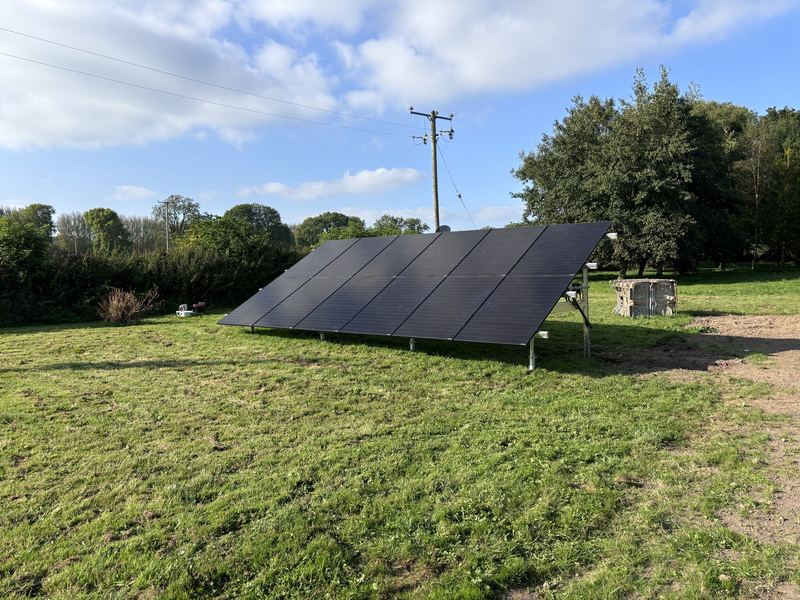
Where we do lean steeper, we lean modestly. Something in the 35 to 40 degree range picks up a little winter benefit, sheds rain and snow better, and costs very little annually. That is usually the right compromise on an Irish ground mount, and it is one of the advantages of not being stuck with a roof pitch.
What chasing winter kWh actually costs
Steeper frames are not free. A panel at 55 degrees presents far more sail area to the wind than the same panel at 30, and wind load is the governing case for ground-mount structures in Ireland. Steeper means heavier sections, more foundation points, deeper embedment or more ballast, and a higher structural cost across the whole array.
Steeper frames are also taller for the same panel, which matters where the exempted development limits on height apply within the curtilage of a house. Confirm the detail with your own local authority before ordering anything, because height and area limits are exactly the sort of thing people discover late.
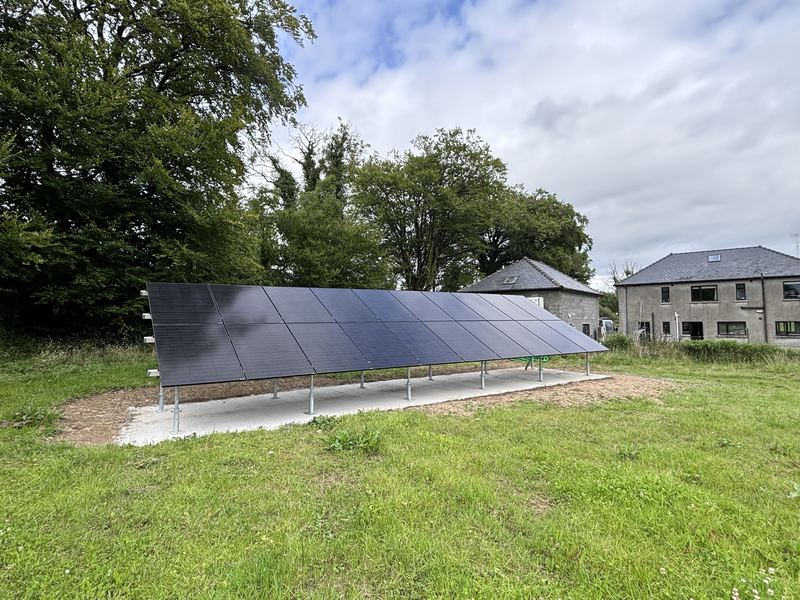
Then there is row spacing. A steeper array casts a longer shadow, so rows must be pushed further apart, which means either fewer kWp on the same ground or a bigger footprint for the same output. On a domestic site that is often the binding constraint rather than cost.
Tracking solves the geometry elegantly and brings moving parts, maintenance and higher capital cost, which rarely stacks up at domestic scale in an Irish wind climate. Spending the same money on an extra panel or two at 35 degrees usually buys more annual kilowatt hours.
Inter-row shading when the sun is low
Self-shading between rows is the single most common design error we see on multi-row ground mounts, and it is a winter problem by nature. In June the sun is high enough that rows never shade each other. In December, with a 12 to 15 degree sun, a row can put its neighbour in shadow for hours around the middle of the day, which is precisely the output you were trying to protect.
The planning rule of thumb we use is a row pitch of roughly 2.5 times the array height, measured from the ground to the top edge of the panel. That keeps rows workable through most of the year without demanding a huge footprint. Chasing full solstice-noon clearance can require pitches well beyond that, which is rarely worth the land it consumes.
Panel-level effects make shading worse than the shaded area suggests. Shade across the bottom of a portrait panel can knock out a whole string section, so a shadow covering a small percentage of the array area can cost a much larger percentage of the output. Bypass diodes limit the damage but do not remove it.
Two practical mitigations. Mount panels in landscape where site width allows, so a low shadow crosses fewer cell strings at once, and use optimisers or separate strings where the layout is unavoidably tight.
Horizon and terrain shading
Inter-row shading is under your control. The horizon is not, and it matters far more in winter than most people expect.
With a midday sun at 12 to 15 degrees, an obstruction only needs to subtend a modest angle to the south to block direct beam entirely. A 5 metre hedge 20 metres to the south sits at roughly 14 degrees above the array, which is enough to remove most direct sun on a December day. The same hedge is completely irrelevant in June. This is why a site that looks perfect in August can disappoint in January.
Terrain does the same at larger scale. A south-facing slope effectively lifts the array relative to the horizon and improves winter performance. A site tucked at the foot of a north-facing slope, in a valley in Wicklow or Kerry or under a rising drumlin flank in Cavan, can lose direct sun for weeks around the solstice even with a clear sky.
Survey it properly. We walk the south arc with a compass and a clinometer, or a phone app doing the same job, recording the elevation of every obstruction from south-east through to south-west. Where a hedge is the obstruction, allow for what it will be in ten years.
Diffuse light does most of the winter work
Ireland is a cloudy country and a large share of annual irradiance arrives as diffuse light, scattered by cloud rather than arriving as a direct beam. In midwinter that share is higher still, and on many December days there is essentially no direct beam at all.
Diffuse light is good news in one narrow sense. It comes from the whole sky dome rather than from the sun's position, so orientation and tilt matter much less on an overcast day, and a shaded or east-facing array is less penalised than it would be in bright sun. It is bad news in every other sense, because the total energy is a fraction of full sun.
Panels do produce on dull days. A heavily overcast December afternoon might deliver in the region of 5 to 15 per cent of the output the same array would give in bright conditions, enough to run background load in a house but not to heat water or charge a car.
Two consequences follow. Cold clear days are the best winter days, because cells are more efficient at low temperatures. And because so much winter light is diffuse, clean glass and an open horizon pay back more than any tweak to tilt.
Frost, snow and keeping the glass clear
Snow in Ireland is occasional rather than seasonal, and it usually clears itself. Panels at 30 to 35 degrees shed snow reasonably well once the surface warms slightly, and the array below the snow generates a trickle that helps release it. Steeper tilts shed faster, which is a minor argument for the 35 to 40 degree range.
Frost is more common and less of a problem. It burns off with the first sun, and cold cells are efficient cells. Never pour hot water on cold glass.
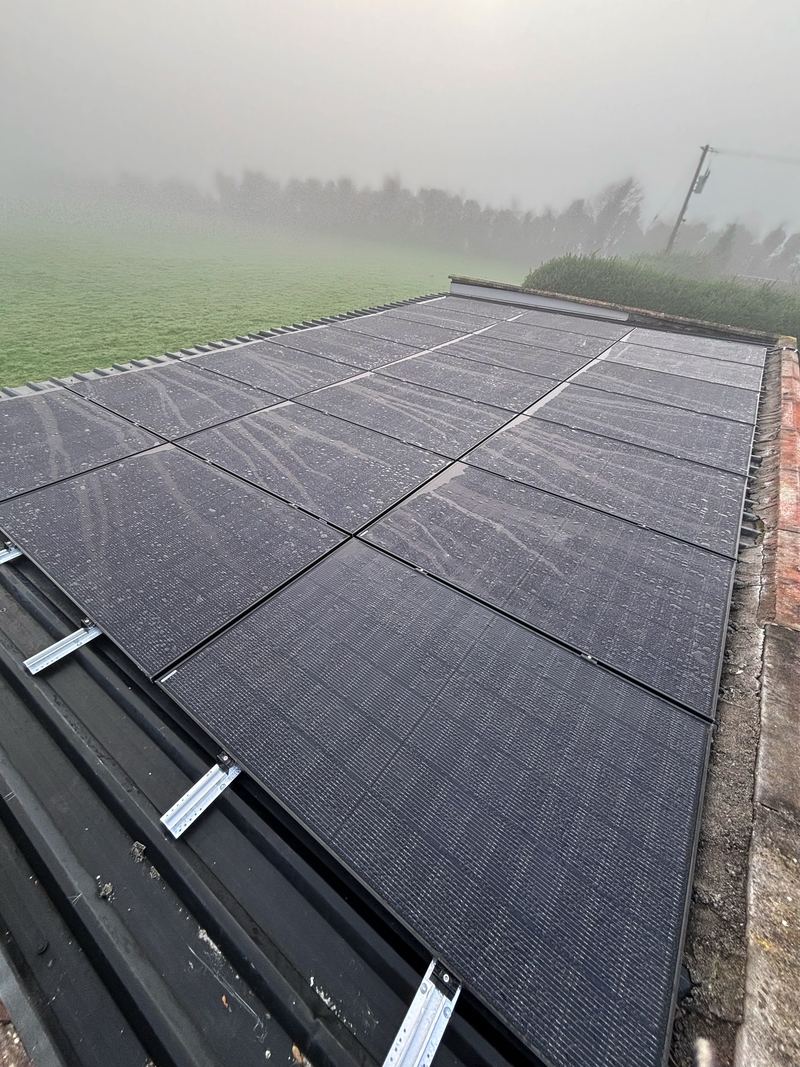
Soiling is the underrated one. Irish winter deposits moss spores, algae, agricultural dust, bird droppings and, near the coast, salt film. Rain deals with most of it, but a low-tilt array, a sheltered site, or an array under trees will accumulate a film that costs a few per cent of output, mostly at the bottom edge where water sits and dries.
This is where a ground mount clearly beats a roof. You clean it standing on the ground with a soft brush and a hose, in half an hour, with nobody on a wet slate roof in January. You can also see the array from the yard, so faults and damage get noticed. Once or twice a year suits most sites.
The shape of an Irish solar year
Here is the honest picture. An Irish ground-mounted array at 30 to 35 degrees facing true south typically produces somewhere in the region of 850 to 1,000 kWh per kWp per year, varying by county, with the south east generally ahead of the north west.
That total is not spread evenly. Roughly speaking, May, June and July each contribute in the region of 12 to 15 per cent of the annual total, while December contributes only a small single-digit percentage, commonly in the region of 5 to 8 per cent of what June delivers rather than of the year. November, December and January together often account for less than a tenth of annual output. April through September typically carries around three quarters of the year.
Plan around that shape instead of fighting it. Solar in Ireland is a summer and shoulder-season asset that trims the annual bill, and the winter contribution is a bonus rather than the basis for a business case. Anyone selling you a system on its December performance is selling you something else.
What does help is a clear southern horizon, a tilt in the 30 to 40 degree band, rows spaced so they do not shade each other, clean glass and a battery shifting what little you make into the evening peak. Together they are the difference between a winter that quietly contributes and one that does nothing.
Frequently asked questions
Should I set my ground mount steeper to get more winter output?
Only modestly. The annual optimum in Ireland is around 30 to 35 degrees, while facing the December sun squarely would need 55 to 65 degrees. Going that steep might add 20 to 30 per cent to a very small December figure while reducing the far larger annual total, and it raises wind loading, structural cost and row spacing. Something around 35 to 40 degrees is usually the sensible compromise.
How much does an Irish array actually generate in December?
Very little compared with summer. December output is typically a small single-digit percentage of what the same array produces in June, and November through January combined often accounts for under a tenth of annual generation. It is still useful for background household load, but it will not heat water or charge a car on most days. Size the system around annual output, not December.
Do solar panels work on dull overcast Irish days?
Yes, on diffuse light scattered by cloud rather than direct beam, which is a large share of Irish annual irradiance. Output on a heavily overcast December day might be in the region of 5 to 15 per cent of bright conditions. Orientation matters less on those days because the light arrives from the whole sky. Cold clear days are by far the best winter performers.
Does snow stop a ground-mounted array working?
Briefly, and it usually clears itself. Panels at 30 to 35 degrees shed snow reasonably well once the surface warms, and Irish snow cover rarely lasts long. Steeper tilts shed faster. If you do want to clear an array, a ground mount is far safer than a roof because you can reach it standing on the ground. Never pour hot water on cold glass.
How often should a ground-mounted array be cleaned in Ireland?
Once or twice a year suits most sites, more where you are near the coast, under trees or beside a farmyard. Rain handles most soiling, but algae, moss and salt film build up along the lower edge and can cost a few per cent of output. Cleaning a ground mount takes half an hour with a soft brush and a hose, with no ladder involved.