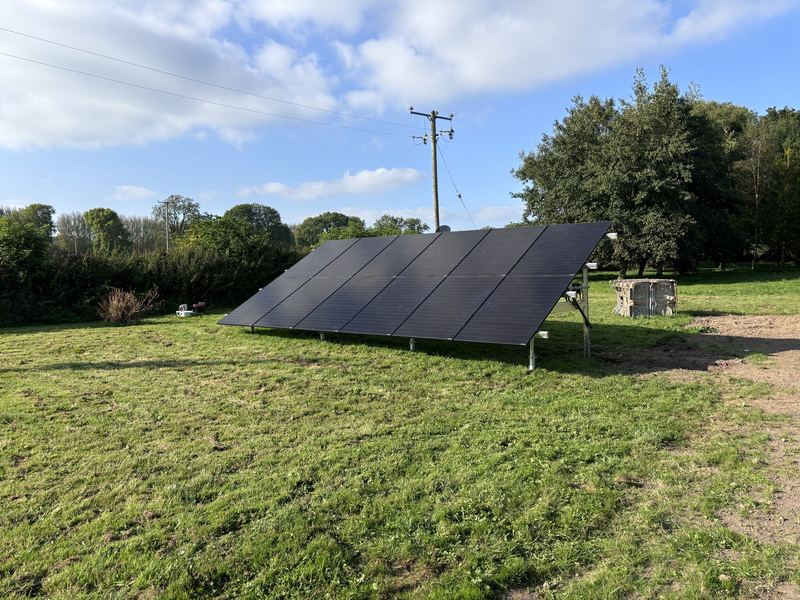
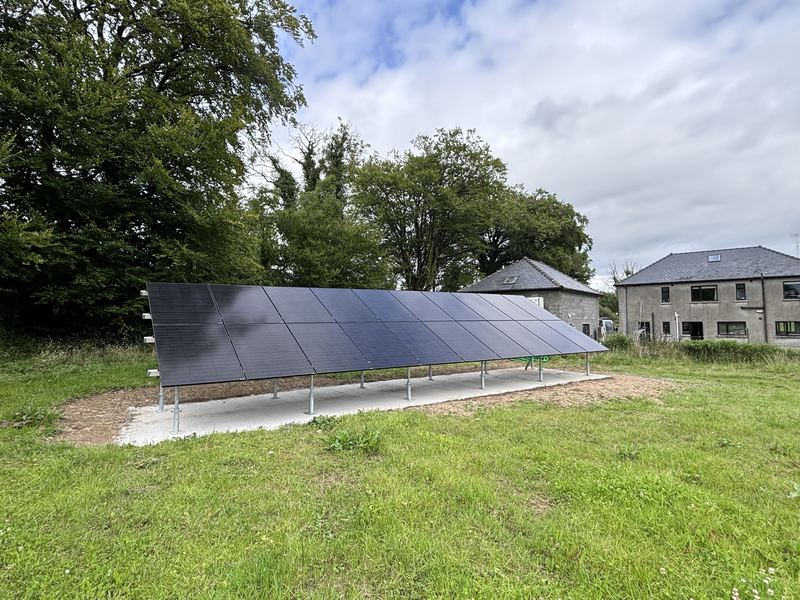
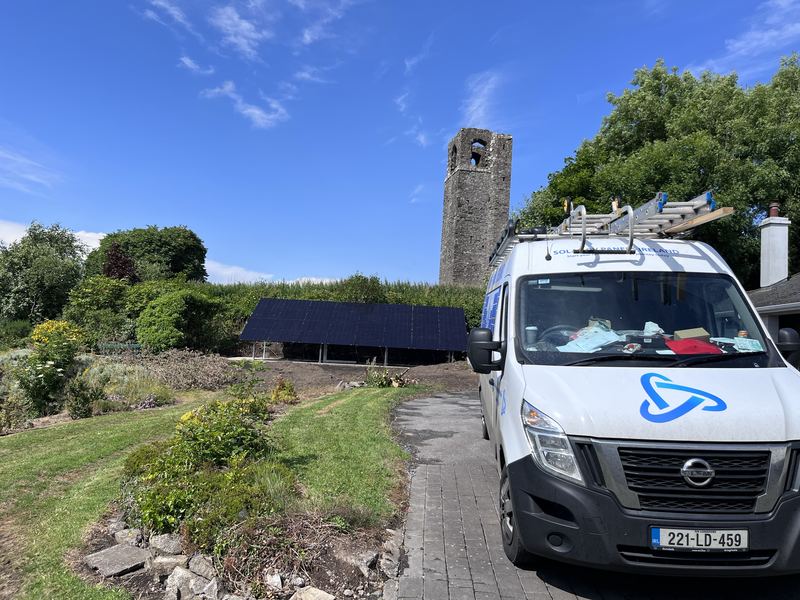
Tipperary offers the pairing we look for in a solar county: strong sunlight and ground that accepts a post without argument. The limestone soils of the Golden Vale around Cashel, Thurles and Tipperary Town run deep, uniform and well drained, which is why a driving rig can get through the foundations for a domestic array in a single morning.
Ground mounting also fits how this county farms. Large regular fields, decent machinery access, and dairy parlours drawing serious load in the middle of the day. Placing the array in the field beside the load, instead of on whatever roof happens to exist, tends to be the better engineering call and the better financial one.
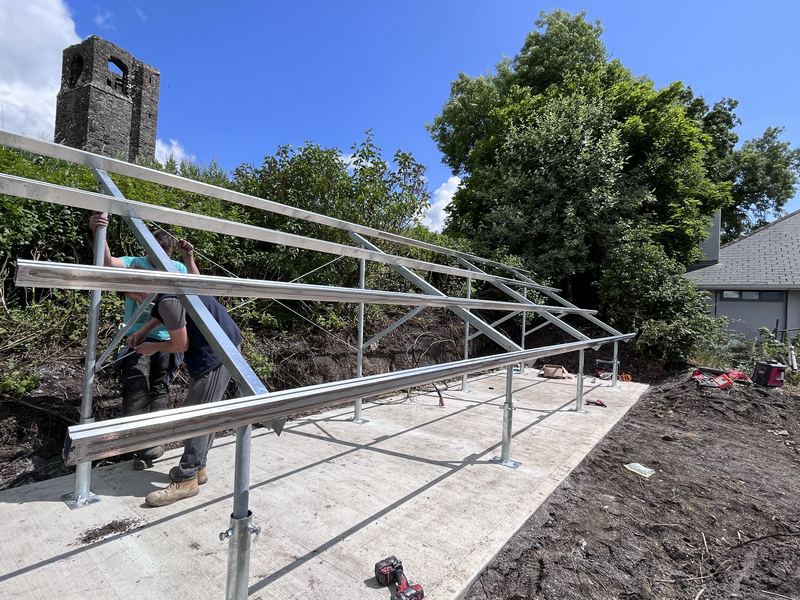
Why the field usually beats the farm roof here
Most Tipperary yards have plenty of roof. Very little of it is any use. Sheds get built to shelter stock and store fodder, so they end up long and low, running whatever way the yard entrance dictated, often with a shallow pitch and a ridge line that throws half the sheeting into the wrong aspect. Add purlin spacing that was never designed to carry panel loading and the roof conversation ends quickly.
A frame in the field takes none of that on. We set the tilt at 30 to 35 degrees, point it at true south, space the rows so they do not shade one another, and put the array within a short cable run of the parlour, the plate cooler or the grain dryer. On a milking platform outside Nenagh or a tillage yard near Roscrea, that proximity to load is what turns generated units into units you never bought.
Maintenance is the quiet advantage. Panels a metre off the ground get washed, inspected and swapped without a scaffold or a man on a slippery roof in January.
Foundations across the Golden Vale and the county's edges
The central limestone belt gives us some of the most predictable driving conditions in Munster. Deep, well-structured brown earths over limestone till mean galvanised steel piles go in fast, straight and to consistent resistance, with no concrete, no spoil and no curing time. A frame set on driven piles can be assembled the same week it is surveyed.
The edges of the county behave differently. On the Galtee and Knockmealdown slopes, and up around the Silvermines, soil cover thins and rock arrives sooner than people expect, which pushes us towards drilled rock anchors or a ballasted design. River ground along the Suir near Carrick-on-Suir can be soft and wet in winter, so we allow for a water table higher than the drilling day suggests.
The practical point is that we probe every site before we quote a foundation. Nobody enjoys a variation order halfway through an install, least of all us.
Tipperary's numbers, and how they compare
The county picks up roughly 1,035 kWh per square metre of horizontal irradiation in an average year, which is well into the upper part of the national spread. Translated into what you actually care about, a correctly oriented ground mount in Tipperary produces in the region of 950 kWh per kWp per year.
Irish ground-mounted systems generally fall between about 850 and 1,000 kWh per kWp, so this county sits comfortably in the top quarter of that band. It is not the very sunniest corner of Ireland, but it is close enough that the difference is small beside the difference between a good frame and a poor roof.
Panels in common use are 440 to 500 W each, so a 6 kWp array is around 13 or 14 panels and a 16 kWp farm array is roughly 35. Allow about 8 to 10 square metres of ground per kWp for a single row, and more where multiple rows have to be spaced, with a row pitch of about 2.5 times the array height as a reasonable planning figure.
Sizing, grants and TAMS III for Tipperary farms
Sizing starts with your consumption pattern rather than your roof area or your budget. A dairy farm with a plate cooler, vacuum pump and water heating running through the morning has a daytime base load that solar matches almost perfectly. A tillage yard with a dryer has a seasonal peak instead, which changes the answer.
Things we look at before proposing a size:
- half-hourly or bill-level consumption data across at least a full year
- whether the supply is single-phase or three-phase, and the existing main fuse rating
- daytime versus night-time split, and whether a battery would shift enough to be worth it
- planned additions such as an EV charger, a second parlour or extra cooling
On the money side, the SEAI grant applies to homes generally built and occupied before 2021, must be installed by an SEAI-registered company, and needs a post-works BER assessment. It is reviewed and stepped down periodically, so take the current rate from seai.ie. Eligible farmers can instead look to the Solar Capital Investment Scheme under TAMS III, which carries a 60 per cent grant rate under a separate investment ceiling. We confirm which route your property qualifies for before you commit.
Planning permission and Tipperary County Council
For a house, S.I. 493 of 2022 broadly exempts free-standing solar arrays within the curtilage from planning permission, so long as they respect the limits. Those limits generally include an aperture area cap of 25 square metres, a height limit of 2.5 metres, a prohibition on placing the array forward of the front wall of the house, and a restriction on how much private open space the array may take.
Different rules apply to protected structures, to properties inside an Architectural Conservation Area, and to sites within a solar safeguarding zone near an aerodrome. Given the number of protected buildings around Cashel and Clonmel, that is not a theoretical concern in this county. Confirm your own case with Tipperary County Council before anything is ordered, and we will supply the drawings and dimensions you need for that.
Farm arrays sited outside a house curtilage sit under separate classes with separate thresholds, so treat a yard installation as its own planning question.
Towns and areas we cover in Tipperary
We install right across the county, from Clonmel and Thurles out to Tipperary Town and every townland in between. There is no travel surcharge for being at the far end of the county.
Ground mounted solar in Tipperary: your questions
Is Tipperary a good county for solar?
It is one of the better ones. Annual horizontal irradiation runs near 1,035 kWh per square metre, and a properly oriented ground mount returns about 950 kWh per kWp per year. Against a national spread of roughly 850 to 1,000 kWh per kWp, that puts Tipperary in the top quarter of Irish counties for expected output.
How fast can you install on Golden Vale ground?
Faster than most places. The deep limestone till around Cashel, Thurles and Tipperary Town takes driven galvanised piles cleanly and to consistent resistance, so there is no concrete and no curing wait. For a typical domestic array the foundations are usually a morning's work, with the frame, panels and electrical work following over the next day or two.
Do I need planning permission for a ground mount in Tipperary?
Usually not for a house, provided the array stays inside the exempted development limits: 25 square metres of aperture, 2.5 metres height, nothing forward of the front wall, and only a limited share of your private open space. Protected structures and conservation areas are different. Check your specific site with Tipperary County Council first.
Can a dairy farm use most of what it generates?
Generally yes, and that is what makes the economics work. Milking, plate cooling, vacuum pumps and water heating all draw power during daylight, so a well-sized array feeds the load directly rather than exporting at a lower rate. We size against your actual consumption data instead of guessing from the shed dimensions.
What does TAMS III cover for solar?
The Solar Capital Investment Scheme under TAMS III offers eligible farmers a 60 per cent grant rate, with its own separate investment ceiling apart from other TAMS investments. Terms and application arrangements change, so we check current eligibility for your holding as part of the survey rather than assuming it. Homeowners follow the SEAI route instead.
How much ground does an array take up?
Allow roughly 8 to 10 square metres per kWp for a single row of panels, so a 6 kWp domestic array occupies a modest patch of a paddock. Multiple rows need spacing to avoid self-shading, and a row pitch of about 2.5 times the array height is a sensible planning assumption for a larger farm system.