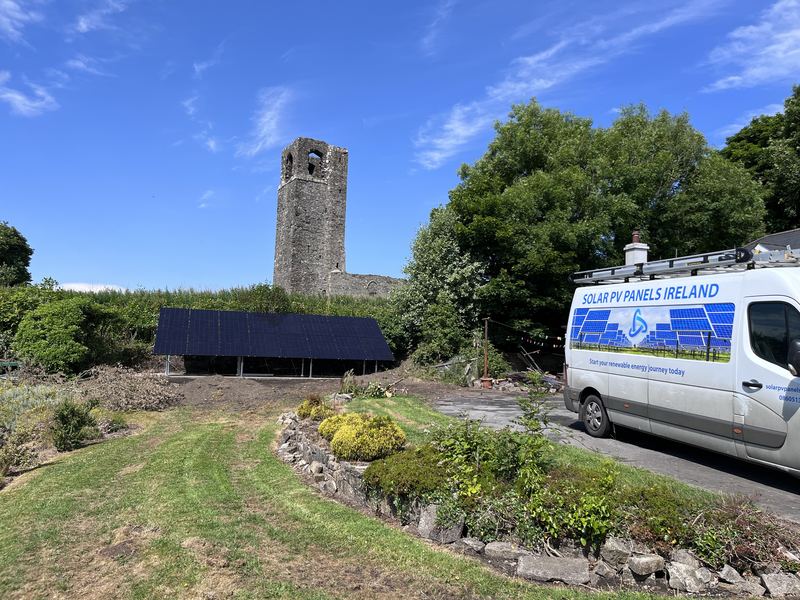
Between Drogheda and Dundalk there are thousands of houses on sites big enough for a solar array in the garden, plus a tilled inland plain with large regular fields. Both suit a ground mount. The frame goes where the sun is, at the pitch that generates most, instead of wherever the builder happened to point the roof.
Louth gets about 1,005 kWh per square metre of solar irradiation across a year, and an array here typically returns close to 935 kWh per kWp. That is towards the strong end of the Irish range of roughly 850 to 1,000 kWh per kWp, and it is one reason payback maths tends to look reasonable in this county.
Finding the space in Ireland's smallest county
Space is the first question we get asked in Louth, and it is usually a smaller problem than people fear. As a planning figure, 8 to 10 square metres of ground per kWp covers a single row, so a 6 kWp array of 13 or 14 panels fits into a corner most rural gardens can spare.
Where two rows are needed, spacing of roughly 2.5 times the array height keeps the back row out of the front row's winter shadow. That is the calculation that decides whether a site takes 6 kWp or 12 kWp, and it is done at survey with a proper shading assessment rather than estimated from a satellite image.
On tilled land around Ardee and Dunleer the constraint disappears entirely. Field sizes there allow the array to sit clear of machinery runs and headlands, which keeps both the farming and the solar straightforward.
Boulder clay, Cooley granite and estuarine silt
The central Louth plain is firm boulder clay over limestone, which is excellent driven pile ground. Posts go to depth predictably, resistance holds along a row, and the frame can be built as soon as the last post is in. Much of the county between Dundalk and Drogheda behaves this way.
The Cooley peninsula is a different proposition. Granite with shallow soil cover often means drilling and resin anchoring instead of driving, and sites there catch Irish Sea gusts funnelling down Carlingford Lough. We uprate the frame for those addresses rather than applying a county wide default. Near the Boyne and Castletown rivers, estuarine silts call for their own approach again.
Foundation choices across the county:
- Driven piles through boulder clay on the central plain
- Rock anchors into shallow granite around Carlingford and Cooley
- Ballast or spread footings on soft estuarine silt
- Uprated frames and fixings on exposed coastal sites
Planning permission and Louth County Council
S.I. 493 of 2022 broadly took domestic ground mounts out of the planning process, within limits. For a house those limits are an aperture area of 25 square metres, a maximum height of 2.5 metres, a position behind the front wall of the dwelling, and a restriction on how much private open space the array may occupy.
Suburban gardens in Drogheda, Blackrock and Dundalk are where the open space test bites hardest, because it is proportional. A large array on a small garden can breach it even when everything else complies, which is worth establishing before any deposit changes hands.
Louth County Council is the planning authority for the whole county, including both main towns. Protected structures and Architectural Conservation Areas, of which Carlingford and parts of Drogheda have their share, are dealt with under different provisions, and solar safeguarding zones near aerodromes carry additional requirements. Confirm your own position with the council first.
Output, grants and payment for exported units
Panels of 440 to 500 W are the standard product, so system sizes move in useful steps, and at roughly 935 kWh per kWp a 6 kWp array in Louth should produce somewhere near 5,600 kWh a year. A ground mount typically beats the same panels on a compromised roof by 10 to 25 per cent, which is where that advantage comes from.
Grant values under the SEAI scheme are reviewed and stepped down from time to time, so check seai.ie for what applies on the day. In general the home must have been built and occupied before 2021, the work must be done by an SEAI registered company, and a post works BER assessment is required. We verify that a ground mounted system qualifies at your property before you commit.
Tillage and mixed farms may qualify under TAMS III instead, where the Solar Capital Investment Scheme carries a 60 per cent grant rate within its own ceiling. Exported units are paid for under the Clean Export Guarantee, at rates that differ by supplier and change.
How we work through a Louth installation
The survey comes first: probing the ground, measuring the horizon for shading, checking the cable run to the consumer unit and agreeing exactly where the array will sit. Coastal and Cooley sites also get a wind loading assessment at that stage, because the frame specification depends on it.
Build is typically two or three days for a domestic system. Foundations go in, the frame is assembled and levelled, panels are mounted and cabled, then the inverter is connected, tested and commissioned with monitoring set up before we leave.
Paperwork is handled by us. Micro generation up to 6 kW single phase or 11 kW three phase goes to ESB Networks on an NC6 notification, which typically takes a few weeks, while larger systems need a full connection application. Grant documentation and the BER appointment are organised in the same sequence so nothing stalls after the array is producing.
Towns and areas we cover in Louth
We install right across the county, from Dundalk and Drogheda out to Blackrock and every townland in between. There is no travel surcharge for being at the far end of the county.
Ground mounted solar in Louth: your questions
How much space does a ground mounted array need in Louth?
Roughly 8 to 10 square metres per kWp for a single row, so about 50 to 60 square metres for a 6 kWp system with working space around it. A second row needs separation of around 2.5 times the array height. Many suburban gardens between Drogheda and Dundalk manage this comfortably at the back of the plot.
Are Cooley and Carlingford sites more difficult?
They need more engineering. Shallow granite often means rock anchors rather than driven piles, and gusts funnelling down Carlingford Lough push the wind loading well above the county norm. We uprate the frame and fixings for those postcodes and specify higher grade galvanising because of salt in the air. It is entirely workable, just not a default design.
What will an array generate here each year?
Expect around 935 kWh per kWp annually from a frame at correct pitch and true south, which puts a 6 kWp system near 5,600 kWh. County irradiation runs at about 1,005 kWh per square metre, placing Louth in the stronger part of the Irish 850 to 1,000 kWh per kWp band. Trees and hedgerows to the south are the usual limiting factor.
Will I need planning permission from Louth County Council?
Often not, but the private open space test catches people out on smaller urban gardens. Provided the array stays under 25 square metres of aperture area, under 2.5 metres high, behind the front wall of the house and within the open space allowance, it is broadly exempt. Confirm with Louth County Council before ordering, particularly in conservation areas.
How long does the grid connection take?
For micro generation up to 6 kW single phase or 11 kW three phase, an NC6 notification goes to ESB Networks and the process typically takes a few weeks. We submit it on your behalf. Systems above those thresholds require a full connection application, which takes longer, so it is started early in the project.
Can the array be moved or removed later?
Yes, more easily than a roof system. Ground screw foundations are designed to be wound out and the ground reinstated, and ballasted frames are simply lifted. Driven piles can be extracted with the right equipment. That flexibility matters if you may reconfigure a yard or sell land at some future point.