The first question we get on a site visit in Longford, Roscommon or Cavan is rarely about panels. It is about ground. How much of the paddock, the lawn or the corner of the silage field is this going to take, and will it be in the way of everything else.
The honest answer depends on how many rows you need, how you plan to cut the grass around it, and how far the array sits from the board. But there are working figures we use every day, and they get you close enough to walk the site with a tape and know whether it fits.
Key takeaways
- Allow roughly 8 to 10 square metres of ground per kWp where the array fits in a single row.
- Multiple rows need a pitch of about 2.5 times array height, closer to 15 to 20 square metres per kWp.
- Leave 3 to 4 metres of clear ground on one long side for mowing, topping or grazing access.
- Keep 2 to 3 metres back from hedges and ditches, and stay clear of ESB Networks overhead lines.
- Trench length from array to board drives cable size and cost, so walk the route before choosing a spot.
The short answer: 8 to 10 square metres per kWp
For a single row of panels, allow roughly 8 to 10 square metres of ground per kWp installed. That figure already includes the frame footprint and a modest working margin around it, so treat it as a planning number rather than the bare panel area.
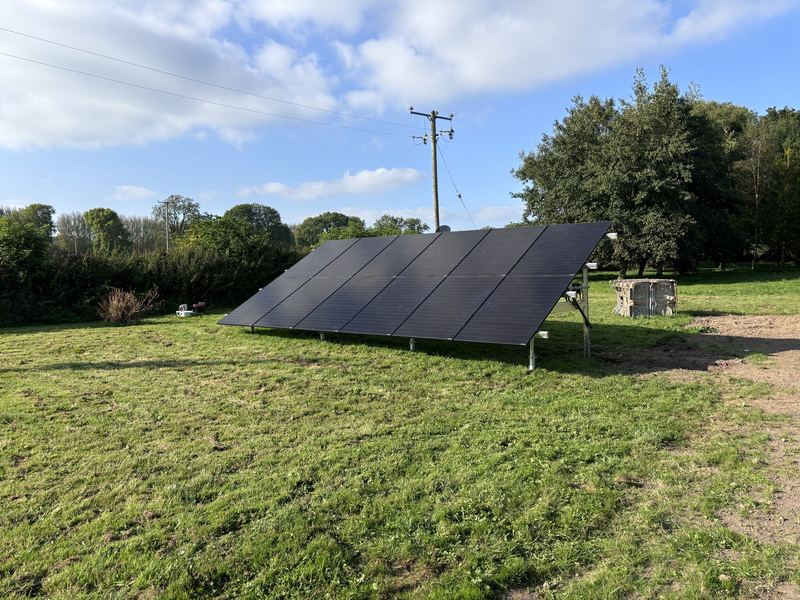
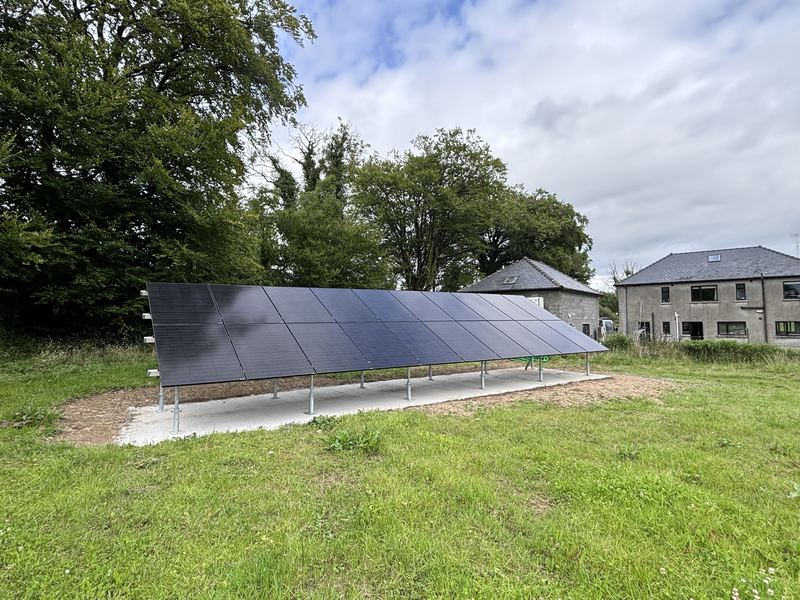
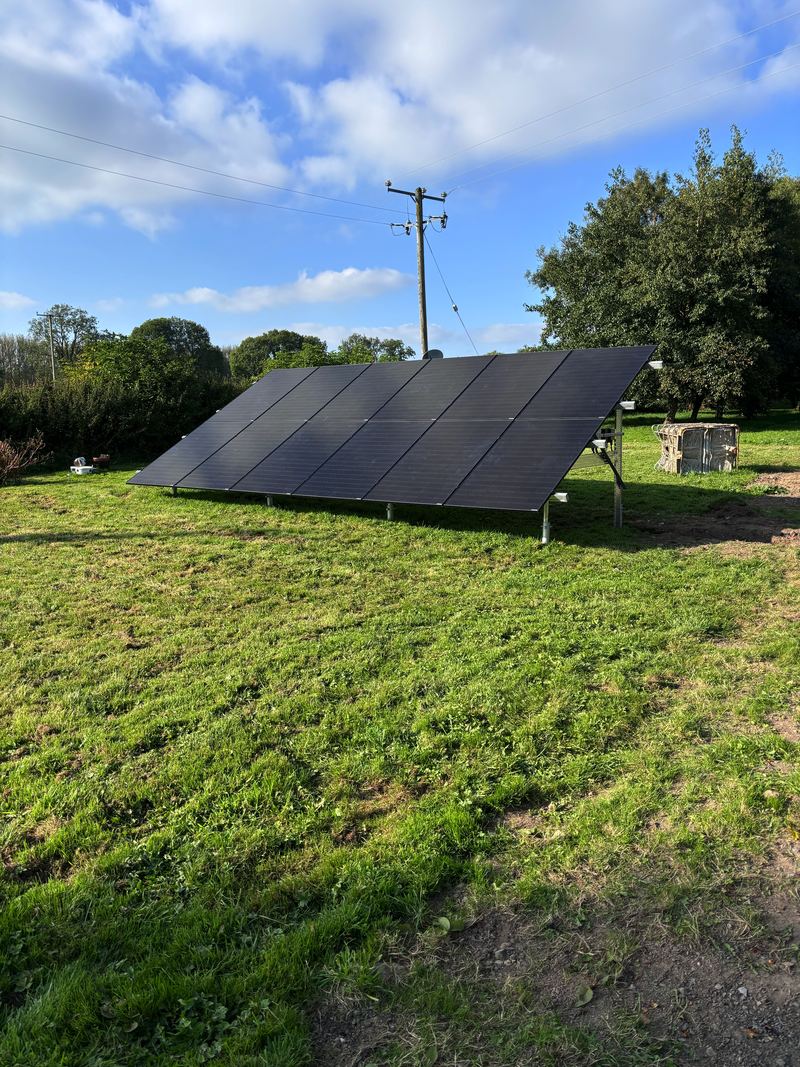
Panels in common use are 440 to 500 W, so a 6 kWp array is about 13 or 14 panels. Set in one row at 30 to 35 degrees, that occupies somewhere around 50 to 60 square metres, or a strip roughly 25 metres long and 2.5 metres deep.
A 30 kWp farm array on the same basis wants somewhere in the region of 240 to 300 square metres if it can be kept to one or two rows. That is a strip along a hedge, not a field.
Treat these as opening figures. The moment you need a second and a third row, the land requirement climbs faster than the kWp does.
Note what the figure does not include. It leaves out the access strip for a mower, the setback from the hedge, the route of the trench and any space you want to keep for a future extension of the array. Those are separate allowances and we deal with each of them below.
Why a second row changes the maths
Panels shade each other. In an Irish winter the sun sits low, and a row of panels standing over two metres tall will throw a long shadow across the row behind it around the middle of December.
The planning figure we use is a row pitch of roughly 2.5 times the array height, measured from the front of one row to the front of the next. On a frame standing about 2.2 metres at the back, that is a pitch of around 5 to 5.5 metres.
Once that pitch is applied, ground per kWp rises to something closer to 15 to 20 square metres for a multi-row layout. A 50 kWp array in four rows can easily want 800 to 1,000 square metres.
You can tighten the pitch and accept some winter shading, or drop the tilt and lower the array to shorten the shadow. Both are trade-offs, both cost yield, and we model them before anything is marked out.
Access for mowing, topping and grazing
Grass grows. An array sitting 300 mm off the ground with no way to get a mower under it becomes a nettle bed inside two summers, and shaded bottom cells drag the whole string down with them.
We normally leave at least 3 to 4 metres of clear ground along one long side so a compact tractor, a ride-on or a quad with a topper can turn. On a farm that is often the difference between the array being maintained and the array being resented.
Raising the leading edge to around 800 mm or a metre lets sheep graze underneath, which is the lowest maintenance answer on a drystock farm in Leitrim or Mayo. It also lifts the whole array, which lengthens the shadow, which pushes the row pitch out again.
Poultry are no trouble under a frame. Horses and cattle are, they will use the legs as a scratching post and pull at cable, so fence them out.
Setbacks from boundaries, ditches and overhead lines
Do not plan to the boundary line. A drainage ditch has to be cleaned, a hedge has to be cut back on rotation, and neither happens if panels sit tight against it.
We keep a minimum of 2 to 3 metres back from a hedge or ditch, and more where the hedge is mature enough to shade the array morning or evening. Every metre of hedge shadow costs generation for the life of the system.
Overhead lines matter more. Where an ESB Networks line crosses the site, the array, the frame and the plant used to install it all have to stay clear of it by the distances ESB Networks specify. That is a safety matter rather than a preference, and it gets checked before anything is driven into the ground.
Inside the curtilage of a house, the 2022 exempted development regulations broadly cap the aperture area at 25 square metres for houses, cap height at 2.5 metres, keep the array behind the front wall of the house and limit how much private open space it may take. Confirm the detail with your own council, whether that is Longford County Council or Cork County Council, before ordering anything.
The trench from the array back to the board
The array is only half the layout. Cable has to get back to the consumer unit, the switch room or the dairy board, and that route needs walking before you settle on a location.
A trench is normally 450 to 600 mm deep on a domestic run and deeper where it crosses a farm roadway or a field that carries heavy machinery. It needs the right ducting, warning tape and a clean reinstatement.
Every metre of trench is time, and every metre also adds cable. Over long runs the conductor has to be sized up to hold voltage drop within limits, so a 60 metre run and a 160 metre run are not the same job at all.
Where we can, we site the array so the run avoids the yard, the percolation area of the septic tank, the water main and the slurry pipe. A morning spent with a site plan and a spade saves a bad afternoon later.
Allow a working corridor of two to three metres along the trench line as well. The digger needs somewhere to put spoil and somewhere to track, and on a tight garden in a village like Ballymahon that corridor is often the real constraint rather than the array footprint itself.
How slope and orientation change the answer
A south facing slope is a gift. Rows can sit closer together because the ground itself falls away from each row, so the shadow lands lower down the slope and the pitch can be tightened.
A north facing slope does the opposite. Rows have to be pushed further apart to clear each other, and the array wants more ground for the same kWp. On a steep north face we usually move the array rather than fight it.
Orientation is the other half. A ground mount can be set true south at 30 to 35 degrees, which is where the Irish figures of roughly 850 to 1,000 kWh per kWp per year come from. That optimum pitch is typically worth 10 to 25 per cent more than the same panels on a compromised roof.
East and west facing ground still works. It flattens the generation curve across the day, which suits a dairy with a morning and an evening milking, but it needs more panels to reach the same annual figure.
A 6 kWp garden array versus a 30 to 50 kWp farm array
These are different jobs. A 6 kWp domestic array in a garden outside Athlone is a single row, one trench, one inverter, and a footprint you can lose behind a hedge if it is planned properly.
A 30 to 50 kWp farm array is a groundworks project. Several rows, a longer trench, three-phase, most likely a full connection application to ESB Networks, and a real conversation about where machinery will go for the next twenty years.
The land figures follow the same logic but the practical problem differs. Domestic customers usually have space in principle and a shortage of unshaded space in practice. Farmers usually have plenty of unshaded ground and a shortage of ground that is not already doing something.
On a farm the best sites are often the awkward ones. The corner that holds water slightly, the headland the sprayer never covers properly, the strip beside the old silage pit.
Where a farm array ends and a solar farm begins
None of the above is a solar farm. A solar farm is a commercial development measured in hectares and megawatts, built to export into the network and consented through a full planning application with environmental screening.
The arrays described here sit behind the meter. They are sized to what the house or the farm actually uses, they connect through your own board, and export is incidental rather than the point of the exercise.
In practice the change happens somewhere above the tens of kilowatts, and it is driven by the connection rather than by acreage. Once a system is past micro-generation thresholds, ESB Networks treats it as a full connection application and the planning position needs checking with the local authority.
If somebody offers to lease a field for solar, that is a different transaction with a different set of questions attached. Do not confuse it with putting 30 kWp beside the yard to cut your own bill.
Frequently asked questions
How much land does a 6 kWp ground mounted array need?
Around 50 to 60 square metres for a single row, which is a strip roughly 25 metres long by 2.5 metres deep. That covers 13 or 14 panels at 440 to 500 W each, the frame footprint and a small working margin. Add mowing access along one side and a setback from the hedge and the real requirement grows a little beyond that.
Can I graze sheep under a ground mounted array?
Yes, and it is the lowest maintenance option on a drystock farm. Raise the leading edge to roughly 800 mm or a metre so sheep can move underneath, and protect the cable runs and any exposed conduit. Cattle and horses are a different question, they lean on frames and chew cable, so they should be fenced out rather than allowed in.
Does a ground mounted array need planning permission?
Within the curtilage of a house, the 2022 exempted development regulations broadly allow free-standing arrays subject to limits on aperture area, height, position relative to the front wall of the house and the share of private open space used. Protected structures, Architectural Conservation Areas and solar safeguarding zones near aerodromes are treated differently. Confirm your own position with the local council before ordering.
How far from the house can the array be?
Technically quite far, practically it is a cost question. Every extra metre is trench, duct, cable and reinstatement, and long runs need larger conductors to hold voltage drop within limits. Runs of 30 to 60 metres are routine and barely change the design. Beyond about 100 metres the cabling strategy and the inverter location need proper design work rather than a rule of thumb.
Is a 50 kWp farm array the same as a solar farm?
No. A 50 kWp array is a behind the meter system sized to offset the farm's own consumption, typically occupying under a quarter of an acre. A solar farm is a commercial generating development measured in hectares and megawatts, built to export, and consented through a full planning application. The two are different in scale, purpose, grid treatment and planning route.