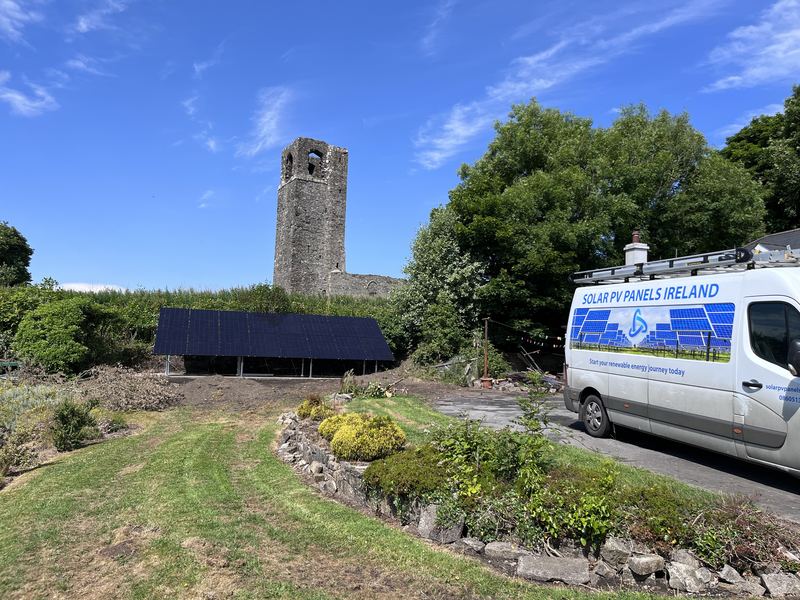
Monaghan sees roughly 955 kWh per square metre of irradiance in a normal year, which works out at about 890 kWh per kWp from a ground-mounted array. That is mid-table against the Irish range of about 850 to 1,000 kWh per kWp. The reason solar stacks up so well in this county has less to do with irradiance and more to do with when the electricity is used.
Poultry houses and mushroom units run fans, lighting, chillers and pumps right through the working day. Land sits immediately beside the load, three-phase supply is common, and the shed roofs are usually spoken for. That combination is hard to beat anywhere in Ireland.
Matching an array to a poultry or mushroom load
The economics of solar turn on self-consumption. Every unit used as it is generated is worth far more than a unit exported, and that is precisely why intensive units around Ballybay and Castleblayney do so well out of a ground-mounted system. The demand curve and the generation curve line up.
Typical daytime loads on a Monaghan farm include:
- Ventilation fans running continuously through the growing cycle.
- Lighting programmes in poultry houses.
- Chillers and cold rooms on mushroom units.
- Water heating, washdown and pressure pumps.
- Packing, grading and conveyor plant.
We start from your bills and your half-hourly data if you have it, not from a panel count. Sizing the array to the base load, then deciding separately whether a battery earns its keep, gives a far better answer than picking a round number of kilowatts.
Drumlin crowns, wet hollows and where the frame goes
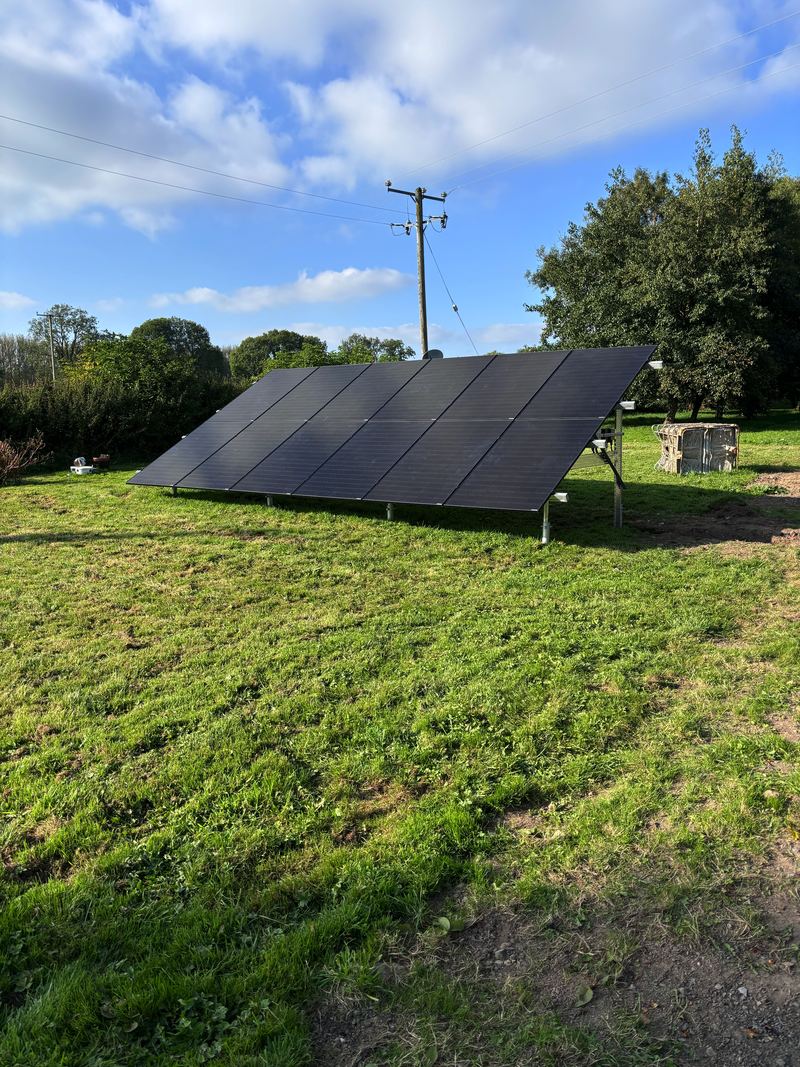
Monaghan is drumlin country. Stiff boulder clay over shale makes up the hills themselves, and the hollows between them are peaty, wet and slow to drain. The crowns drive well, so a pile rig makes short work of a row on the right ground. The hollows we design out at layout stage instead of trying to engineer around them.
Aspect follows from that. A drumlin flank facing south is a genuine advantage, and one facing north is a penalty no panel choice will recover, so site selection is the single biggest lever on annual output here. The water table is the other thing we allow for, since a dry hole in July says very little about the same hole in January.
Row spacing gets a second look on sloping ground. Rows set across a south-facing flank can sit tighter without shading one another, while on the flat we allow the full pitch of roughly 2.5 times the array height. Fencing finishes the job, because stock and machinery move through most of these fields.
Why the field beats the shed roof here
Farm buildings in this county are working hard already. Poultry and mushroom sheds carry insulation, ventilation plant and services, and many were never designed with an extra load on the purlins in mind. Adding panels can mean structural work before a single module goes up. A ground frame sidesteps the survey, the strengthening and the roof penetrations.
There is a performance argument as well. A frame pitched between 30 and 35 degrees and squared to true south normally returns 10 to 25 per cent more than the same modules on a roof with the wrong slope or bearing. Cleaning and fault-finding are easier at ground level too, which matters on a site where downtime costs money and nobody wants a contractor up on a shed roof.
Planning permission and Monaghan County Council
For dwellings, exempted development under S.I. 493 of 2022 broadly permits a free-standing array within the curtilage without planning permission, subject to limits of 25 square metres aperture area, 2.5 metres height, nothing forward of the front wall and a cap on the private open space used. Confirm your own layout with Monaghan County Council before committing to a frame size.
Farm arrays are a different conversation. Anything sited out in a field, or beyond the exemption thresholds, is normally a planning application, and a unit near Clones or Carrickmacross with a sizeable array should budget time for that. Protected structures and Architectural Conservation Areas carry their own rules, so check the status of the building before assuming an exemption applies.
From survey to switch-on
We start with a site visit: probing on the drumlin crown where the array will sit, a look at the supply and switchgear, and a cable route from the array to the distribution board. On a farm we also ask what else is planned for the yard, because a trench opened once is cheaper than a trench opened twice.
Foundations, frame, panels, cabling and inverter follow in that order, with commissioning and handover at the end. Grid notification for micro-generation is an ESB Networks NC6 up to 6 kW single-phase or 11 kW three-phase. Larger three-phase farm systems, which is most of what we build around Monaghan Town, need a full connection application, and that typically takes a few weeks.
On the money side, TAMS III includes a Solar Capital Investment Scheme with a 60 per cent grant rate for eligible farmers under a separate investment ceiling, while homeowners should check the current SEAI grant position on seai.ie, since the value is reviewed and stepped down periodically. As a rule the house must have been built and occupied before 2021, the installer has to be SEAI-registered, and a BER assessment follows the work. Whatever leaves the site is paid for under the Clean Export Guarantee, at a rate that depends on the supplier, and that income falls under a micro-generation tax exemption.
Towns and areas we cover in Monaghan
We install right across the county, from Monaghan Town and Carrickmacross out to Ballybay and every townland in between. There is no travel surcharge for being at the far end of the county.
Ground mounted solar in Monaghan: your questions
What will an array actually produce in Monaghan?
Expect in the region of 890 kWh per kWp per year, from irradiance of about 955 kWh per square metre. That is squarely mid-table for Ireland, where county figures run from roughly 850 up to 1,000 kWh per kWp. On a farm the more useful figure is how much of that output you consume directly rather than export.
Will a poultry unit use everything the array makes?
Often close to it during daylight. Fans, lights, chillers and pumps give a near-constant daytime draw, so a correctly sized array on a Monaghan poultry or mushroom unit tends to be consumed on site rather than exported. That is the whole point of sizing from your consumption data instead of from the space available in the field.
Can you build on the wet ground between drumlins?
We would rather not, and usually we do not have to. The inter-drumlin hollows are peaty and hold water, so the array goes on the crown or the flank where boulder clay gives solid driving. Where a hollow cannot be avoided, longer screws or a ballasted frame handle it, but the layout is the cheaper fix.
Do I need planning permission from Monaghan County Council?
A house array inside the curtilage is broadly exempt if it respects the aperture area, height, front wall and open space limits. Farm arrays out in a field generally are not exempt and need an application to Monaghan County Council. Check before ordering, especially if the building is protected or sits inside a conservation area.
What grant support is there for a farm system?
TAMS III includes the Solar Capital Investment Scheme, which offers a 60 per cent grant rate to eligible farmers under its own investment ceiling. The scheme rules and application windows change, so confirm the current position before you plan around it. Homeowners follow the SEAI route instead, with current values published on seai.ie.
Does three-phase supply change the design?
It does, and most intensive units in this county already have it. Three-phase allows a larger inverter, better load balancing across the site and micro-generation notification up to 11 kW rather than 6 kW. Above that threshold a full connection application to ESB Networks is needed, which is normal for farm-scale arrays here.