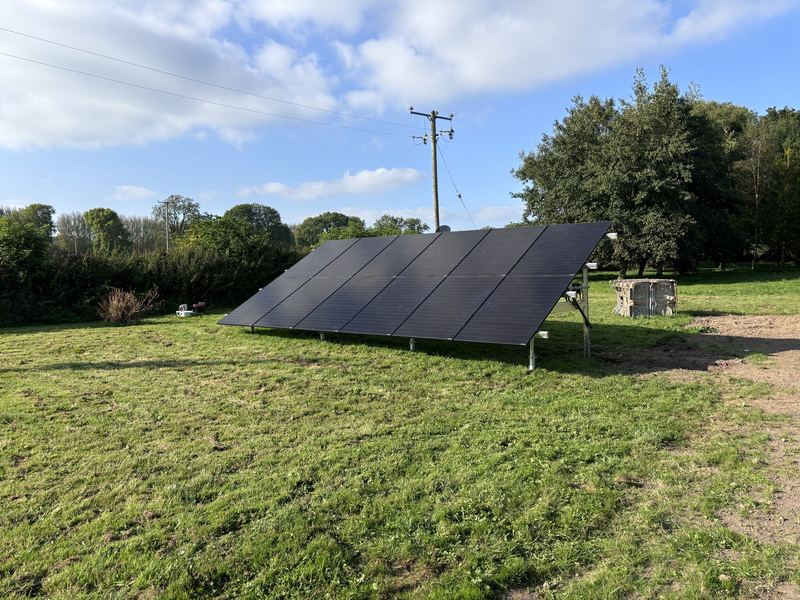
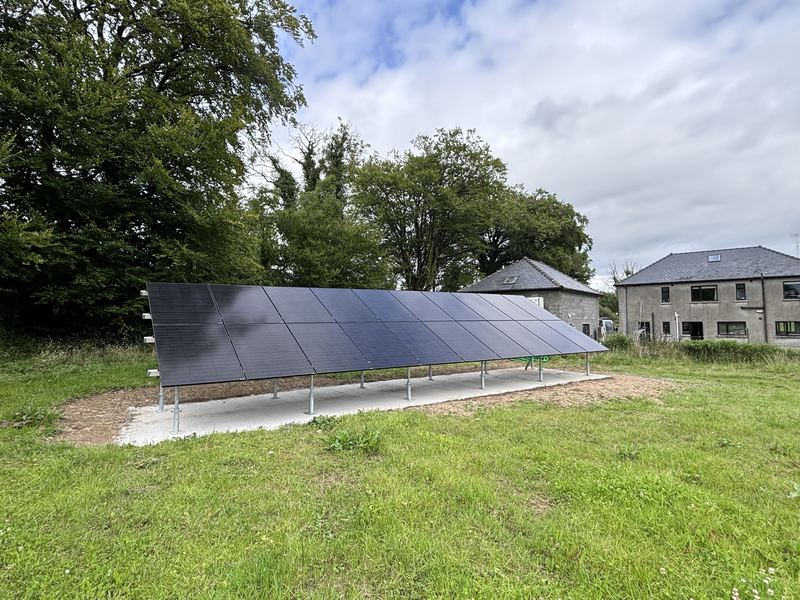
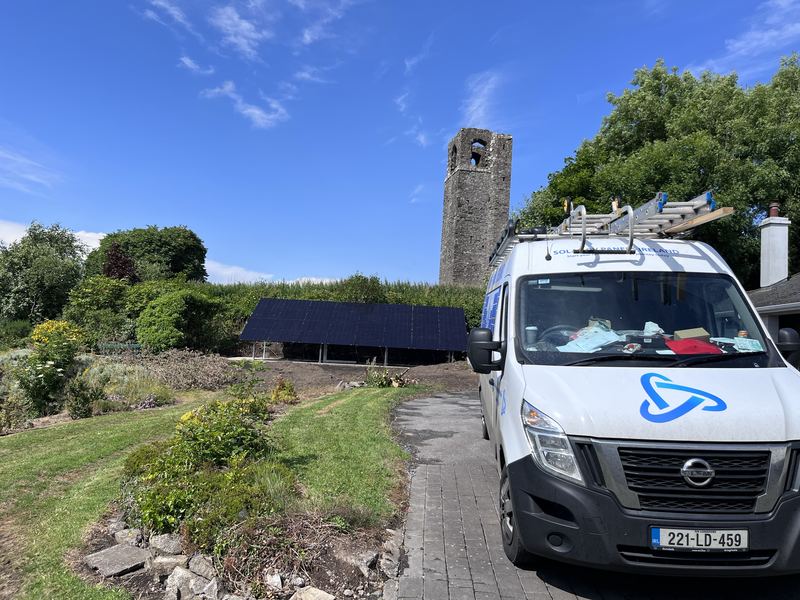
Few counties give an installer as easy a run as Kilkenny. The brown earths over limestone through the Nore and Barrow valleys are deep, fertile and firm, which makes for some of the cleanest pile driving anywhere in the country. Fields are big and regular, machinery access is good, and irradiance is near the top of the Irish table.
The catch, when there is one, grows above ground. Mature ash and beech along a southern boundary will take hours of winter generation off an otherwise perfect array. We survey the horizon and the hedgerow line before we agree a position, because moving a frame twenty metres is free at design stage and expensive afterwards.
Yield figures for a Kilkenny array
Roughly 1,040 kWh of energy lands on each square metre of Kilkenny over a year, which places the county among the sunnier parts of Ireland. From a frame pitched at 30 to 35 degrees and facing true south, expect in the order of 955 kWh per kWp per year. Arrays nationally fall in a band starting near 850 and topping out around 1,000 per kWp, so Kilkenny sits well into the upper quartile.
Those numbers only hold if the array sees the sky. Twenty per cent of a winter afternoon disappears behind a single mature beech, and no amount of panel quality compensates for it. Shading assessment is the part of a Kilkenny survey we spend the most time on, and it regularly changes where the frame ends up sitting in a field.
Trees, hedgerows and the case against the roof
A farmhouse roof in Kilkenny is often shaded by the same trees that shelter the yard, and it faces whatever direction the original house was built to. Split slopes, chimneys and later extensions cut up the usable area further. Panels end up on the only available plane rather than the best one.
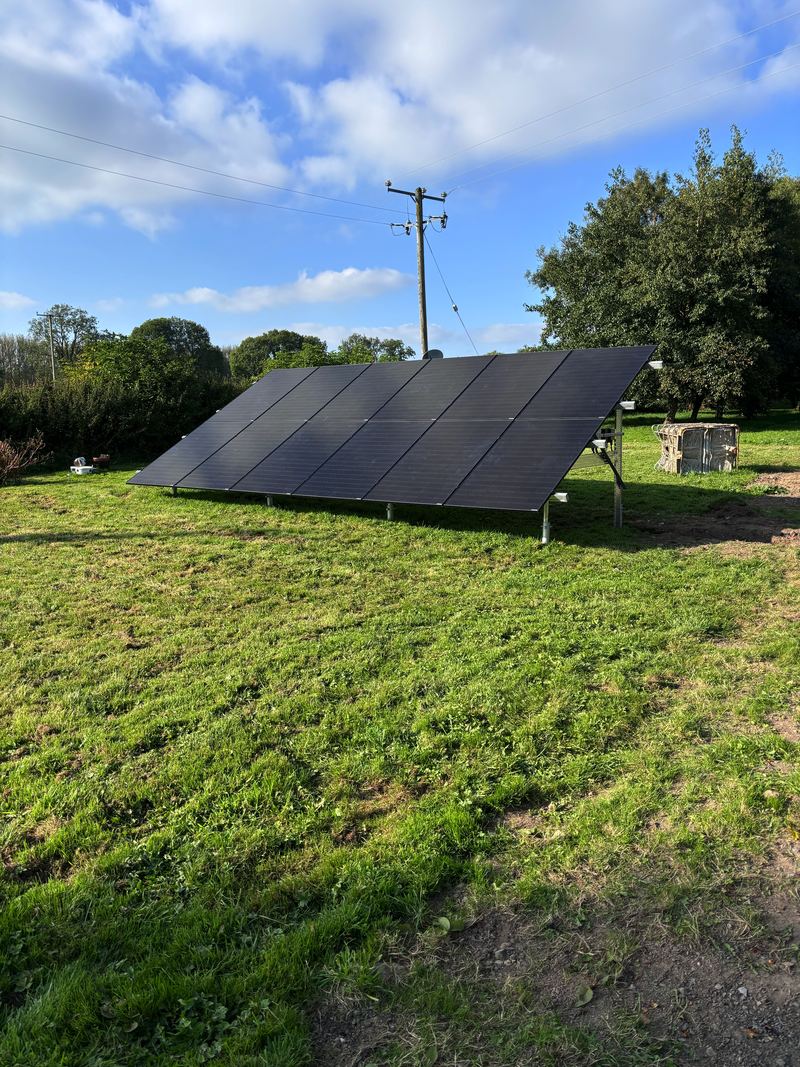
A frame in a field can be positioned precisely where the shading study says it should go. That gets you optimum pitch, true south, and a lift of anywhere from 10 to 25 per cent against the same modules fixed to a poor roof plane. It also leaves the roof alone, which matters where slates are old or where a shed is already carrying as much as it should. On dairy holdings around Callan and Ballyragget, siting the array close to the parlour keeps generation feeding cooling and water heating directly.
Hedgerow shading is worth raising with a neighbour early if the offending line sits on a boundary you do not own. In most cases moving the array up the field is simpler than negotiating over trees, and at design stage it costs nothing at all.
Ground conditions in the valleys and up on the plateau
Through the lowland belt from Thomastown to Graiguenamanagh and out around Kilkenny City, the soils are deep and consistent over limestone. Driven piles are the obvious answer: fast, no concrete, no spoil and a frame standing plumb the same afternoon. Reinstatement is minimal because nothing is excavated.
North of the city the Castlecomer plateau is a different proposition, with shale and thinner cover where rock can appear close to the surface. There we plan for alternatives before the rig travels:
- Driven piles where cover is deep enough through the Nore and Barrow valleys
- Resin-fixed rock anchors where shale or limestone sits shallow on the plateau
- Ground screws for mixed ground, or where the frame may need to come out again
- Ballast on made ground, or anywhere nothing should be penetrated
Rock does not rule a site out. Anchors drilled and resin-fixed into sound stone give a very rigid foundation, arguably stiffer than a pile in soft ground. It takes longer on the day and it costs more, which is precisely why probing happens before a quote goes out.
Kilkenny County Council and the planning position
Kilkenny County Council handles planning for the whole county, city included. Most domestic ground-mounted arrays need no application at all, since the 2022 regulations treat free-standing solar beside a house as exempted development once a set of conditions is respected.
Those conditions come down to four things: aperture area, overall height, position relative to the front wall of the house, and the share of private open space used. For a dwelling the first two figures are 25 square metres and 2.5 metres. Protected structures and Architectural Conservation Areas, which are a live issue in the medieval core of Kilkenny City and in parts of Thomastown, are handled differently. Solar safeguarding zones near aerodromes carry their own rules. Confirm your position with the council before ordering.
Sizing, grants and getting paid for exports
Work out the size from daytime demand rather than the annual bill. Allow between eight and ten square metres of ground for every kWp installed in one line, more where rows need spacing at about 2.5 times the array height. With 440 to 500 W panels, a 6 kWp domestic system is thirteen or fourteen modules, while a milking parlour or a grain operation usually warrants a good deal more.
Homeowners should have eligibility for the SEAI grant confirmed for their own property before committing. In general terms that means occupation before 2021, registration on the SEAI list for whoever does the install, and a BER assessment once the system is running. Because the scheme steps down from time to time, treat any figure you hear locally as out of date and check seai.ie. On the farm side, TAMS III offers the Solar Capital Investment Scheme at a 60 per cent rate with its own ceiling. Exported units are paid for under the Clean Export Guarantee at supplier-specific rates.
ESB Networks handles small systems on an NC6 notification, the threshold being 6 kW on a single-phase supply and 11 kW on three-phase. Larger arrays, which most parlours end up wanting, go through a full connection application with a longer lead time, typically by a few weeks. We submit the paperwork and arrange export metering once the system is commissioned.
Towns and areas we cover in Kilkenny
We install right across the county, from Kilkenny City and Callan out to Ballyragget and every townland in between. There is no travel surcharge for being at the far end of the county.
Ground mounted solar in Kilkenny: your questions
Will the trees on my southern boundary ruin the array?
Not necessarily, but they decide where it goes. A line of mature ash or beech is the most common constraint on Kilkenny sites, and it costs most in winter when the sun is low. We model the horizon during the survey and site the frame clear of the shadow path, which often means moving it well up the field.
How good is the ground for driven piles here?
Through the Nore and Barrow valleys it is about as good as Ireland offers. Deep brown earths over limestone give consistent resistance, so posts drive quickly and hold well without concrete. Up on the Castlecomer plateau the picture changes, with shale and thin cover often calling for rock anchors instead.
Do I need planning permission in Kilkenny?
Generally no for a domestic array within the curtilage of a house, provided it stays inside the exempted development limits on aperture area, height, position relative to the front wall and private open space. Kilkenny County Council is the authority to confirm with, and protected structures in the city centre are treated separately.
How much electricity should I expect each year?
Around 955 kWh per kWp annually from a south-facing array at optimum tilt, which is near the top end of what Irish ground mounts deliver, a band running from about 850 to 1,000. The county receives about 1,040 kWh per square metre a year. Actual output depends on shading, so a clear southern aspect is what protects that figure.
I milk cows near Callan. Is there farm grant support?
The Solar Capital Investment Scheme within TAMS III runs at a 60 per cent rate for farmers who qualify, with a separate ceiling on investment. It suits dairy well, because milk cooling, plate cooling and water heating draw power through the middle of the day when a ground-mounted array is producing most.
Can I add a battery later on?
Yes, and it is worth sizing the inverter with that in mind at the start. A battery shifts midday generation into the evening, which suits households out at work all day. We fit Sigenergy among other systems. Whatever is not stored or used still exports and is paid for under the Clean Export Guarantee.