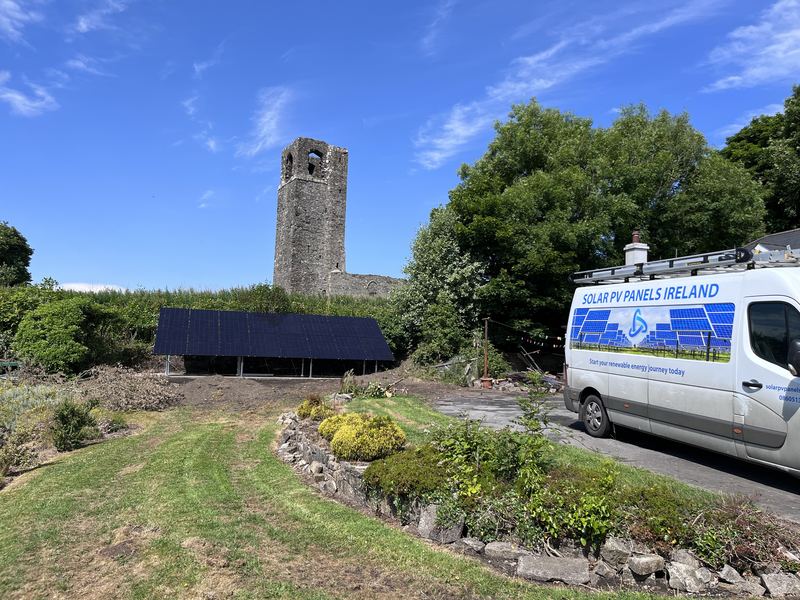
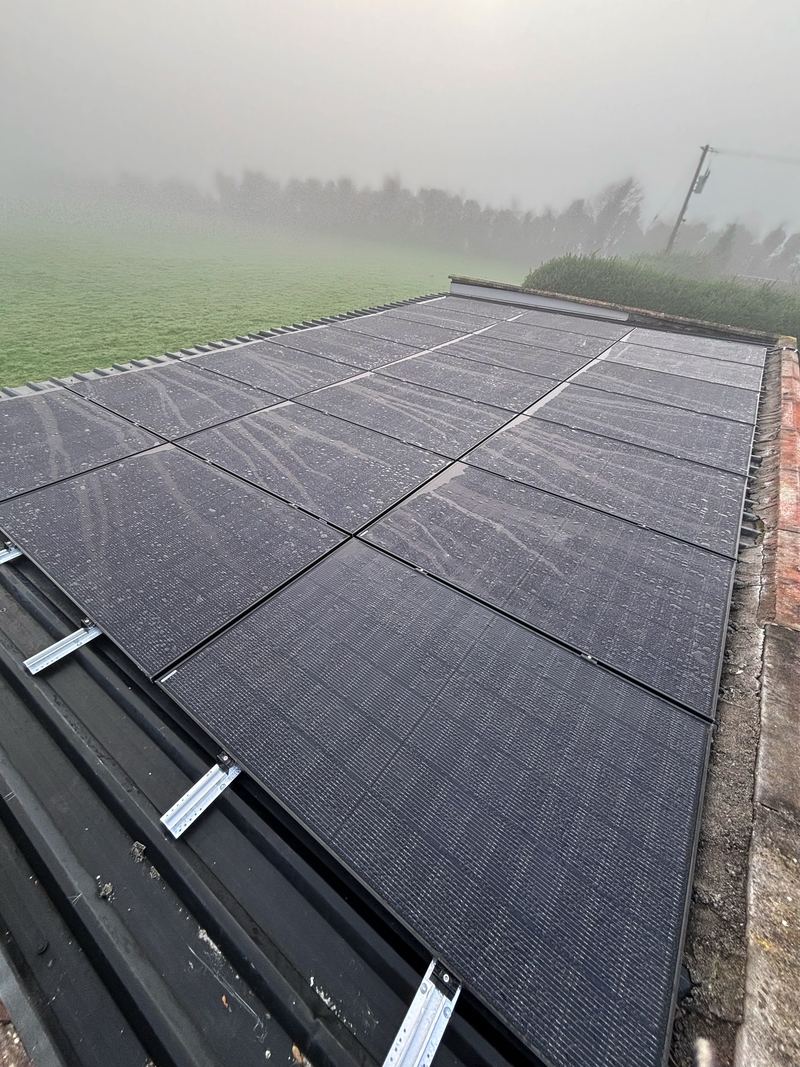
Plenty of Leitrim holdings have a shed roof pointing the wrong way and a field pointing exactly the right way. That is the case for a ground mount in a sentence. We put the panels on a frame in the field, at the pitch and orientation that suits generation, and leave the shed to do the job it was built for.
The county receives roughly 930 kWh per square metre of irradiation in a year, and a properly oriented ground array here returns in the region of 865 kWh per kWp. Ireland as a whole runs from about 850 to 1,000 kWh per kWp, so Leitrim sits near the lower end and every design decision carries more weight.
Wet ground, drumlins and what actually holds a frame here
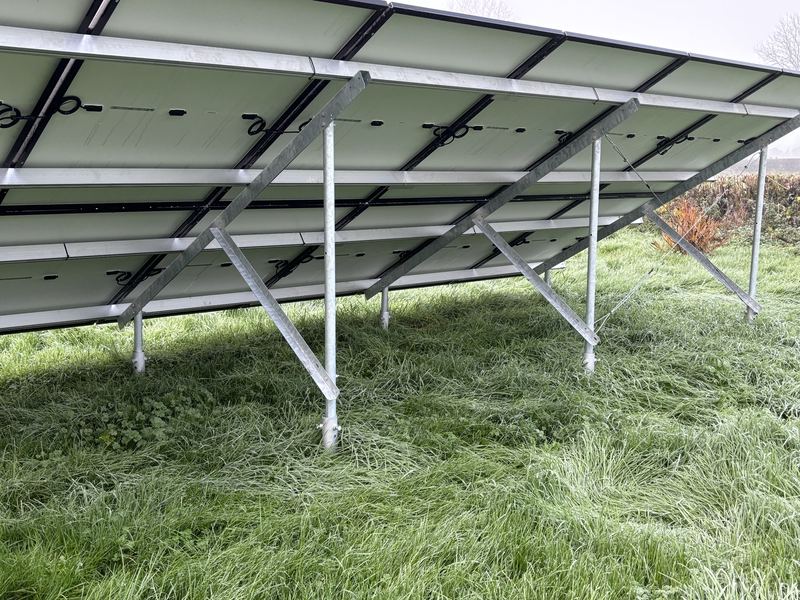
Leitrim ground is heavy. Gley soils, drumlin boulder clay and wide areas of peat over shale and sandstone, with a water table that spends much of the year close to the surface. The driven pile that works so well on the limestone counties east of the Shannon is not the automatic answer in this county.
Ballasted frames and spread footings carry most Leitrim installs, with long ground screws where peat has depth but reasonable consistency. The rule on every survey we do here is to design for the wettest month rather than for the conditions on the day the probe rod went in.
Around Ballinamore and Mohill the drumlin crowns are usually firmer and drier than the hollows a hundred metres downhill, so layout is decided as much by what is underfoot as by where the sun tracks. Up towards Manorhamilton, sandstone sometimes lies shallow enough to anchor into directly.
Getting the most out of 865 kWh per kWp
Lower irradiation is not a reason to skip solar in Leitrim. It is a reason to stop handing output away to a bad roof. Every degree of tilt and every degree off true south costs more in a county starting from 930 kWh per square metre than it does in the sunny south east.
We generally pitch arrays here a little steeper than the standard 30 to 35 degrees. A steeper frame sheds rain and moss, keeps the glass cleaner through a wet winter, and captures more of the low December sun, at the cost of a small amount of midsummer yield that this county has to spare anyway.
Details that matter more in Leitrim than almost anywhere:
- True south orientation rather than whatever the yard happens to face
- A slightly steeper tilt for winter sun and rain shedding
- Clear sky to the south, allowing for conifer plantations that keep growing
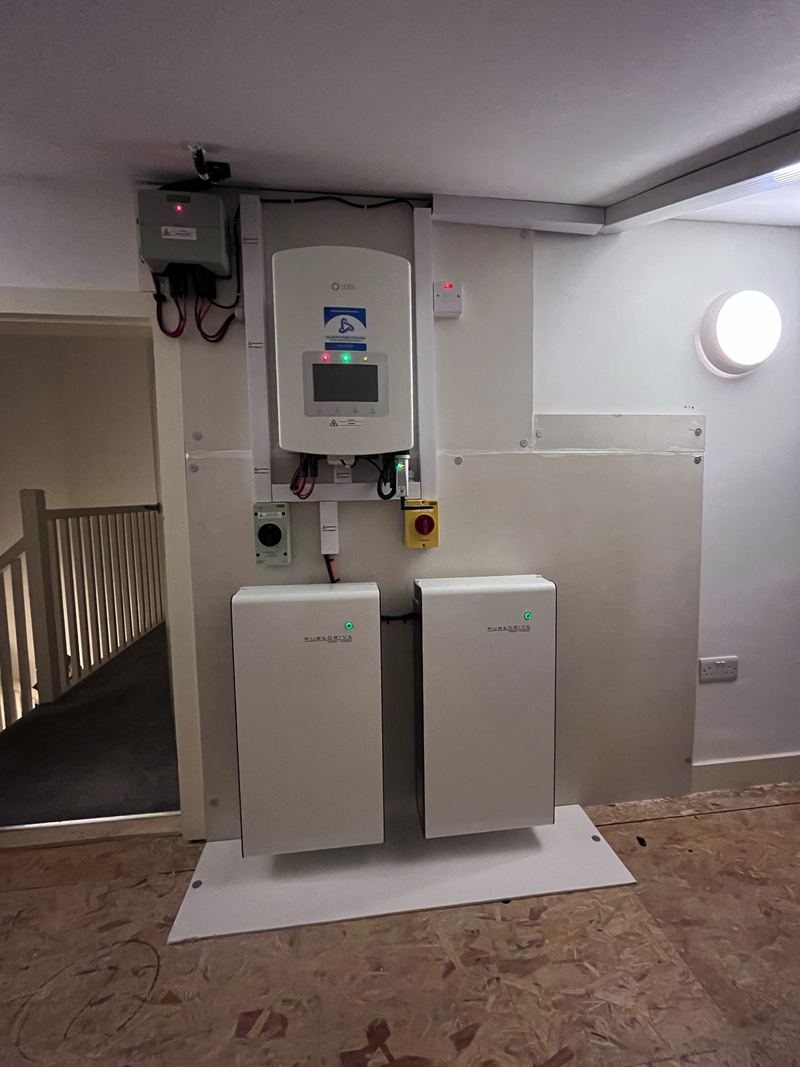
- Battery storage, so scarce winter generation is used rather than exported
Grants, TAMS and income from export
Homeowners can apply for the SEAI solar grant, which is periodically reviewed and stepped down, so the figure that matters is the one published on seai.ie on the day you apply. The property generally has to have been built and occupied before 2021, an SEAI registered company must do the work, and a BER assessment follows the installation. Eligibility for a ground mounted array is something we confirm for your specific site before you commit to anything.
Farmers around Drumshanbo, Mohill and Kinlough should look at TAMS III instead. The Solar Capital Investment Scheme carries a 60 per cent grant rate for eligible applicants, with its own separate investment ceiling.
Exported units are paid for under the Clean Export Guarantee. Suppliers set their own rates and revise them, so compare what is on offer when you sign up. Income from micro generation also benefits from a tax exemption, which your accountant can apply.
Planning permission and Leitrim County Council
In general, a free standing array beside a house counts as exempted development under the 2022 regulations, S.I. 493 of 2022. The tests to watch are the 25 square metre aperture area allowed for houses, the 2.5 metre height limit, the ban on placing panels forward of the front wall of the dwelling, and the proportion of private open space the frame may occupy.
None of that removes the need to check. Protected structures and Architectural Conservation Areas are treated separately, and safeguarding zones near aerodromes bring their own restrictions. Leitrim County Council in Carrick-on-Shannon is the authority to speak to, and a short call before ordering steel is time well spent.
Agricultural buildings and larger commercial arrays follow different rules again. If your plan is bigger than a domestic system, expect a planning conversation and build the timeline into your project rather than discovering it late.
Lanes, access and what install week involves
Access shapes a Leitrim job more than most people expect. Long private lanes, soft verges and forestry tracks decide whether the frame components come in on a rigid lorry or get shuttled in with a tractor and trailer. We check that at survey, not on delivery morning.
Machinery is chosen for the ground. Tracked plant spreads load on soft going where a wheeled machine would rut, and we lay ground protection across the route where the surface matters to you. Reinstatement of any trench line is part of the job, not an extra.
Once the frame is up and panels are fitted, DC cabling runs back to the inverter, the system is tested and commissioned, and the ESB Networks NC6 notification is submitted for micro generation up to 6 kW single phase or 11 kW three phase. Larger systems need a full connection application, which takes longer.
Towns and areas we cover in Leitrim
We install right across the county, from Carrick-on-Shannon and Manorhamilton out to Kinlough and every townland in between. There is no travel surcharge for being at the far end of the county.
Ground mounted solar in Leitrim: your questions
Is Leitrim too wet for ground mounted solar?
No. Rain reduces output on the day but the annual figure still comes in around 865 kWh per kWp, and a clean south facing frame beats a shaded or badly angled roof by a wide margin. What the wet does change is the foundation. Ballast, spread footings and long screws replace short driven piles on most Leitrim sites.
Why do you tilt arrays steeper in Leitrim?
Two reasons. A steeper pitch sheds rain, moss and dirt, which matters in the wettest of the inland counties, and it lifts capture of low winter sun when generation is scarcest. The trade off is slightly less midsummer yield, which is the part of the year Leitrim systems have least trouble with anyway.
What foundation would you use on a drumlin farm near Ballinamore?
Usually a ballasted frame or spread footings on the drumlin crown, where the boulder clay is firmer and drier than the hollow below it. If probing shows consistent ground with reasonable depth, long ground screws are an option and they can be removed later. We decide after probing across the whole footprint, not at one corner.
Do I need planning permission in Leitrim?
For a domestic array within the curtilage of the house, broadly not, provided you stay under 25 square metres of aperture area, under 2.5 metres in height, behind the front wall line and within the private open space limit. Leitrim County Council confirms how those tests apply to your address, and protected structures are handled differently.
Can I add a battery later or should it go in now?
Either works, though fitting it during the original install saves a second visit and a second set of isolation works. In a county where winter generation is limited, storage helps you use what you make instead of exporting it at a modest rate. We size the inverter with future storage in mind whichever route you take.
How long does an installation take?
Most domestic ground mounts take two to three days on site once materials are delivered, plus survey and design beforehand. Difficult access or a ballasted design on soft ground can add a day. Grid notification through ESB Networks runs in parallel and typically takes a few weeks for micro generation sized systems.