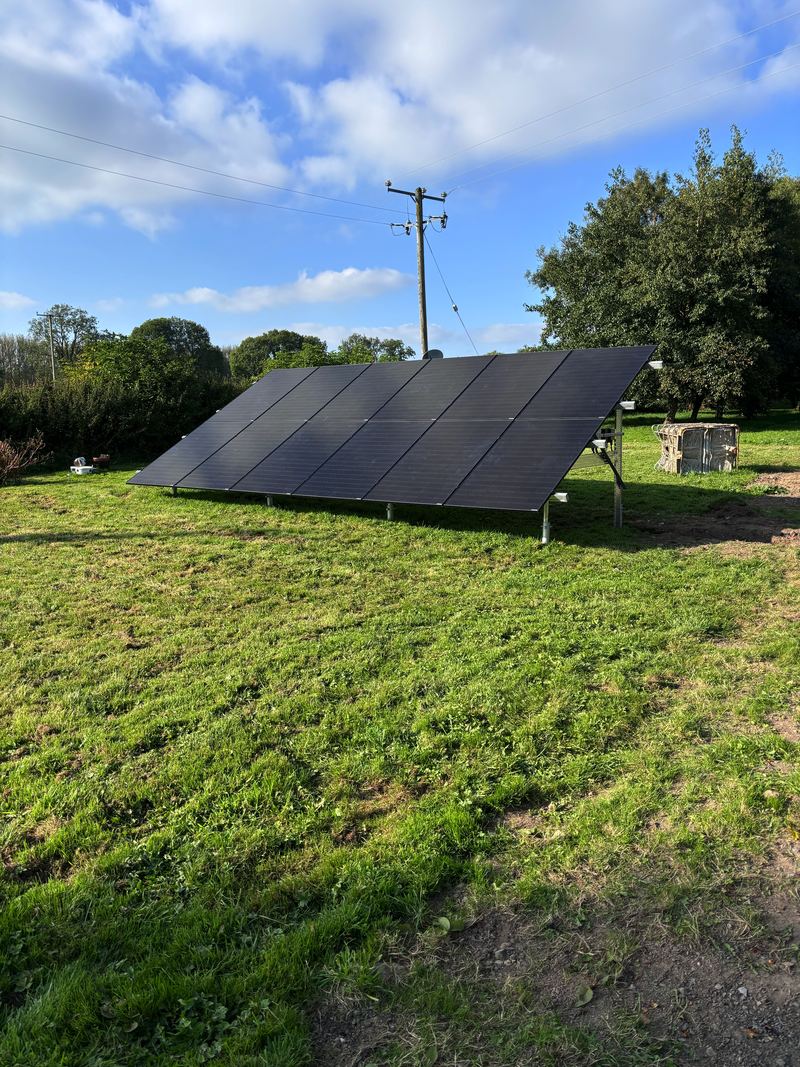
Our yard is at Kilcurry, Ballymahon, so Longford is not a county we visit, it is the county we work out of. Joseph Reilly and the crew are on these roads every week, from Granard down to Lanesborough, and the vans are back in the yard most evenings. That has practical consequences for anyone here thinking about a ground mounted array.
Longford averages roughly 970 kWh per square metre of irradiation a year, and a well set frame typically returns about 900 kWh per kWp. The national spread runs from around 850 to 1,000 kWh per kWp, which places Longford mid table, with good, dependable output and no unusual engineering demands on most sites.
Home ground, and what that changes for you
Being local is not a slogan here. It means the surveyor who walks your field is the person who designs the frame, and the crew who install it are twenty minutes from your gate rather than three hours. Snags get closed out quickly because coming back costs us very little.
It also means we know the ground before we arrive. We have driven posts on the till around Edgeworthstown and Drumlish, worked the cutaway near Lanesborough, and dealt with the same lanes, the same yards and the same ESB Networks staff for years.
Aftercare is where most solar customers eventually judge an installer. Inverter faults, a monitoring app that stops reporting, a panel wanting a wash after a dry spell: these are small jobs, and they only stay small if somebody actually calls out. In Longford Town and the surrounding parishes, that call is a short drive for us.
Till, drumlin and Shannon bog: choosing a foundation
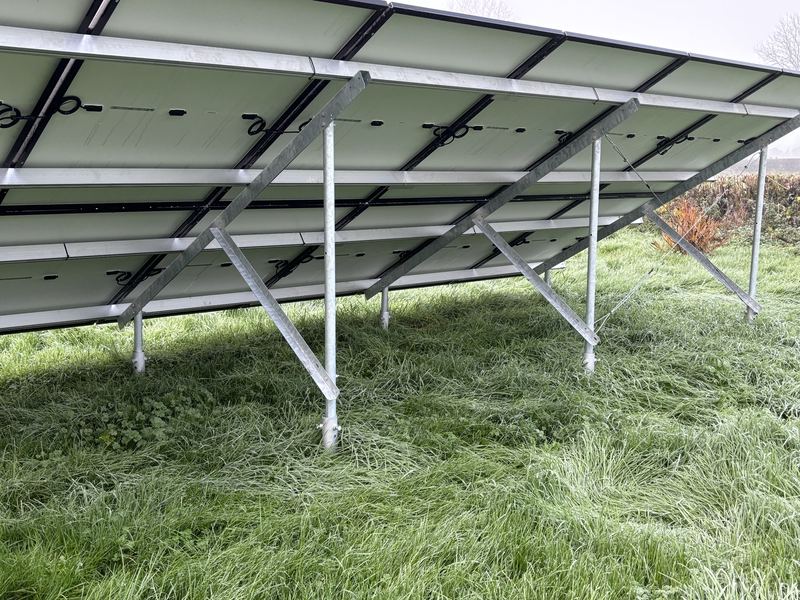
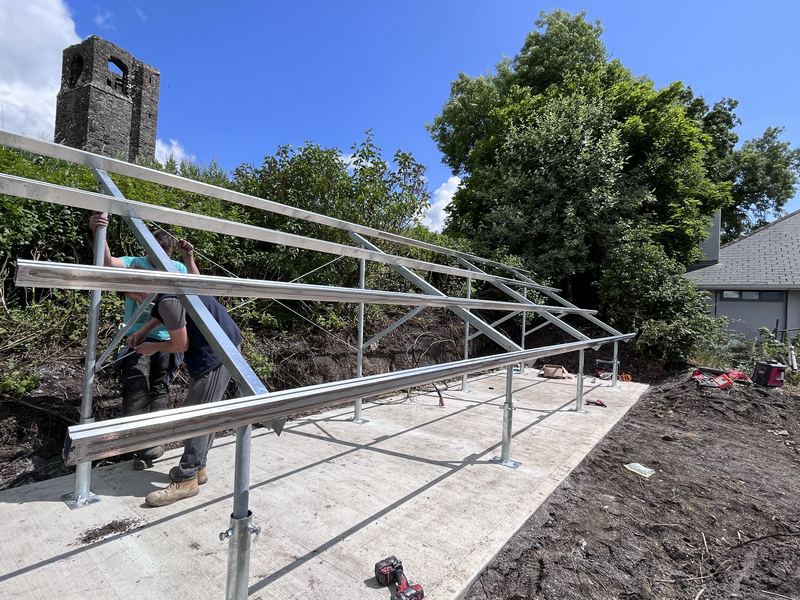
Two very different ground types sit inside this county. Limestone till and drumlin boulder clay across the east and north drive well, take a galvanised post cleanly and need no concrete. Along the Shannon corridor and out around Lanesborough there is substantial raised bog and cutaway, and none of that applies.
On peat we probe for depth first and then design. Long ground screws work where the peat is consistent and the underlying mineral layer is reachable. Where it is not, a ballasted frame spreads the load on the surface and keeps the array stable through a wet winter without penetrating anything.
The usual options on a Longford site:
- Driven piles on limestone till around Granard and Edgeworthstown
- Ground screws on mixed or moderately soft ground
- Ballast or spread footings on Shannon corridor cutaway
- Occasional rock anchors where shallow limestone appears
Why the field wins over the roof around here
Rural Longford housing tends to sit on generous sites, which removes the main obstacle that stops ground mounts in towns. If you have half an acre, you have room for a 6 to 10 kWp array without going near the roof or looking at it from the kitchen window.
Angle is the reason people move outdoors. A frame set at 30 to 35 degrees facing true south usually generates 10 to 25 per cent more than identical panels on a roof pitched wrong, oriented wrong, or shaded by a chimney and a mature beech. That difference compounds over the life of the system.
Beef and sheep farms in this county add another argument. Shed roofs are often north facing, structurally marginal or already carrying a lot of years, while there is a headland or paddock corner nearby that is doing very little. Panels there are easy to fence, easy to clean and easy to extend later.
Planning permission and Longford County Council
Free standing solar within the curtilage of a home is, in general terms, exempted development under the 2022 regulations, S.I. 493 of 2022. Houses have an aperture area allowance of 25 square metres, the frame may not exceed 2.5 metres in height, it cannot go forward of the front wall of the dwelling, and only a limited portion of your private open space may be covered.
Those are general rules and your address may not be a general case. Protected structures and Architectural Conservation Areas have their own requirements, and solar safeguarding zones near aerodromes restrict what can be installed. Longford County Council in Longford Town is the planning authority, and we would always confirm with them before ordering.
For farmyard and commercial arrays the exemption thresholds are different again, and a large agricultural system may need a full application. We tell customers which side of that line their project sits on at survey stage.
Grants, export income and the ESB Networks connection
The SEAI grant for domestic solar is reviewed and stepped down periodically, so treat seai.ie as the only reliable source for the current value. Broadly, the home must have been built and occupied before 2021, the installation must be carried out by an SEAI registered company, and a BER assessment follows the works. Whether a ground mounted array qualifies at your property is something we confirm in advance.
Farmers have the TAMS III Solar Capital Investment Scheme available, with a 60 per cent grant rate for eligible applicants under a separate investment ceiling.
On the grid side, micro generation up to 6 kW single phase or 11 kW three phase is notified using an ESB Networks NC6 form, which we complete and submit as part of the job and which typically takes a few weeks. Larger arrays need a full connection application. Exported units are paid for under the Clean Export Guarantee at rates that vary by supplier, and a micro generation income tax exemption applies.
Towns and areas we cover in Longford
We install right across the county, from Longford Town and Granard out to Drumlish and every townland in between. There is no travel surcharge for being at the far end of the county.
Ground mounted solar in Longford: your questions
Where are you based in Longford?
Our yard is at Kilcurry, Ballymahon, and we operate across all 26 counties from there. For Longford customers that means short lead times on site surveys, quick returns for snagging, and aftercare calls that do not involve waiting for a crew to be in the area. Most of the county is well under an hour from the yard.
What output should I expect from a Longford array?
Around 900 kWh per kWp a year on a frame set at proper pitch and true south, so roughly 5,400 kWh from a 6 kWp system. County irradiation averages about 970 kWh per square metre, which places Longford in the middle of the Irish 850 to 1,000 kWh per kWp range. Shading and tilt are the main variables.
Can you build on cutaway bog near Lanesborough?
Yes, with the right foundation. Peat and cutaway will not hold a short driven pile, so we probe the footprint for depth and then choose between long ground screws that reach firmer material and a ballasted frame that spreads load across the surface. Both are proven on the Shannon corridor and both allow for a rising winter water table.
Do I need planning permission in Longford?
Usually not for a domestic array, provided it stays within the exempted development limits: 25 square metres of aperture area, 2.5 metres height, sited behind the front wall of the house and within the private open space allowance. Longford County Council will confirm your particular case, and protected structures or conservation areas are assessed differently.
How big a site do I need?
Allow roughly 8 to 10 square metres of ground per kWp for a single row, so a 6 kWp array needs somewhere near 50 to 60 square metres including working room. Multiple rows need spacing of about 2.5 times the array height to prevent self shading. Most rural sites in this county have far more space than that available.
Do you fit batteries as well as panels?
Yes. We install battery storage alongside ground mounted arrays, including Sigenergy systems, plus inverters and EV charging. Storage lets you hold midday generation for evening use instead of exporting it, which usually improves the economics because self consumed units are worth more than exported ones. We size storage against your actual daily usage pattern.