The SEAI solar PV grant is the single most common question we take on the phone, and the ground-mount version of it has a wrinkle. People want to know whether putting the panels in the garden or the paddock instead of on the slates changes anything about the money.
The honest answer is that the mechanism is the same and the eligibility rules are the same. The one thing you must not do is assume that any given ground-mounted layout will be accepted without it being confirmed for your specific property first. Here is how the scheme works, what it asks of you, and what we check before anyone commits to anything.
Key takeaways
- The SEAI domestic solar grant is paid after the works, and you must apply before any installation begins.
- Grant values are reviewed and stepped down periodically, so always check the current rates on seai.ie before budgeting.
- Only an SEAI-registered company can carry out grant-aided work, and there is no retrospective route for unregistered jobs.
- Ground-mounted arrays are not excluded, but confirm eligibility for your specific property in writing before ordering anything.
- Farmers should weigh the SEAI non-domestic route against TAMS III, which grants 60 per cent to eligible holdings.
How the grant mechanism actually works
The domestic solar PV grant is administered by the Sustainable Energy Authority of Ireland. It is a capital grant towards the installed cost of a solar photovoltaic system on a home, and it is paid after the work is finished rather than up front.
The value is calculated on installed capacity in kWp, up to a capped system size. A larger array attracts more grant until you reach that ceiling, after which any additional capacity is entirely at your own cost. We are deliberately not printing rates here. SEAI reviews the grant periodically and it has been stepped down more than once as system costs have fallen, so any figure written into a blog post has a very short shelf life. Check the current values on seai.ie before you budget.
The sequence in practice is: apply and receive a grant offer before any work starts, have the system installed by a registered company, get the post-works BER done, then submit the paperwork. The grant is paid to you afterwards, or netted off your invoice if your installer works that way. Applying after the panels are already up is the most common and most expensive mistake we see.
Who is eligible
The core conditions are straightforward enough.
- The property must be a dwelling in the Republic of Ireland that was built and occupied before 2021. The exact date test is set out on seai.ie and it is worth reading the wording rather than relying on what somebody told you.
- The property must not already have had a solar PV grant paid on it.
- The work must be carried out by a company on the SEAI registered list.
- A post-works BER assessment must be completed and published.
Newer homes are generally excluded because they were built under building regulations that already require a renewable energy contribution, so many of them arrived with panels fitted. If your house was completed close to the cut-off, check the date on the BER record or the commencement notice rather than guessing.
Rented properties, holiday homes and houses held in a company name each carry their own considerations, and the applicant normally needs to be the owner. If the ownership position is at all unusual, sort it out before applying rather than after.
The registered installer requirement
SEAI will only pay a grant where the installation was carried out by a company on its registered list. This is not a formality. If an unregistered contractor does the work, no grant is payable afterwards and there is no retrospective route back.
Registration carries obligations. The installer signs up to SEAI's code of practice and the relevant technical standards, the electrical work is certified by a registered electrical contractor, and the installation is open to SEAI inspection. A share of grant-aided jobs are inspected, and the inspector looks at earthing, isolation, labelling, cable routing and the mounting structure as well as the panels themselves.
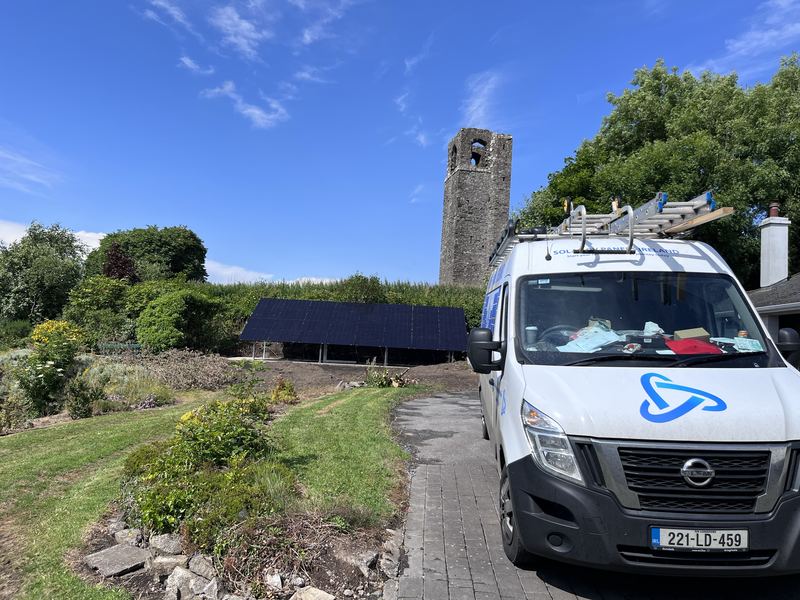
Solar PV Panels Ireland is an SEAI-registered company and Joseph Reilly is a qualified electrical contractor, so the certification and the grant paperwork are handled in-house rather than subcontracted. If you are collecting quotes elsewhere, ask each company for its registration status directly and confirm it against the SEAI list rather than taking a logo on a van as proof.
Does a ground-mounted array qualify?
This is the part people get wrong, in both directions.
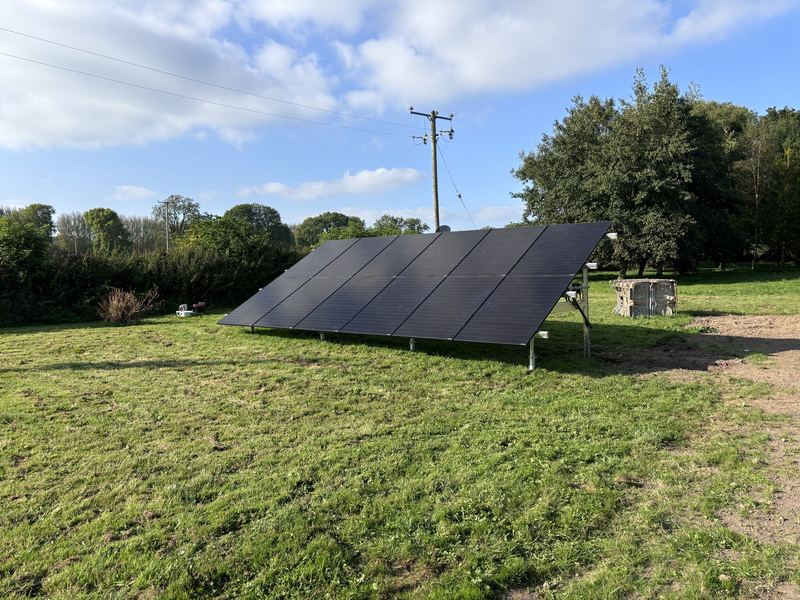
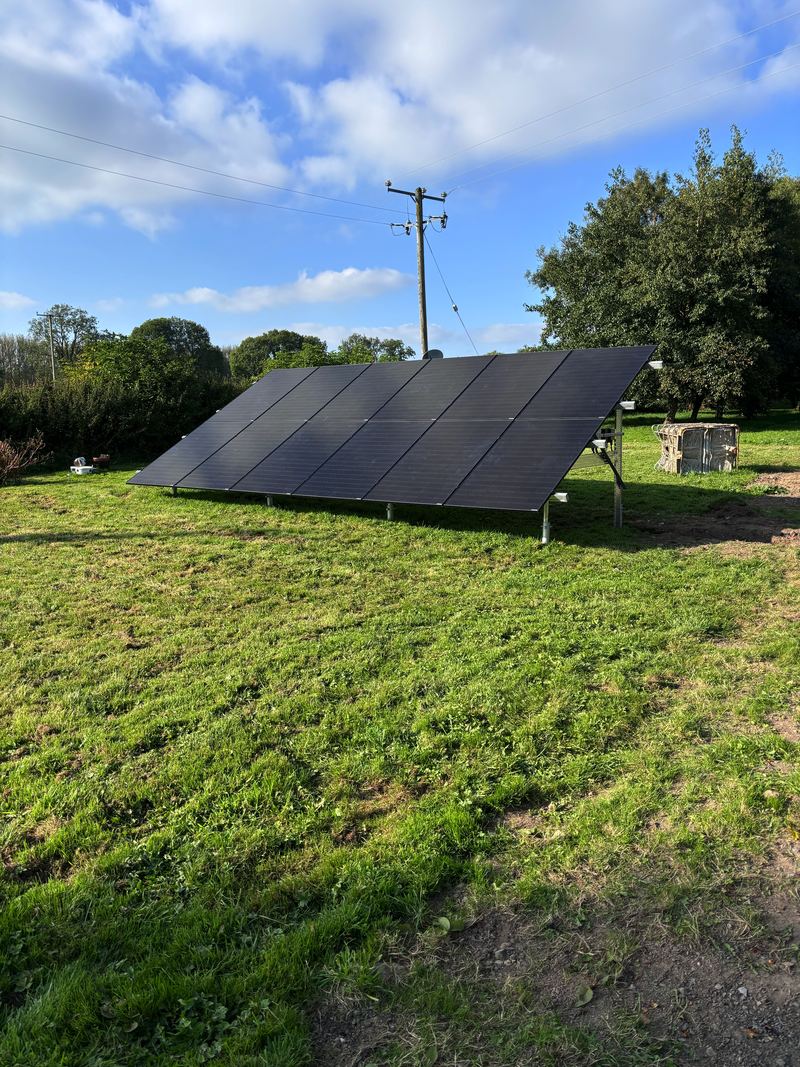
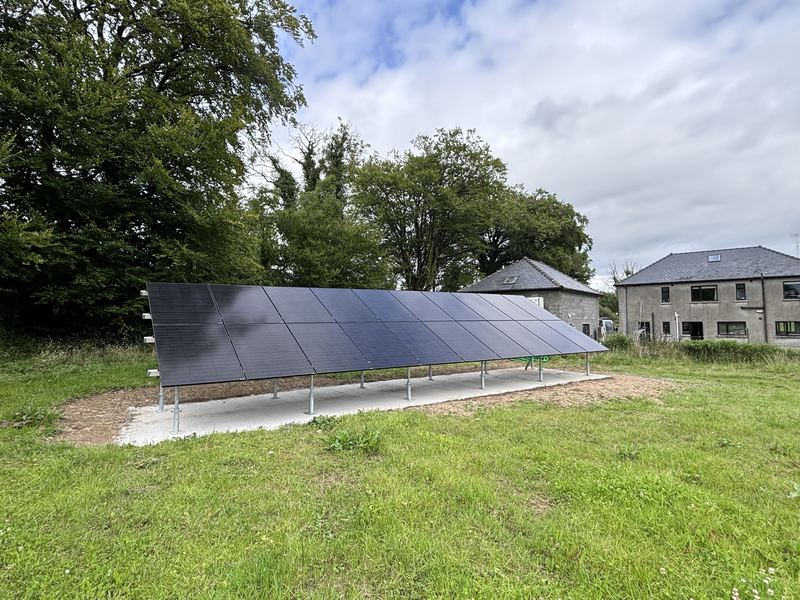
The grant is for a solar PV system serving the home. It is not written as a roof-only scheme, and ground-mounted arrays serving a dwelling have been grant-aided. What matters is that the array serves that dwelling, that it sits on the same property, that the works meet the scheme's technical requirements, and that the paperwork describes what is actually being built.
Where ground mounts get complicated is the surrounding detail rather than the panels. The array needs to be within the curtilage of the house and connected on the house's own supply rather than a separate meter. Planning status matters too, because no public scheme is going to look kindly on works that needed permission and did not have it. Distance from the house, the cable route and the metering arrangement all need to be described correctly on the application.
Our standing advice is therefore simple. Do not order steel and do not sign anything on the assumption that a particular ground layout qualifies. We confirm eligibility for the specific property, in writing, with a grant offer in hand, before anything is committed.
The post-works BER step
A post-works Building Energy Rating assessment is a mandatory part of the domestic grant. It is carried out after the installation by a registered BER assessor, and the resulting certificate has to be published on the national register before the grant can be paid.
Two things tend to surprise homeowners. The first is that it is a survey of the whole house, not of the solar array, so the assessor will want access to the attic, the boiler, the cylinder and the windows, and will ask about insulation and heating controls. The second is that the cost of the BER generally falls to the homeowner, although SEAI has at times contributed towards it under the domestic scheme. Confirm the current position on seai.ie rather than assuming either way.
The upside is a genuinely useful document. A ground-mounted array of a decent size, particularly paired with a battery or a heat pump, usually moves the rating, and that certificate is exactly what a buyer, a valuer or a lender will look at later on.
What the grant does not cover
The domestic grant is aimed at the PV system. It does not stretch to everything a ground-mount job involves, and it is better to know that at quotation stage than at invoice stage.
- Groundworks and foundations. Driven piles, ground screws, ballast or rock anchors are chosen by your soil, not by the grant, and difficult ground adds cost.
- The trench and buried armoured cable from the array back to the house. On a long run this is a real line item.
- Battery storage. Batteries are not covered by the domestic solar grant, though they change how much of your own generation you actually use.
- Fencing, stock-proofing on farm sites, and any tree or hedge work needed to clear the array of shade.
None of that makes ground mounting uneconomic. It does mean the grant covers a smaller share of the total than it would on a simple roof job, so the comparison between quotes should be made on full installed cost, not on panel count.
ESB Networks, the NC6 and getting paid for exports
Every grant-aided system has to be notified to ESB Networks. For micro-generation the route is the NC6 form, which covers systems up to 6 kW single-phase or 11 kW three-phase. We submit that on your behalf as part of the job, and turnaround is typically a few weeks. Anything above those thresholds needs a full connection application, which is a longer process and should be started early.
Once you are connected and registered, the Clean Export Guarantee obliges your electricity supplier to pay for the units you export to the grid. Rates differ by supplier and they change, so it is worth comparing rather than assuming your current supplier is competitive. Irish CEG rates have sat in a broad range of roughly 15 to 25 cent per unit in recent years, but treat that only as indicative and check live offers.
There is also an income tax exemption on micro-generation export income up to a set annual limit. It exists and it has been extended before, but the amount and the end date are matters for Revenue rather than for us. Ask your accountant if the sums are material to you.
Non-domestic solar and the TAMS III route for farmers
Businesses, farms and community buildings sit outside the domestic scheme, and the routes available are different.
For non-domestic solar, SEAI has run support aimed at commercial, industrial and agricultural premises, typically structured around installed capacity with its own ceiling and its own application process. Eligibility, capacity caps and rates are reviewed, so check the current non-domestic pages on seai.ie, or talk to us about which route fits the meter you are on.
Farmers have a second option through the Department of Agriculture. The TAMS III Solar Capital Investment Scheme supports solar PV and associated equipment at a 60 per cent grant rate for eligible farmers, and it carries its own separate investment ceiling that does not eat into the ceiling available for other TAMS investments. It runs in tranches, and applications are made through the Department's online system rather than through SEAI.
You cannot draw two public grants for the same equipment, so the real decision is which scheme suits the holding better. On a dairy farm in Cavan or a tillage farm in Wexford with a heavy daytime load, TAMS III is frequently the stronger route. We are happy to walk through both before you choose.
Frequently asked questions
Can I get the SEAI grant for a ground-mounted array rather than a roof one?
The scheme is not written as roof-only, and ground-mounted arrays serving a dwelling have been grant-aided. The array needs to be within the curtilage of the house, connected on the house's own supply, and correctly described on the application. Because the detail matters, we confirm eligibility for your specific property with a grant offer in hand before any steel is ordered.
How much is the SEAI solar grant at the moment?
We deliberately do not publish a figure. The grant is calculated on installed capacity up to a capped system size, and SEAI reviews it periodically, stepping it down as system costs fall. Any number written into a blog post goes out of date quickly. The current rates and the capacity cap are published on seai.ie, and we quote using whatever is live on the day.
Does my house qualify if it was built recently?
The scheme is generally aimed at homes built and occupied before 2021, on the basis that newer dwellings were built under regulations already requiring a renewable contribution. If your house was completed near that cut-off, check the date on the BER record or the commencement notice rather than relying on memory, and confirm the exact wording of the test on seai.ie.
Why do I need a BER assessment after the panels go in?
A published post-works BER is a condition of the domestic grant. A registered assessor surveys the whole house, not just the array, so expect questions about insulation, heating controls, the cylinder and the windows. The certificate has to appear on the national register before the grant is paid, and it is the same document buyers and lenders will look for later.
Can I claim both an SEAI grant and TAMS III on the same panels?
No. You cannot draw two public grants for the same equipment, so the choice is which scheme suits the holding better. The TAMS III Solar Capital Investment Scheme grants 60 per cent to eligible farmers and carries a separate investment ceiling, and it is applied for through the Department of Agriculture. The SEAI routes are separate and administered independently of it.