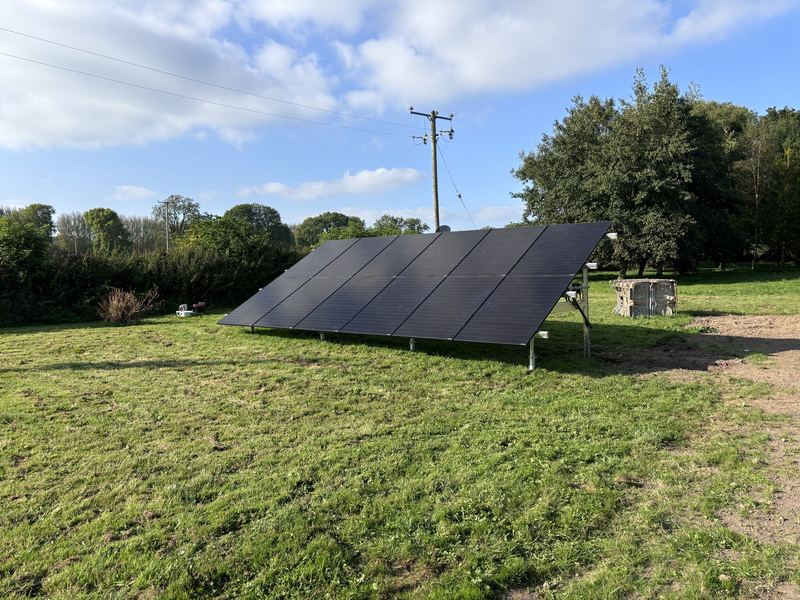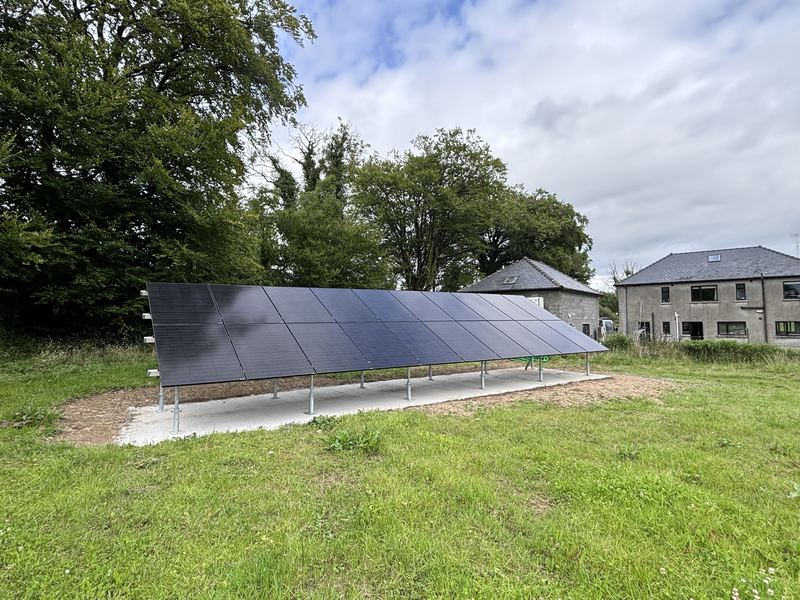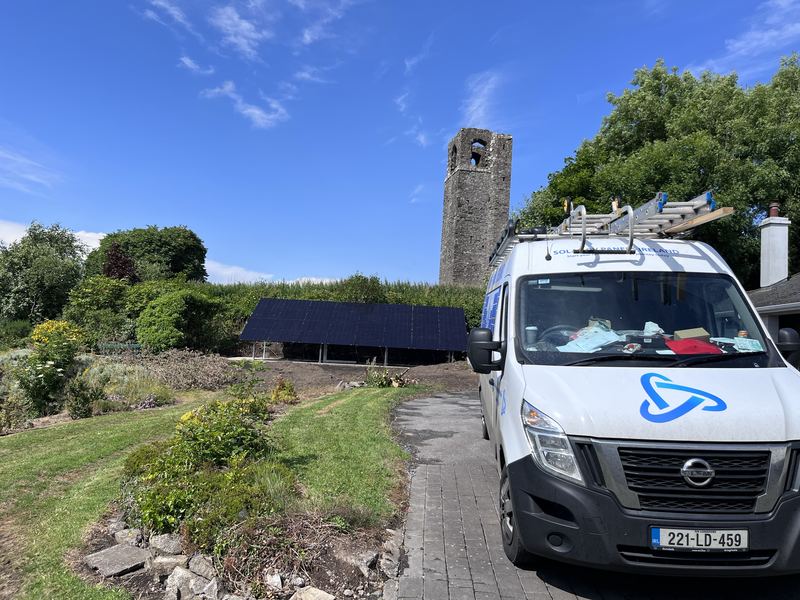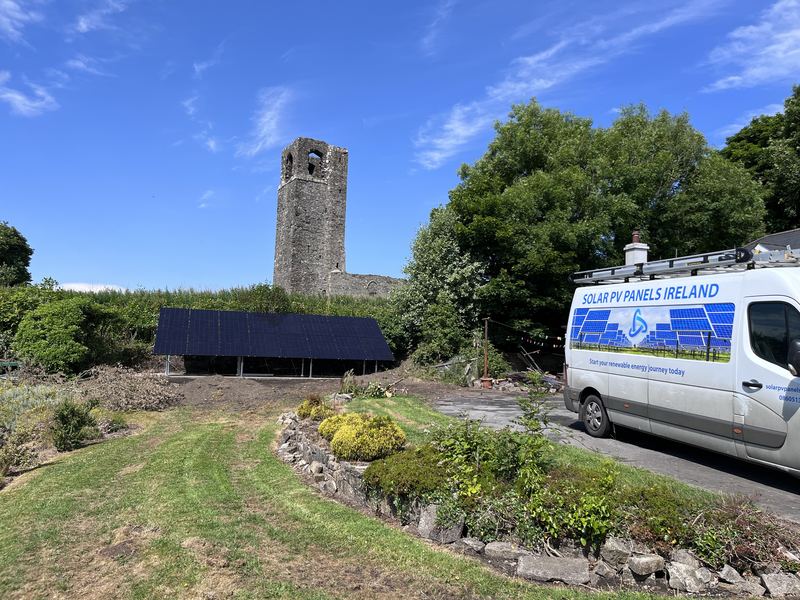
The panels are the easy part. Two 6 kWp arrays, one in a boulder clay field outside Ardee and one on cutaway bog in west Offaly, use the same modules and the same inverter and completely different foundations. The racking decides whether the array is still straight and true in twenty years.
There are four families of foundation we use in Ireland: driven piles, ground screws, ballasted or concrete systems, and rock anchors. Each suits particular ground. None of them is universally best, and any installer who only ever offers one is choosing for their own convenience rather than for your site.
Key takeaways
- Site investigation comes first: trial holes and a pull-test turn foundation assumptions into measured numbers before anything is ordered.
- Driven piles suit firm boulder clay in Meath, Louth and the drumlins, but refuse on cobbles or shallow rock.
- Ground screws handle mixed, wet and peaty ground and stay removable, which matters in Mayo and Donegal.
- Ballast suits deep peat, cutaway bog, made ground and rock, at the cost of considerable weight and settlement risk.
- Coastal Atlantic sites need heavier galvanising, careful fixings and structures designed for much higher wind loads.
Start with the ground, not the catalogue
The correct order is site investigation, then structural design, then racking selection. It is routinely done backwards: a system picked on price, the ground expected to cooperate.
On a domestic array the investigation can be proportionate. A few trial holes dug at the corners and the middle of the proposed array tell you a great deal: depth of topsoil, what the subsoil actually is, whether you hit rock at 400 mm or 2 metres, and whether the hole fills with water while you stand looking at it.
For anything larger, or where the ground is doubtful, a pull-test is worth the money. You install two or three sample piles or screws to the design depth and load them until they move, which gives you a measured capacity rather than an assumed one. It converts an argument into a number.
Local knowledge helps but does not substitute for digging. Ground changes across a single field, and the top of a drumlin in Monaghan and the wet hollow forty metres away can want two different foundation types on the same array.
Driven piles: fastest and cheapest where the ground is consistent
A driven pile is a galvanised steel section, typically a C or a W profile, hammered directly into the ground by a hydraulic pile driver mounted on a tracked or towed rig. No concrete, no spoil, no curing time. On good ground a small domestic array can be piled in a morning.
They want firm mineral soil. The boulder clay across much of Meath, Louth and the drumlin country of Cavan and Monaghan is close to ideal, being dense, well graded and capable of gripping the pile along its full embedded length. Typical embedment runs somewhere around 1.5 to 2.5 metres depending on the design loads and the soil.
The weaknesses are also specific. Boulder clay lives up to its name, and a pile that strikes a large cobble at 900 mm will refuse, deflect, or damage the section. Piles cannot be relied on in peat, in loose made ground, or where bedrock sits shallow enough to stop the pile before it has developed capacity. They also need machine access, which rules them out on tight sites and on soft ground in winter.
Where they suit, they are hard to beat: least material, least disturbance, fastest programme.
Ground screws: the all-rounder for mixed, soft and peaty ground
A ground screw is a steel shaft with one or more helical flights welded to it, wound into the ground by a hydraulic rotary head rather than hammered. The helix pulls the screw down and, once installed, bears against undisturbed soil above and below it. That geometry is why screws resist uplift far better than a plain post.
They are our default where the ground is variable, and Ireland is variable. Screws cope with soft silts, wet clays, made ground and mixed fill in a way piles do not. Given enough length they will work in peat, which is why they matter in Mayo, west Donegal and the raised bogs of the midlands. In blanket peat the screw has to pass through the peat entirely and develop its capacity in the mineral horizon or the head beneath it, which can mean shafts of 3 metres or more.
Screws also tolerate obstruction better. Meet a boulder and you can often back out, shift a few hundred millimetres and try again. Installation torque is measurable, so you get a live reading of ground quality as you go.
The trade-offs are cost and rate. A screw is a dearer component than a plain driven section, installation is slower, and long screws for deep peat add up quickly. Where peat is very deep and saturated, ballast is often the better answer.
Ballast and concrete: when nothing may be penetrated
Ballasted systems sit on the surface. The frame is weighted down with precast concrete blocks, cast in situ pads, or purpose-made ballast trays, and resists wind by mass and geometry rather than by grip.
They earn their place in several Irish situations. On rock with almost no cover, where you would spend a fortune drilling. On deep peat where nothing you drive or wind in will find competent ground. On made ground, old landfill or contaminated sites where penetrating the cap is not permitted. On sites with services, archaeology or a liner underneath that must not be disturbed. Cutaway bog in Offaly and Laois often falls into this bracket, particularly where the remaining peat is deep, saturated and structurally poor.
The engineering cost is weight. Wind uplift on a tilted array is significant, and a ballasted frame has to be heavy enough to hold down the worst-case gust with a proper factor of safety. On an exposed western site that means a great deal of concrete, with the delivery, handling and bearing pressure that follows.
Settlement is the real risk on soft ground. Concrete is heavy, peat consolidates, and an array that sinks unevenly over five years is an array that needs re-levelling. Where we ballast on soft ground we spread the load, keep the tilt modest and check levels during the early years.
Rock anchors: shallow limestone and granite
Where competent rock sits within a few hundred millimetres of the surface, the sensible foundation is to fix into it. A hole is drilled, cleaned out thoroughly, and a threaded bar or anchor is set with a chemical resin grout. Once cured, the capacity available from a properly installed anchor in sound rock is far higher than anything you will get from soil.
This is the common answer across the limestone country of Roscommon and east Galway, where cover over the bedrock can be thin enough that a pile refuses at 500 mm, and on the granite of the Wicklow uplands. Karst limestone deserves a note of caution: fissures, solution features and voids are real in that country, and an anchor drilled into a void is worthless. Drill logs and attentive operators matter.
Practicalities to plan for. Hole cleaning is not optional, because resin bonded to rock flour is a failed anchor waiting for a storm, and resin has a temperature window that constrains work on a cold February morning.
Rock anchoring is usually the dearest foundation per point, but it needs few points and produces a very stiff array.
Pull-out, overturning, frost and the water table
Every ground mount is designed against two failure modes. Pull-out, where wind lifts the array and drags the foundation vertically out of the ground. Overturning, where wind pushes the panel face and tries to rotate the whole frame about its base.
Pull-out capacity comes from different places in each system. A driven pile relies on skin friction along the shaft, so it is proportional to embedded length and soil density and it falls away sharply in soft or saturated ground. A ground screw adds the bearing resistance of the helix against the soil cone above it, which is why a screw outperforms a pile of the same length in weak ground. A ballasted frame has no pull-out resistance at all, only dead weight. A rock anchor relies on the resin bond and on the mass of rock engaged by the anchor.
Overturning is resisted by the spacing and stiffness of the foundation points and by the rigidity of the frame between them. This is why cross-bracing and correctly torqued connections are not cosmetic, and why a frame assembled with hand-tight bolts will eventually rack itself out of square.
Frost and water change all of it. Irish frost penetration is modest, but a foundation bearing close to the surface in a frost-susceptible silt can still be jacked upwards over repeated cycles, so set the working depth below that zone. A high water table cuts skin friction, so a pile capacity measured in August is not the capacity available in February. If your trial hole fills with water, design for the wet case.
Galvanising, corrosion and Atlantic wind loading
Steel in Irish ground and Irish air needs proper protection, and the specification is not a detail to leave to the cheapest supplier. Hot dip galvanising to a recognised standard, with the thicker coatings on anything buried, is the baseline. Thin pre-galvanised strip is fine for above-ground rails inland and is not what you want in the ground on the Atlantic coast.
Corrosivity is a function of location. An inland site in Longford or Westmeath is a mild environment for galvanised steel. A field within a couple of kilometres of the sea in Clare, Kerry, Mayo, Sligo or Donegal is a considerably harsher one, with chloride-laden air accelerating attack, particularly at cut edges, drilled holes and stainless-to-galvanised contacts. Coastal sites justify thicker galvanising, stainless fixings of an appropriate grade, and attention to bimetallic contact wherever two different metals meet.
Peat brings its own chemistry. It is acidic, often waterlogged and aggressive to buried steel, so components buried in bog need a heavier coating than the same parts in dry mineral soil.
Wind is the other coastal factor and it drives the structure rather than the coating. Exposed sites in the Atlantic counties see basic wind speeds well above sheltered midlands sites, and the load on an array rises steeply with speed. Practical consequences: lower tilt to cut sail area, shorter cantilevers at row ends, more foundation points, heavier sections and greater embedment. A frame designed for a sheltered site in Laois and shipped to a hilltop in Belmullet without recalculation is a claim waiting to happen.
Reinstatement, removability and end of life
How the site looks afterwards ought to be part of the decision.
Driven piles and ground screws produce almost no spoil and very little disturbance. The grass round each post recovers in a season, sheep graze between the rows, and there is nothing to break out at the end. Both can be extracted: piles pulled with a jack, screws unwound with the same rotary head that installed them, leaving a small hole that closes over. On agricultural land, and on any site where you may want the field back, that is a real advantage and it is worth stating in writing.
Concrete is the opposite. Cast pads are permanent in practical terms and the disturbed ground takes years to blend back into the field. Precast ballast blocks can at least be lifted and taken away, so where ballast is unavoidable we would rather use blocks than pour pads.
The short version: on firm mineral ground use driven piles, on mixed or soft ground use screws, on shallow rock use anchors, and use ballast where nothing may be penetrated. Dig the holes first and let the ground decide.
Frequently asked questions
How do I know whether my field will take driven piles?
Dig trial holes before deciding. You are looking for firm mineral subsoil, no shallow bedrock, no deep peat and no standing water in the hole. Boulder clay across Meath, Louth, Cavan and Monaghan is often ideal. Where the ground looks marginal, install two or three sample piles and pull-test them. That gives a measured capacity instead of an assumption you find out about in a storm.
Can a ground-mounted array be built on peat?
Often yes, but not with driven piles. Ground screws long enough to pass through the peat and develop capacity in the mineral layer beneath will work in many blanket peat and raised bog situations, sometimes needing shafts of 3 metres or more. Where the peat is very deep and saturated, a ballasted surface system spread to limit settlement is usually the safer engineering answer.
What galvanising specification should I ask for near the coast?
Ask for hot dip galvanising to a recognised standard with the thicker coating class on anything buried, rather than thin pre-galvanised strip. Within a couple of kilometres of the sea in Kerry, Clare, Mayo or Donegal, chloride-laden air attacks cut edges and bimetallic contacts fastest. Specify appropriate stainless fixings and check that dissimilar metals are isolated where they meet.
Will the foundations damage my field permanently?
Driven piles and ground screws create very little disturbance and almost no spoil, and both can be extracted at end of life, leaving a small hole that closes over. Cast concrete pads are effectively permanent and expensive to break out. If reinstatement matters to you, say so early and we will favour a removable foundation and plan machine access to avoid rutting wet ground.
Does a windy site mean a stronger frame or a different foundation?
Usually both. Higher design wind speeds on exposed Atlantic sites increase uplift and overturning forces, so you may need more foundation points, deeper embedment, heavier sections and shorter cantilevers at row ends. Reducing tilt cuts the sail area and lowers the load considerably. A frame specified for a sheltered midlands site should never be installed on an exposed hilltop without recalculation.