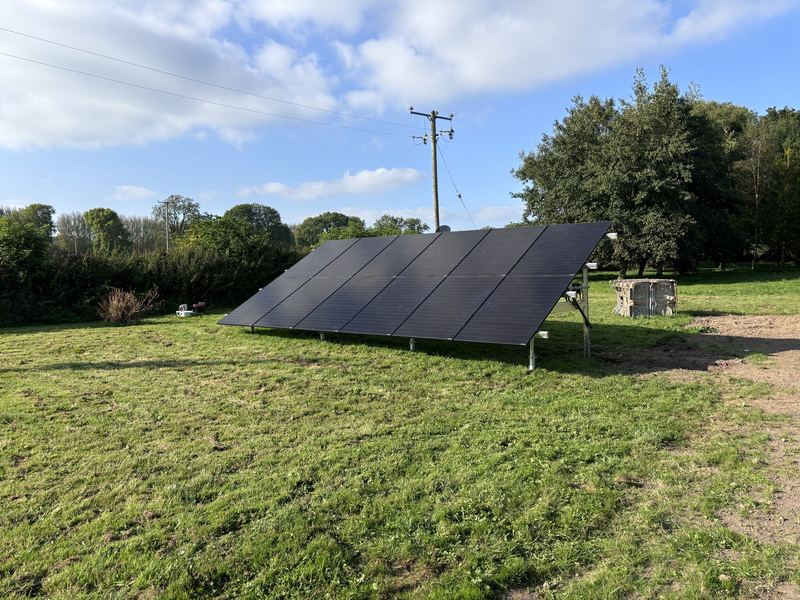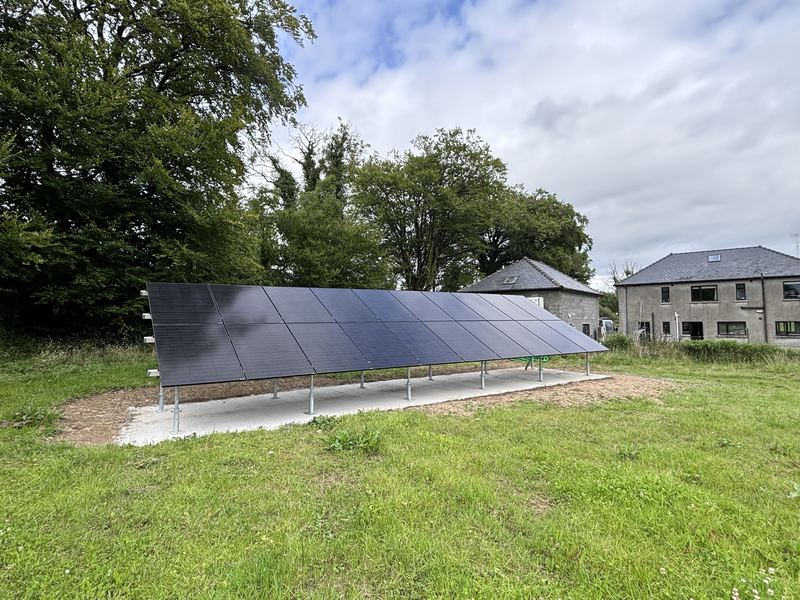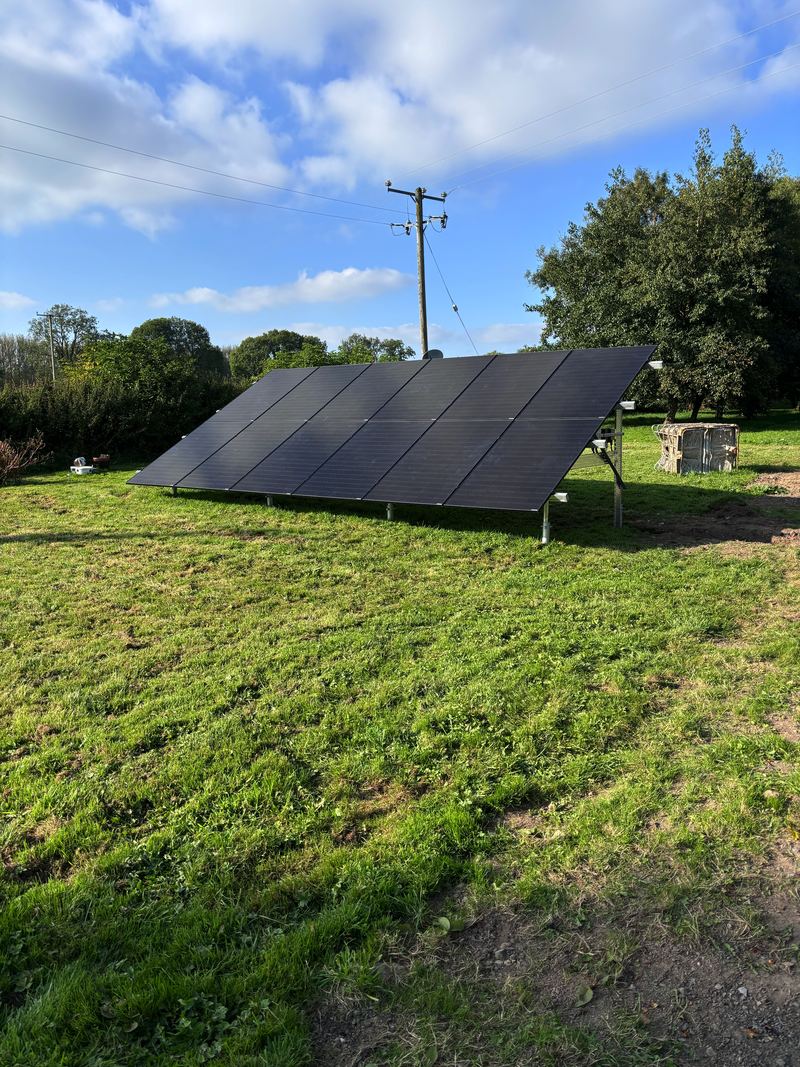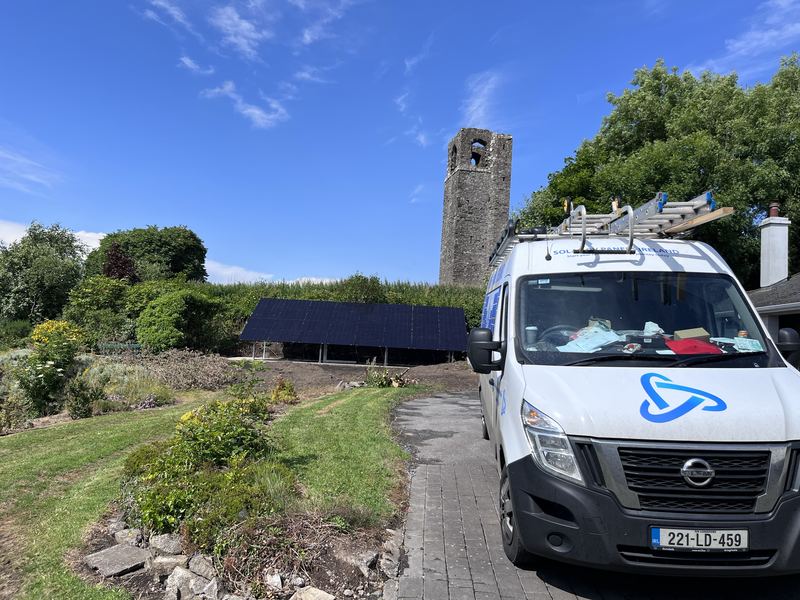
Planning is the step that stops most ground-mount projects before they start, usually because somebody heard a rumour in a pub or read a forum post from 2019. The rules changed materially in late 2022, and a good deal of what is still circulating is simply out of date.
What follows is how the exemptions broadly work for houses, farms and business premises, where the limits sit, and the situations where a full planning application is genuinely the right route. It is general guidance from installers rather than legal advice, and the only opinion that binds you is that of your own local authority.
Key takeaways
- S.I. 493 of 2022 broadly exempts free-standing home solar within set limits, but every condition must be met.
- For houses the key caps are 25 square metres of aperture area and 2.5 metres in overall height.
- The array cannot sit forward of the front wall, or reduce private open space below the stated minimum.
- Protected structures, Architectural Conservation Areas and aerodrome safeguarding zones restrict or remove the standard solar exemptions.
- Confirm with your county council, and use a section 5 declaration where the answer is genuinely unclear.
Exempted development, and what it actually means
Exempted development is a class of works that the planning regulations allow you to carry out without applying for permission. It does not mean unregulated. The exemption comes with conditions and limitations, and if you exceed any one of them the whole thing falls outside the exemption and you needed permission after all.
The relevant instrument is the Planning and Development (Exempted Development) (No. 3) Regulations 2022, S.I. 493 of 2022, which substantially widened the solar exemptions for houses, agricultural buildings, industrial buildings and a range of other premises. It is the document your council's planning officer will be working from.
Two general points apply before any of the class-specific limits. Exemptions are restricted where works would affect a protected structure or an Architectural Conservation Area, and they are restricted inside the solar safeguarding zones around certain aerodromes. Both are dealt with further down.
Where there is genuine doubt, section 5 of the Planning and Development Act 2000 lets you ask the council for a formal declaration on whether specific works are exempted development. It costs a modest fee and it produces an answer you can rely on.
The 2022 regulations for houses: the limits that matter
Broadly, and subject to the conditions set out in the regulations, a free-standing solar array within the curtilage of a house is exempted development where it stays inside these limits.
- Aperture area. The total aperture area of free-standing solar panels is capped at 25 square metres for a house. That is panel area, and it counts alongside any panels already installed on the roof of the house or on other structures within the curtilage.
- Height. The structure must not exceed 2.5 metres in height above ground level. That is the top of the panel, not just the top of the post.
- Position. The array must not be forward of the front wall of the house. In practice that rules out most front lawns and roadside verges.
- Private open space. The array must not reduce the private open space at the rear or side of the house below the stated minimum. Small suburban gardens are where this one bites.
- Boundaries. There are separation requirements in the regulations, so a frame set tight against a neighbour's wall is always worth checking first.
Treat that as the general shape of the rules rather than the letter of them. The statutory wording is precise, and your council reads the wording, not a summary.
Measuring aperture area and private open space
Two of those limits get miscalculated regularly, and both are easy to get right with a tape and ten minutes.
Aperture area is not the same as kilowatts. A modern 440 to 500 W panel is roughly 1.9 by 1.13 metres, so about 2.1 to 2.2 square metres of aperture each. Twenty five square metres therefore works out at somewhere around 11 or 12 panels, which at current module wattages is roughly 5 to 6 kWp. If you want 10 kWp on the ground at a house, you are very likely outside the exemption and into a planning application.
Private open space is measured, not eyeballed. Councils generally look at the usable private amenity space to the rear and side of the dwelling. On a rural site of half a hectare this is a non-issue. On a semi-detached house in Naas or Ennis with a 60 square metre back garden, a 25 square metre array plus its row spacing takes a serious bite out of the remainder.
Measure the garden, draw the array to scale with its actual ground footprint including the tilt, and keep that drawing. It is the same drawing your council will ask for if any query ever arises.
Farms and agricultural land
Agricultural buildings were treated separately and more generously in the 2022 regulations, which reflects the size of the roofs involved and the daytime loads on a working farm.
Roof-mounted solar on farm buildings had its previous area caps removed for most cases, subject to conditions such as a set-back from the edge of the roof and a limit on how far the panels may project above the roof plane. That change is why so many sheds in Cavan, Tipperary and Cork gained panels after 2022.
Free-standing arrays on a farm are a different matter and are not covered by the house exemption unless they sit within the curtilage of the dwelling. A frame out in a field serving a milking parlour or a grain store rather than the house is not automatically exempt, and its status depends on what it serves, where it sits and how large it is.
In practice, most farm ground-mount jobs we do fall into one of three categories: a modest array inside the curtilage of the farmhouse under the house exemption, a larger array that goes through a planning application, or a roof array on an existing shed where the exemption is comfortable. Establish which one you are in before ordering a frame.
Industrial and commercial premises
The 2022 regulations also widened solar exemptions for industrial buildings, light industrial buildings and a list of other classes including business and hotel premises, agricultural buildings, and certain community, health and educational buildings.
For those classes the exemptions generally focus on roof-mounted panels, with conditions covering set-back from the roof edge and projection above the roof surface. Free-standing arrays at commercial premises sit on much tighter ground, and the safe working assumption for a large yard-mounted array at a factory in Athlone or a hotel in Killarney is that permission will be needed.
There is also a practical constraint that has nothing to do with the council. A commercial array above 6 kW single-phase or 11 kW three-phase falls outside the NC6 micro-generation notification and needs a full connection application to ESB Networks. That should be started in parallel with any planning work, because on larger commercial jobs it is usually the grid side that sets the programme rather than the planning side.
Protected structures and Architectural Conservation Areas
The solar exemptions do not override the protections attaching to a protected structure or a proposed protected structure, and they are restricted within an Architectural Conservation Area.
If your house is on the council's Record of Protected Structures, assume that solar works need to be discussed with the conservation officer, whether they go on the roof, on an outbuilding, or on a frame in the garden. Most councils have a conservation officer who will meet you and give a view, and that conversation is a great deal cheaper than a refusal or an enforcement notice.
An ACA is a designated area rather than a single building, and they are common in the older parts of towns like Westport, Birr, Kinsale and Trim. Within an ACA, works that would materially affect the character of the area lose their exempted status. A ground array screened behind a wall at the back of a house may be perfectly acceptable, while the same array visible from the street may not be.
Ground mounting is often the answer in conservation cases rather than the problem, because the panels can be kept off a historic roof entirely and placed out of public view.
Solar safeguarding zones near aerodromes
Glare from solar panels is a genuine aviation safety issue, and the regulations set out solar safeguarding zones around a list of aerodromes. Inside those zones the solar exemptions are restricted, and works may need permission and consultation with the airport authority even where they would otherwise have been exempt.
The zones are defined around the aerodromes named in the regulations, so they matter for parts of Fingal and north County Dublin near Dublin Airport, areas around Shannon in County Clare, the surroundings of Cork Airport, and land near Ireland West Airport Knock, Kerry Airport, Donegal Airport, Waterford and Weston, along with military aerodromes.
If you are within a few kilometres of any airfield, including a small one, check before you design anything. It is not a difficult check to make, and a glare assessment can be required for larger arrays. The practical fix is often a change of tilt or orientation, which is a design decision far better made before the frame is fabricated than after it is standing.
When a planning application is the right route
Applying for permission is not a defeat, and for a lot of the systems worth building it is simply the correct route.
Apply when you want more than roughly 25 square metres of panel at a house, when the array serves farm or commercial buildings rather than the dwelling, when the only workable position is forward of the front wall, when you are dealing with a protected structure or an ACA, or when the site falls inside a safeguarding zone.
A domestic-scale application to a county council involves a site notice, a newspaper notice in some cases, site location and layout drawings, elevations, and a fee. The statutory period for a decision is eight weeks from a valid application where no further information is sought, though further information requests and third party appeals extend that considerably. Plan on months rather than weeks if the site is at all sensitive.
Before you order anything, ring the planning section of your council, describe the array in the terms used above, and if there is any doubt left take the section 5 declaration route. Longford, Meath, Kerry and every other authority work from the same regulations, but the person whose agreement you need is the one dealing with your address.
Frequently asked questions
Do I need planning permission for ground-mounted solar panels at my house?
Usually not, if you stay inside the exemption. Broadly, a free-standing array within the curtilage of a house is exempt where the aperture area is no more than 25 square metres, the height is under 2.5 metres, it is not forward of the front wall, and enough private open space remains. Exceed any single limit and permission is required, so confirm with your council.
How many panels fit inside the 25 square metre cap?
A typical 440 to 500 W module is around 2.1 to 2.2 square metres of aperture, so 25 square metres works out at roughly 11 or 12 panels, or somewhere near 5 to 6 kWp at current wattages. Panels already on your roof count towards the same total, which regularly catches people who added roof solar a few years earlier.
Is a ground array on farmland exempt because the land is agricultural?
Not automatically. The 2022 regulations were generous towards roof-mounted solar on agricultural buildings, but a free-standing frame in a field serving a parlour or a grain store is a different question and often needs permission. Only arrays sitting inside the curtilage of the farmhouse fall under the house exemption. Check with your council before ordering any steel.
What is a section 5 declaration and should I get one?
Section 5 of the Planning and Development Act 2000 lets you ask your council for a formal declaration on whether specific works are exempted development. You submit a description and drawings with a modest fee and receive an answer you can rely on. It is worth doing on any borderline site, on a protected structure, or where a neighbour has already raised an objection.
Does living near an airport affect ground-mounted solar?
It can. The regulations set solar safeguarding zones around named aerodromes, and inside those zones the normal exemptions are restricted because of the glare risk to pilots. That affects parts of Fingal near Dublin Airport, areas around Shannon, Cork and Knock, and others. Check early, because the fix is often a tilt or orientation change made at design stage.