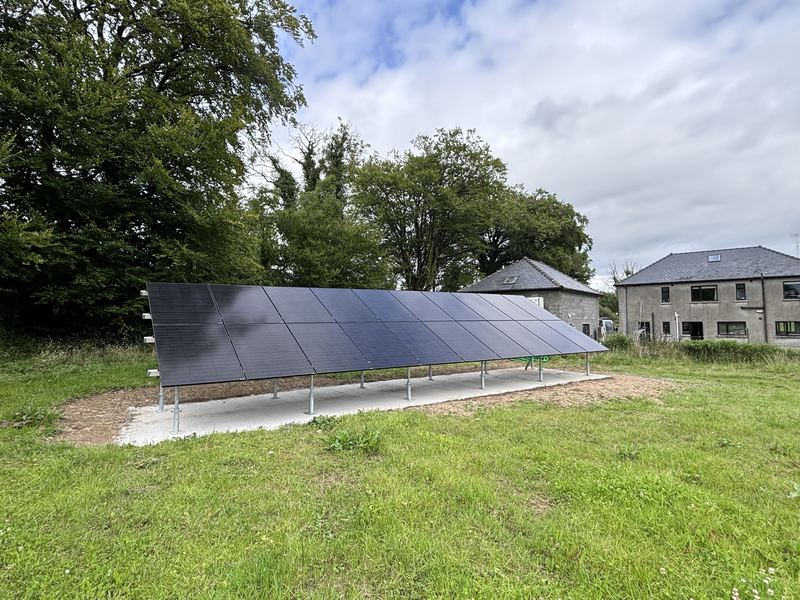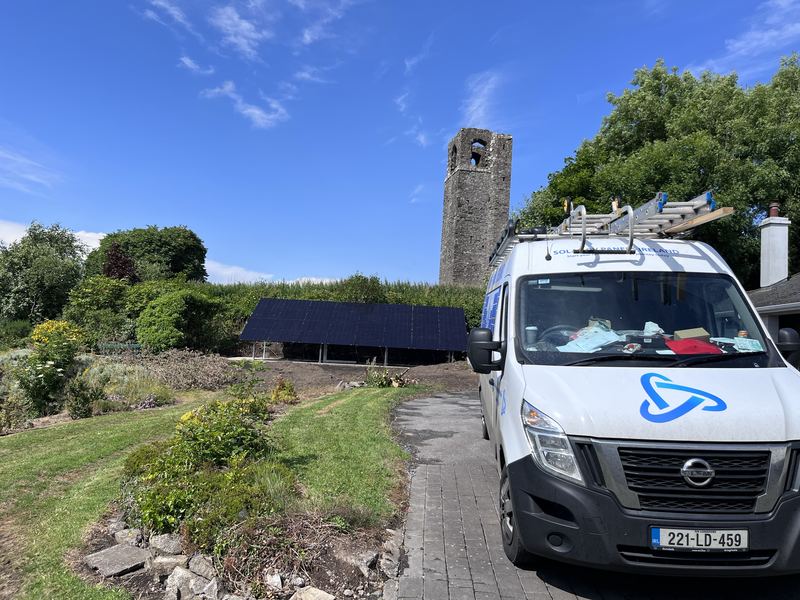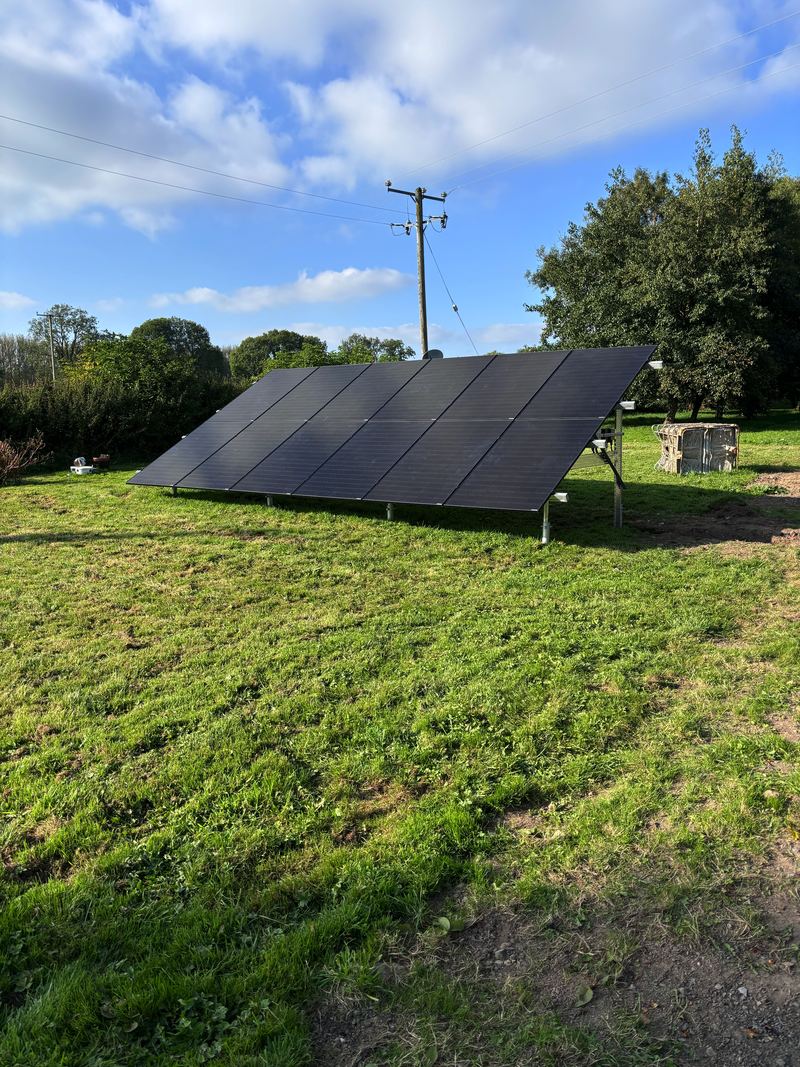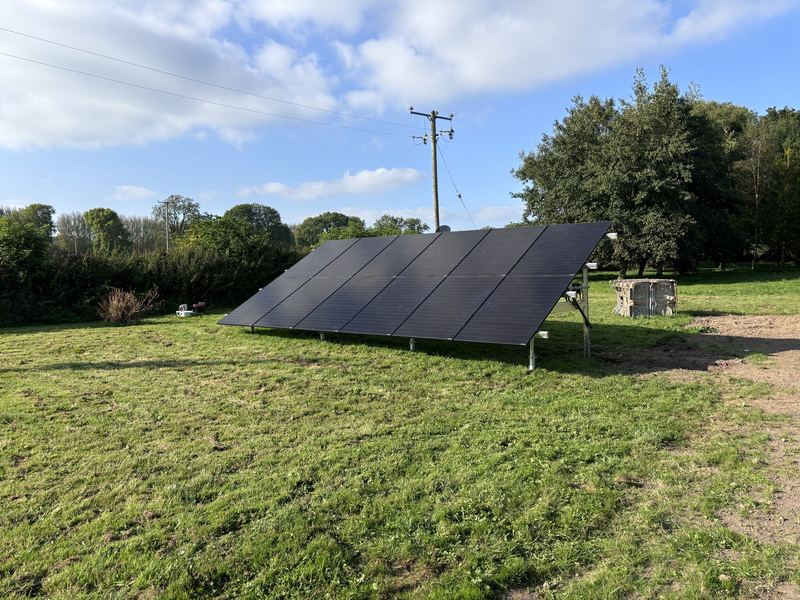
The question comes up on nearly every site visit. You have a south-facing roof of some sort, and you have a field or a big garden, and you want to know which one will actually make more electricity over the next twenty five years. It is a fair question and it deserves a numerical answer rather than a sales pitch.
The short version is that on most Irish properties a ground-mounted array will out-produce the same panels on the same house's roof, and the gap is usually somewhere between 10 and 25 per cent. The reason is not exotic technology. It is geometry, airflow and access. Below is how each of those plays out in real Irish weather, and the cases where the roof still wins.
Key takeaways
- A ground mount can be set at Ireland's optimum 30 to 35 degree tilt facing true south; a roof rarely can.
- Expect roughly 850 to 1,000 kWh per kWp per year, lowest in Donegal and Leitrim, highest in Wexford.
- Open air behind a ground frame keeps modules cooler than roof panels, worth a couple of per cent annually.
- Cleaning a ground array takes a pole brush and half an hour; roof arrays usually go uncleaned for years.
- Shading is the biggest single loss on Irish sites, and only a ground array lets you move away from it.
What actually drives yield in Ireland
Irish solar output is set by four things: how much light lands on the plane of the array, how warm the panels get, how clean they are, and how much of the year they spend in shade. Everything else, the inverter brand, the cable route, the app on your phone, moves the number by a percentage point or two.
Annual irradiation on a horizontal surface in Ireland runs from roughly 930 kWh per square metre in Donegal and Leitrim up to around 1,080 in Wexford. That is a spread of about 15 per cent from the north west corner to the south east corner, before you tilt anything at all.
Tilting a panel south at 30 to 35 degrees adds meaningfully to that figure, because the glass is presented more squarely to the sun for more of the day. In practice a well-set ground array in Ireland lands somewhere around 850 to 1,000 kWh per kWp per year, with Donegal, Leitrim and Sligo at the low end and Wexford, Waterford and south Cork at the top. Those are the numbers we design to, and they are the numbers we would ask any installer to quote you.
Tilt and orientation: the one thing you cannot change on a roof
Optimum tilt in Ireland is roughly 30 to 35 degrees from horizontal, facing true south rather than magnetic south. True south here sits a couple of degrees off the compass reading, which is a small correction but worth making properly when the frame is going in anyway.
A ground mount hits that exactly. We set the rails, check the pitch with a digital level and the heading with a GPS bearing, and that is the array's geometry for its whole working life. A roof gives you whatever the builder gave you in 1978 or 2004.
Common Irish roof pitches run around 30 to 45 degrees on older houses and 15 to 25 degrees on newer estate builds and dormers. Pitch is often close enough to be workable. Orientation is where roofs lose. A plane facing south east or south west typically gives up a few per cent against true south, and an east or west facing plane gives up considerably more, often in the region of 15 to 20 per cent.
Stack a compromised orientation on top of a shallow pitch and the roof can sit 20 per cent or more behind the same panels on a frame in the field. That single factor accounts for most of the ground mount advantage.
Diffuse light and why Irish overcast is not the disaster people expect
A lot of homeowners assume cloud kills solar. It does not. It changes the character of the generation rather than removing it.
On an overcast Irish day the light reaching the ground is mostly diffuse, scattered across the whole sky dome instead of arriving as a beam from one direction. Modern panels still generate in that light, at a fraction of their rated output rather than at nothing. A bright grey day in March will still fill a domestic battery.
Diffuse conditions do narrow the ground mount's advantage during any given cloudy hour, because when light arrives from every direction the exact angle of the glass matters less. It does not remove the advantage. Ireland still takes a substantial share of its annual energy from clear and broken-cloud days between April and August, and on those days beam angle matters a great deal.
The practical consequence is that Irish arrays produce a long, low, spread-out daily curve rather than the sharp midday spike you see in southern Europe. That suits self consumption and battery charging. It also means a slightly shallower tilt, nearer 30 degrees than 35, often makes sense where summer output matters most to the household.
Panel temperature and rear ventilation
Silicon panels lose output as they heat up. The temperature coefficient on a typical modern module is around minus 0.3 per cent per degree Celsius above 25 degrees, so a panel sitting at 55 degrees is producing roughly 9 per cent below its rated figure.
Ireland rarely sees the 40 degree air temperatures that punish arrays in Spain, but panels get far hotter than the air around them. A dark module in still, sunny June conditions can sit 20 to 30 degrees above ambient if it has no way to shed heat.
This is where a ground frame quietly wins. There is open air on every side of it. Wind moves across the back of the modules as well as the front, and the lowest rail typically sits several hundred millimetres clear of the grass. Roof panels sit on rails with a much smaller gap above the slate or tile, and that cavity warms up and stays warm through the afternoon.
The effect is not enormous in an Irish summer, generally a couple of per cent across the year. It is real, though, and it shows up exactly when output is highest and most useful.
Soiling, moss and the cleaning problem
Irish rain does most of the cleaning for you. On a panel pitched at 30 degrees or more, rainfall carries off pollen, dust and general grime without any help. Arrays that never get touched still perform perfectly well.
The exceptions are local, and they are the ones worth planning around. Bird droppings under a line of trees or a busy hedgerow. Lichen and moss creeping along the bottom frame edge in damp shaded corners, common in the wetter western counties. Silage and slurry film near a farmyard. Salt and fine sand on exposed coastal sites in Kerry, Clare and Donegal. Dust in tillage country during a dry harvest in Wexford or Meath.
None of that is difficult to remove. The difference is who can remove it. A ground array is cleaned from standing height with a soft brush on a pole and a bucket of water, by the owner, in about half an hour. A roof array means a ladder, a scaffold, or a contractor with a telescopic pole system, and in our experience most people simply never bother.
Over twenty years that access difference is worth more than the raw soiling rate ever is.
Snow, frost and the winter months
Snow is a minor factor in Ireland compared with a Nordic climate, but frost and freezing fog are not, particularly inland. Longford, Westmeath, Offaly and Roscommon see more hard frosts and more sustained fog than the coastal counties do.
A steeper tilt sheds snow and frost faster. At 30 to 35 degrees a covering of wet snow usually slides off within hours of the panel surface warming, and hoar frost burns off through the morning. At 15 degrees, common on newer estate roofs and dormers, the same covering can sit there for a day or more and produce nothing.
Ground arrays do have one snow disadvantage worth naming honestly. If the bottom rail sits low and snow drifts against the frame, the lowest row of cells can stay buried after the rest of the panel has cleared. We normally set the low edge at least 600 to 800 millimetres above ground level, which handles typical Irish snowfall and also keeps grass, weeds and rain splashback off the glass.
Shading, and how the two options differ
Shading is the most destructive thing that happens to an Irish array, and it is where site choice matters more than equipment choice.
Modules are strings of cells. Shade one cell heavily and, depending on the bypass diode layout, you can lose a third of that panel's output or more, and on a poorly configured string the loss spreads further. Optimisers and micro-inverters limit the damage, but they do not create light.
Roof shading sources are fixed and often unavoidable: the chimney, a dormer, a hip, the neighbour's gable, a satellite dish, and the mature beech or sycamore that came with the site. You cannot move the roof, and planning issues aside, you often cannot fell the tree.
A ground array can simply be sited somewhere else. Twenty metres further down the paddock, clear of the hedgerow line, is frequently all it takes. We survey the horizon with a shading tool before fixing the position, paying particular attention to the low winter sun, which in Ireland only reaches around 12 to 15 degrees above the horizon near the solstice and is therefore blocked by objects that cause no trouble whatsoever in June.
When the roof is still the better choice
We install both, and there are plenty of properties where the roof is the right call.
- A clean, unshaded, south or south west facing roof at a decent pitch. If the plane is genuinely good, the ground mount's margin shrinks to a few per cent and the extra groundworks are hard to justify.
- Urban and suburban sites where the private open space is not there. A terraced house in Drogheda or a semi in Fingal usually has no room for a frame and the row spacing it needs.
- Sites where the cable run from a suitable field back to the house is very long. Every metre of buried armoured cable adds cost and a little loss.
- Ground that is expensive to build on, such as deep peat needing long ground screws, or shallow rock needing drilled anchors.
Where the roof is compromised and the ground is available, the numbers point one way. A 6 kWp array is only about 13 or 14 panels at current module sizes, needing somewhere in the region of 50 to 60 square metres of ground for a single row, and most rural Irish sites have that to spare several times over.
Frequently asked questions
Is a ground-mounted array really 25 per cent better than my roof?
Only against a genuinely compromised roof. The 10 to 25 per cent range compares an optimally pitched south facing frame with a roof that has the wrong orientation, a shallow pitch, some shading, or all three. Against a clean, unshaded, south facing roof at 35 degrees the difference narrows to a few per cent. We model both planes for your address before advising either way.
Does Irish cloud cover make solar not worth doing?
No. A large share of Ireland's annual solar energy arrives as diffuse light through cloud, and modern panels generate in it. Output is a long low curve rather than a sharp midday peak, which suits household self consumption and battery charging well. Annual yields of roughly 850 to 1,000 kWh per kWp are normal across the country, varying mainly by county.
What tilt should a ground array in Ireland be set at?
Roughly 30 to 35 degrees from horizontal, facing true south. Nearer 35 degrees favours the shoulder months and winter, while nearer 30 slightly favours the summer peak. Both shed snow and frost adequately. Site exposure matters as well, since a very windy coastal site in Mayo or Donegal may push the structural design towards the lower end of that range.
How much ground does a ground-mounted system need?
Allow roughly 8 to 10 square metres per kWp for a single row, so a 6 kWp array of 13 or 14 panels needs about 50 to 60 square metres. Multiple rows need spacing so the front row does not shade the one behind it, and a row pitch of about 2.5 times the array height is a reasonable planning figure at Irish latitudes.
Do ground panels get dirtier than roof panels in Ireland?
Slightly, because they sit closer to grass, rain splashback, machinery dust and livestock. In practice Irish rainfall keeps a panel at 30 degrees clean enough, and the deciding factor is access rather than soiling rate. You can brush a ground array from standing height in half an hour, which is why ground arrays tend to be cleaner in year ten than roof arrays are.