Irradiance in Clare averages about 1,000 kWh per square metre annually. On that basis a properly built ground mount should return somewhere in the region of 920 kWh per kWp. Nationally the figure runs from roughly 850 to 1,000 kWh per kWp, putting Clare above the middle of the pack, and the number holds up better in the west of the county than most people expect.
The harder questions in Clare are wind and ground, not sunshine. Burren limestone, deep estuarine silt along the Fergus, and blanket peat on the higher west Clare land can appear within a few kilometres of each other. We install from Ennis and Sixmilebridge out to Kilrush, Ennistymon and Scariff, and we survey each site on its own terms.
Wind loading comes first in Clare
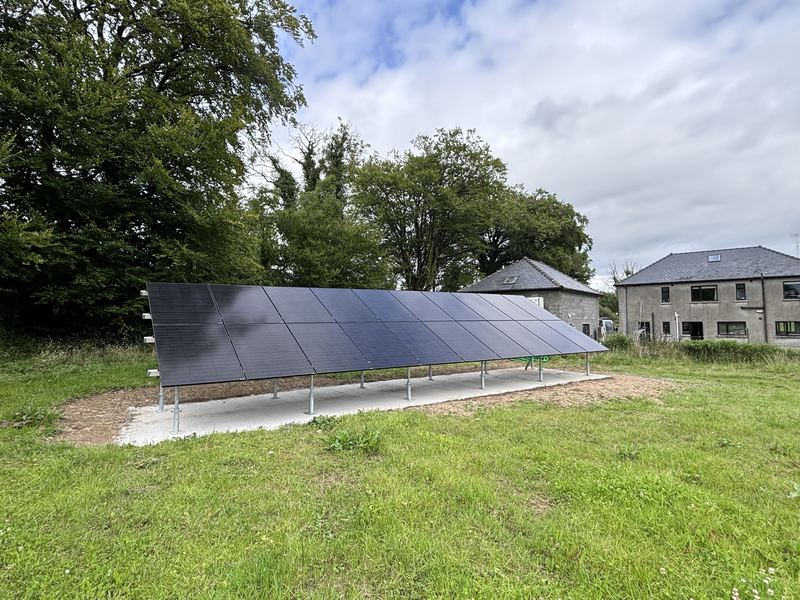
West Clare is among the most exposed places in Ireland. Frames fail in this country because of wind uplift, not because of panel quality, so the engineering brief on a Clare site starts with the structural calculation and works back from there. We design to the higher terrain category used for exposed open and coastal ground instead of a sheltered inland default.
In practice that means deeper post embedment, closer post spacing, heavier rails and more fixings per module. It also shapes the tilt. A steeper array catches more winter sun but presents a bigger sail, so on the most exposed sites we will trade a small amount of annual yield for a frame that is still square in twenty years. This is not the part of a Clare install where money should be saved.
One county, three kinds of ground
Around Ennis and the lower Fergus, estuarine silts are soft and deep, and long screws or piled solutions are the sensible route. East Clare and the Burren fringe give shallow soil over limestone, sometimes only 200 or 300 mm before rock. The higher west Clare ground carries blanket peat of very uneven depth. Foundation choice follows the probe, never the map.
The methods we use here are:
- Rock anchors, resin fixed into sound limestone, where cover is thin.
- Driven galvanised piles where there is a consistent depth of firm mineral soil.
- Ground screws, long enough to pass through soft material into competent ground beneath.
- Ballasted frames on cast pads or blocks where peat is deep or nothing may be penetrated.
It is common to need more than one of these on a single holding, which is why the whole array footprint gets probed before a price is issued. A quote priced on piles that turns into a rock-drilling job halfway through is nobody's idea of a good day, so we settle the method first.
Planning permission and Clare County Council
Most domestic ground mounts fall inside exempted development, as set out in S.I. 493 of 2022. Broadly, an array standing free inside the curtilage of a dwelling is allowed up to 25 square metres of aperture area and 2.5 metres in height, must stay behind the front wall of the house, and must leave sufficient private open space around it.
Clare carries one wrinkle worth raising early. Solar safeguarding zones near aerodromes are treated differently because of glint and glare, which puts part of the county into that conversation. Protected structures and Architectural Conservation Areas also fall outside the general exemption. Check your specific address with Clare County Council before committing to a layout, and we will supply the drawings and dimensions the enquiry needs.
Sizing an array around your own consumption
The right size is the one your site actually uses. Dairy farms on the limestone lowlands run parlour, cooling and water heating through daylight hours, which is close to an ideal match for solar. A house at Ennistymon with two people out at work all day is a different calculation, and storage becomes more relevant than extra panels.
Ground take is in the order of 8 to 10 square metres per kWp for one row, with a setback of about 2.5 times the array height where a second row goes in behind it. Most modules on the market sit between 440 and 500 W, which makes a 6 kWp system roughly 13 or 14 panels. Trenching, switchgear and the distance back to the board drive the cost more than the panel count does. Around Shannon and Sixmilebridge, three-phase supply on commercial and industrial sites opens up larger systems, which then need a full ESB Networks connection application rather than the simpler NC6 route.
Grants, export payments and the install itself
Grant support for homes comes through SEAI, and the amount moves as the scheme is reviewed and tapered, so treat seai.ie as the only reliable source for it. Broadly, the dwelling should date from before 2021 in both construction and occupation, the installing company must hold SEAI registration, and a BER assessment follows the works. Before you commit to anything we get confirmation that a free-standing array qualifies at your particular property, since a ground mount and a roof system are not always assessed on the same terms. Farmers should look at the Solar Capital Investment Scheme within TAMS III, where the grant rate for eligible applicants is 60 per cent and the ceiling is separate from other measures.
Exported units are paid for under the Clean Export Guarantee. Rates differ between suppliers and change, so compare current offers, and note the micro-generation income tax exemption that applies to that income. On site, expect setting out and foundations first, then frame, rails, panels, DC work, inverter and commissioning. A typical domestic job in Clare takes a few days once the ground is agreed.
Towns and areas we cover in Clare
We install right across the county, from Ennis and Shannon out to Scariff and every townland in between. There is no travel surcharge for being at the far end of the county.
Ground mounted solar in Clare: your questions
Will an array survive west Clare wind?
It will if it is specified for the site. We design to the higher terrain category for exposed coastal ground, which means deeper embedment, tighter post spacing and more fixings per module. Tilt is also moderated on the worst sites to reduce sail area. The structural calculation is done before the layout, not after it.
What yield should I expect in Clare?
Around 920 kWh per kWp a year from a well oriented ground mount, based on county irradiance of roughly 1,000 kWh per square metre. With the country as a whole spanning about 850 to 1,000 kWh per kWp, Clare sits comfortably inside that band. Exposure and horizon at your own site will move the number either way.
My ground is limestone with very little soil over it. Is that a problem?
Not at all, it just changes the method. Across east Clare and the Burren fringe we often find rock at 200 to 300 mm, so we drill and resin-fix anchors into sound limestone instead of driving piles. Anchored frames on rock are among the most secure foundations available. We carry the drilling gear as standard here.
Do I need permission from Clare County Council?
Many domestic arrays are exempt under the 2022 regulations, subject to the 25 square metre aperture cap, the 2.5 metre height limit, the front wall rule and the private open space test. Aerodrome safeguarding zones, protected structures and Architectural Conservation Areas are treated separately. Confirm your address with Clare County Council before ordering anything.
Can a ground mount work on a small site near Ennis?
Frequently yes. A 6 kWp array needs somewhere in the region of 50 to 60 square metres of clear ground and can be tucked along a side boundary behind the building line. The constraints on smaller sites are usually the private open space test and the front wall rule rather than a shortage of physical space.
How do you protect fixings from salt air?
On coastal sites around Kilrush and the west Clare shoreline we specify higher-grade galvanising and stainless fasteners, and we detail the frame so water sheds rather than pooling in sections. Salt attacks fixings long before it touches the panels, so the small extra cost at the bolt is worth paying at the outset.