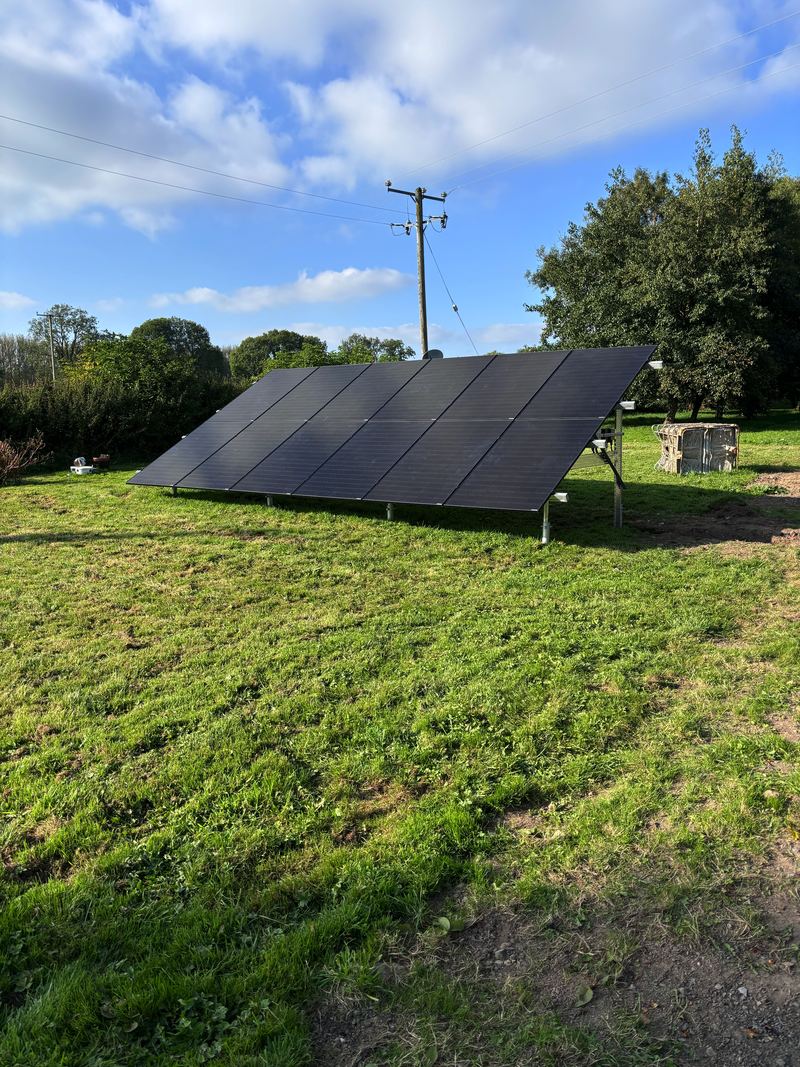
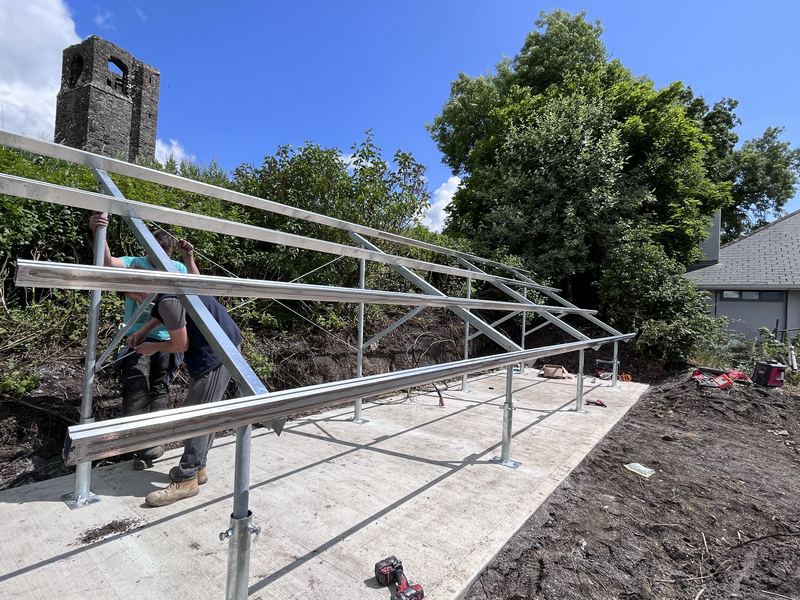
Roscommon averages roughly 960 kWh per square metre of irradiance a year, which gives about 895 kWh per kWp from a ground-mounted array. That sits mid-range against Irish figures of roughly 850 to 1,000 kWh per kWp, and it is achievable on most sites here because the county is open, low-lying and largely free of terrain shading.
The complication is underfoot. Limestone lies close to the surface across much of the county, and the raised bogs along the Shannon and the Suck are the other extreme. Both are workable. Neither is worth guessing at, which is why a probe comes before a price on every job we take on between Boyle and Athleague.
Roof or field on a Roscommon holding
Farmyards from Strokestown to Castlerea usually have at least one shed with a big south-facing slope, and on paper it looks like the obvious place for panels. In practice the purlin spacing, the sheeting condition or the age of the structure often rules it out, and a lot of dwelling roofs in the county face the road rather than the sun.
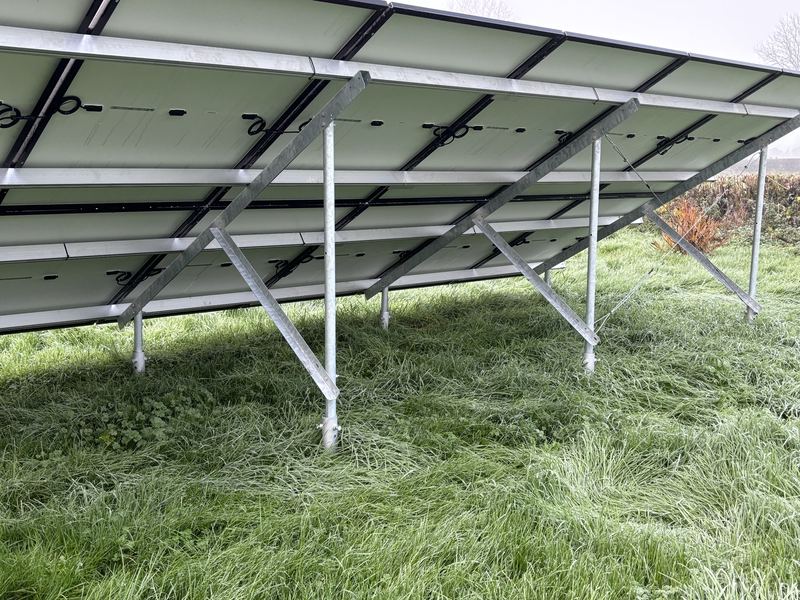
A ground frame settles the argument. Pitch goes to 30 to 35 degrees, the array faces true south, and output typically runs 10 to 25 per cent ahead of the same panels on a compromised roof. Nothing is drilled through a roof covering, nothing needs a structural report, and every part of the system stays reachable for cleaning and testing. On holdings with land to spare, giving up a corner of a field costs very little.
Exposure still gets checked. Roscommon is inland and sheltered compared with the Atlantic counties, but open callow ground and hilltop sites near Boyle carry more wind load than a yard tucked behind trees, and the frame is specified to the terrain category the site actually sits in.
Shallow limestone and what it does to a foundation
Rock at 300 to 500 millimetres is normal in Roscommon, not exceptional. That single fact is the most common cause of a re-quote in Connacht, because a price built on driven piles becomes a drilling job the moment the rig meets limestone at knee depth. We carry rock-drilling gear as standard on jobs in this county rather than treating it as a variation on the day.
Depending on what the probe shows, the foundation will be one of:
- Driven piles where soil cover is deep enough and consistent.
- Resin-fixed rock anchors into shallow limestone bedrock.
- Ballasted frames on rock, made ground, or anywhere penetration is unwise.
- Long ground screws on raised bog along the Shannon and Suck corridors.
The callows are their own case. Land that floods seasonally needs the array set well clear of the flood level, or moved to higher ground entirely.
Sizing, grants and export payments
Space is rarely the limiting factor here. A single row takes something in the order of 8 to 10 square metres for each kWp installed, and a second row has to stand back from the first by roughly 2.5 times the array height or the two will shade one another through the winter. At 440 to 500 W a panel, a 6 kWp array is 13 or 14 modules.
The SEAI grant is reviewed and stepped down from time to time, so take the current value from seai.ie and nowhere else. Eligibility normally means a dwelling built and occupied before 2021, an SEAI-registered company carrying out the work, and a BER assessment once it is finished. Confirmation that a ground-mounted array qualifies on your particular property comes before any commitment. Suckler and sheep farmers have a separate route in the Solar Capital Investment Scheme within TAMS III, grant aided at 60 per cent for eligible applicants and carrying its own investment ceiling. Whatever you export is bought back under the Clean Export Guarantee, at a rate that depends on your supplier and is revised periodically, and that income sits under a micro-generation tax exemption.
Planning permission and Roscommon County Council
Most domestic ground mounts in this county fall under exempted development. S.I. 493 of 2022, the regulations brought in that year, generally allow a free-standing array in the curtilage of a house once the thresholds are respected: no more than 25 square metres of aperture area, nothing standing higher than 2.5 metres, no part of the frame forward of the front wall, and only a limited proportion of the private open space taken up.
Take the layout to Roscommon County Council before you order, particularly if the array is going close to a boundary or beside a gable that faces the road. Protected structures and Architectural Conservation Areas fall outside the exemption and are assessed on their own merits. An array in a field beyond the curtilage, common enough on holdings around Ballaghaderreen and Boyle, is normally a planning application.
What we do on the day
The survey covers a probe grid across the array footprint, a rock check, the electrical board, the cable route and a horizon sweep. Houses in and around Roscommon Town often need a conversation about where the frame will look right as well as where it will perform best, and that is worth having before anything is ordered.
Installation starts with foundations, which on rock means drilling and setting anchors rather than driving posts. Frame, panels, DC and AC cabling, inverter and any battery follow, then testing, labelling and a handover on the monitoring. The grid side is an NC6 notification to ESB Networks, which covers micro-generation to 6 kW on single-phase or 11 kW where three-phase is present. Larger arrays take the full connection application route instead, and that adds a few weeks of paperwork.
Towns and areas we cover in Roscommon
We install right across the county, from Roscommon Town and Boyle out to Athleague and every townland in between. There is no travel surcharge for being at the far end of the county.
Ground mounted solar in Roscommon: your questions
What happens if you hit rock in my field?
Nothing dramatic, because we expect it. Rock at 300 to 500 millimetres is the Roscommon norm, so drilling gear travels with the crew and resin-fixed anchors are a standard foundation here rather than an extra. Probing across the footprint before we quote means the price reflects the ground you actually have.
How much will a ground mounted system generate in Roscommon?
About 895 kWh per kWp a year, from irradiance of roughly 960 kWh per square metre. That is a mid-range Irish figure against a national spread of about 850 to 1,000 kWh per kWp. Open country and few hills mean most sites achieve close to the modelled output rather than losing hours to terrain shading.
Can an array go on the callows or on bog ground?
On seasonal flood land the answer is usually to move the array to higher ground, because raising a frame above flood level gets expensive quickly. On raised bog along the Shannon and Suck, long ground screws or a ballasted frame work well. Either way the peat or flood depth has to be established first.
Who do I contact about planning permission?
Roscommon County Council. An array in the curtilage of a house is normally exempted development so long as it stays under the size, height and siting thresholds, though a call to the planners before ordering costs nothing. An array out in a field, or at a protected structure, is a different matter and normally needs a full application.
How long does an install take from start to finish?
Most domestic arrays are a two to three day job on site once the survey is done and the equipment has arrived. Rock drilling adds time to the foundation stage. Around that sit the design, the grid notification and the grant paperwork, so allow a few weeks overall rather than judging it by the days on site.
Do I need a battery to make it worthwhile?
Not necessarily. If you are at home during the day, or you run a workshop, pumps or a farm load, a lot of the generation is used as it is produced. Storage helps where consumption is concentrated in the evening. We look at your usage pattern first and treat the battery as a separate decision.