Farms in Ireland use electricity at the wrong time of day for a lot of technologies and at very close to the right time of day for solar. Milking starts before the sun is high, but the plate cooler, the bulk tank, the vacuum pump and the water heater run right through the middle of the day.
That is the case for farm solar in one paragraph. The TAMS III Solar Capital Investment Scheme is what moves the sums, and a ground mount is very often the only sensible place to put the array. Here is how we work through it on a farm visit.
Key takeaways
- TAMS III Solar Capital Investment Scheme grants 60 per cent, under an investment ceiling separate from other TAMS measures.
- Size a farm array from the daytime load profile, milking, cooling, ventilation or drying, not from available space.
- NC6 covers up to 6 kW single-phase and 11 kW three-phase; larger farm arrays need a full connection application.
- Asbestos sheeting, purlin spacing, orientation and wind uplift rule out many farm roofs before cost is discussed.
- A ground mount set true south at 30 to 35 degrees typically yields 10 to 25 per cent more.
TAMS III and the 60 per cent grant rate
The Solar Capital Investment Scheme sits within TAMS III and offers eligible farmers a grant rate of 60 per cent on approved solar investment. It carries its own investment ceiling, separate from the ceiling that applies to your other TAMS investments.
That separation is the part farmers most often miss. It means a solar application does not eat the allowance you were holding for a slurry store, a handling unit or a milking upgrade.
The scheme covers panels, mounting, inverter and, depending on the specification approved, battery storage. Eligible items and reference costs are set by the Department, so what you can claim against is defined rather than open ended.
Terms and reference costs are revised from time to time. Check the current position with your agricultural adviser or on the Department's own pages before you commit to a specification, and make sure approval is in place before any work starts on site.
Grant aid also changes the shape of the decision, not just the price. At a 60 per cent rate, a system sized properly to the farm's own load becomes viable on farms where the same array would not have made sense on cash alone, which is why the load analysis matters more than the headline percentage.
Start with the load profile, not the roof area
The size of a farm array should come from consumption, not from how much space happens to be available. We ask for twelve months of bills, or half hourly data where the meter provides it, and we look at when the load actually falls.
A dairy has two sharp peaks and a long midday plateau of cooling and water heating. That plateau is where solar earns its keep.
Poultry houses run ventilation continuously and hardest in warm bright weather, which is when the array is producing most. That is close to an ideal match. Mushroom units run climate control year round with a high, flat base load, which is almost as good.
Grain drying is the awkward one, a heavy short seasonal draw in late summer and autumn that coincides with reasonable generation but not with the annual peak. Every unit you use yourself is worth considerably more than a unit exported, so size to the daytime base load first and extend with storage after.
Beef and sheep farms are the honest exception. A drystock yard in Leitrim with a couple of lights, a water pump and a welder does not have the daytime load to justify a large array, and we will say so. In that case the dwelling load, an EV or a heat pump usually carries the case instead.
Single-phase, three-phase and what your supply can carry
Most yards with a milking parlour or significant motor load are already on three-phase. If yours is not, adding it carries a cost and a lead time from ESB Networks that has to be established before the design is finalised, not after.
Three-phase changes what is possible. It raises the micro-generation notification threshold, suits larger inverters and balances load better across the yard.
Check the rating of the existing supply and the main board as well. We regularly find yards where the incomer, the mains cable from the pole or the board itself is the real constraint rather than the roof or the field.
Where a farm has more than one MPRN, for example a dwelling on one meter and the yard on another, an array can only offset load on the meter it is connected to. That single fact often decides where the array goes and where the trench runs.
ESB Networks: NC6 notification or a full connection application
For micro-generation, ESB Networks operate the NC6 notification process. It covers up to 6 kW on single-phase and up to 11 kW on three-phase, and it is a notification submitted by the installer rather than an approval you sit waiting on.
Above those figures the system needs a full connection application. That is a longer process, typically a few weeks at minimum, and what comes back can carry conditions.
Most farm arrays sit well above 11 kW, so plan for the full application from the start. Begin it early, because the design, the inverter selection and any export limit can all be affected by the response.
It is also possible to install a larger array and limit export at the inverter. Where the objective is self-consumption rather than export income, that is frequently the cleanest route and it can simplify the connection considerably.
Either way, the paperwork is our job rather than yours. We prepare the single line diagram, the inverter datasheets and the application itself, and we keep the grant timeline and the connection timeline running alongside each other so neither one holds up the other.
Why a ground mount usually beats the shed roof
Farm sheds look like free real estate and often are not. The first thing we check is whether the sheeting is asbestos cement, which is common on older hay barns and cubicle houses. You do not fix panels to it and you do not walk on it.
Purlin spacing is the next issue. Agricultural buildings are designed to a different standard than houses, and the spacing, section and condition of the purlins frequently will not take the additional load without strengthening.
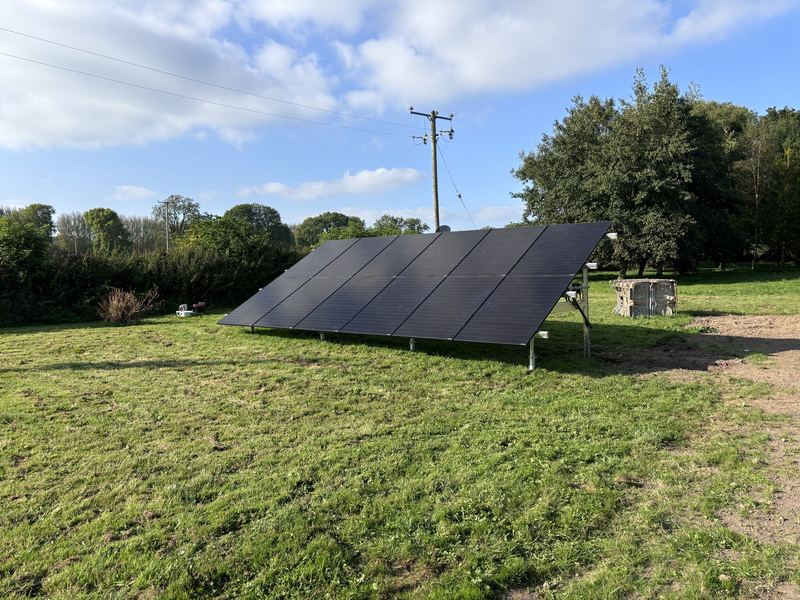
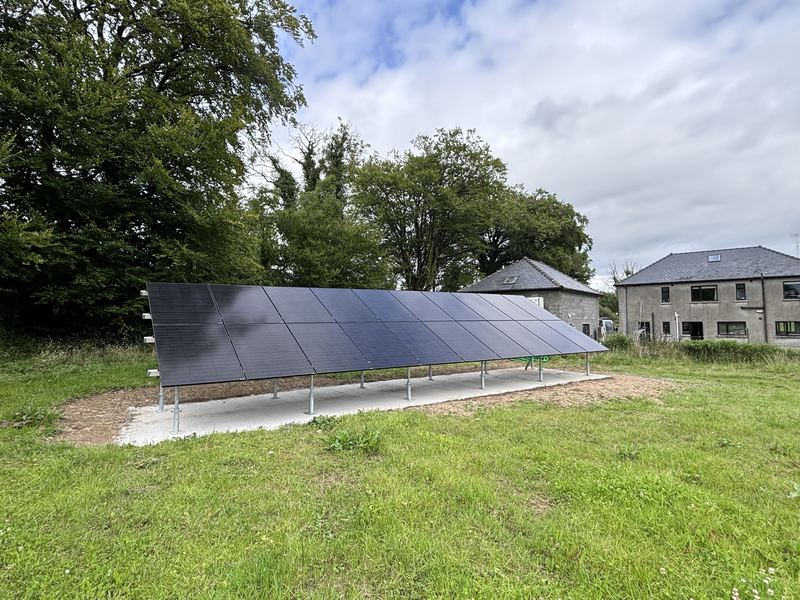
Then orientation. Sheds are aligned to the yard and the prevailing wind, not to the sun. A roof running the wrong way costs you 10 to 25 per cent compared with a ground mount set true south at 30 to 35 degrees.
Wind uplift is usually what ends the conversation. An exposed shed roof in Clare or Donegal sees serious uplift loading, and fixings and structure have to be calculated for it. A ground frame sits low, is engineered for that specific site, and can be inspected and maintained from the ground for twenty five years.
There is a practical point too. If a shed roof needs replacing in eight years, the panels have to come off and go back on. A ground array does not tie the solar investment to the life of a building you may want to alter, extend or knock.
Foundations and ground conditions on a farm
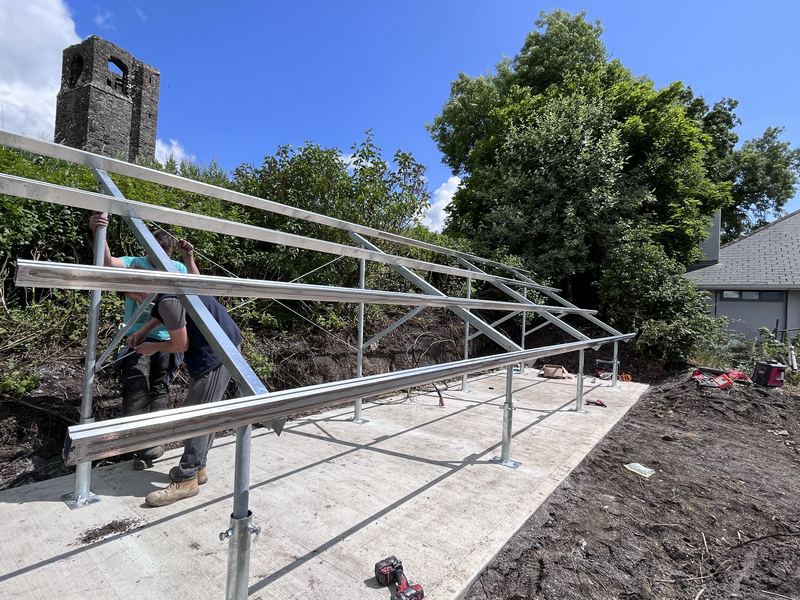
What goes under the frame depends entirely on what is under the field. Driven galvanised piles are the fastest and cheapest option where there is firm mineral soil or boulder clay and the driving rig can get in.
Ground screws suit softer or mixed ground, including peat where the screws are long enough, and they can be wound back out later without leaving concrete behind. That matters on rented land or where reinstatement is a condition.
On shallow limestone, which covers a lot of Galway, Clare and Roscommon, resin fixed rock anchors are usually the answer. Where nothing may be penetrated, on deep peat, made ground or over services, ballasted frames weighted with concrete are the fallback.
We dig trial holes before quoting foundations. A single field can contain three of these conditions, and guessing at that stage is how a job goes wrong.
Siting matters as much as the method. Keep the array clear of slurry spreading lines, silage pit traffic, the route the contractor's harvester takes and any ground you may want for a future shed. Frames are movable in theory and nobody ever moves them in practice.
Battery storage and where it pays on a farm
A battery on a farm is not a backup toy. It shifts midday generation into the milking peaks at either end of the day, which is exactly where a dairy's demand sits and where solar is weakest.
Sizing follows the same logic as the array. Look at the evening and early morning draw, size the battery to cover a useful share of it, and stop there. An oversized battery cycles less often and takes longer to justify.
Storage also covers the harvest and drying period, holds cheap night rate units where the tariff supports it, and gives some resilience during outages if the system is specified for it.
Raise storage at the application stage rather than afterwards, because grant treatment depends on the specification that was approved.
Export, the Clean Export Guarantee and tax
Suppliers are obliged to pay for units you export under the Clean Export Guarantee. Rates differ between suppliers and they change, so compare current rates rather than a figure somebody quoted two years ago.
Export is a bonus rather than a business plan on an array sized to your own load. If you find yourself exporting a large share of what you generate, either the array is too big or the load profile was read wrong.
There is a micro-generation income tax exemption covering profits from the sale of exported electricity, subject to conditions and to limits set out in legislation. Confirm the current position with your accountant, because it has been amended more than once.
Grant aid, self-consumption and export all interact with each other. Work them out together, before the order goes in, not after the panels are on the frame.
Frequently asked questions
Does TAMS III cover ground mounted solar as well as roof mounted?
The Solar Capital Investment Scheme is about the solar installation rather than a particular mounting method, and eligible items are defined by the Department's own list and reference costs. Because specifications and eligible items are revised periodically, confirm the current treatment of a ground mounted system with your agricultural adviser before you commit, and make sure written approval is in place before work begins.
Do I need three-phase for a farm solar array?
Not always, but it helps. Three-phase raises the micro-generation notification threshold to 11 kW, suits larger inverters and balances load across the yard better. Most parlours and yards with significant motor load already have it. If yours does not, price the upgrade and the ESB Networks lead time before the array is designed, because it changes what the system can be.
How large an array can I install without a full connection application?
Micro-generation under the ESB Networks NC6 notification route covers up to 6 kW on single-phase and up to 11 kW on three-phase. Above those figures you need a full connection application, which takes longer and can come back with conditions. Most farm arrays exceed 11 kW, so the full application is the normal route and it should be started early.
Can I put solar panels on an asbestos cement roof?
No. Asbestos cement sheeting cannot be drilled, fixed to or walked on, and it is still common on older hay barns and cubicle houses. Replacing the roof to make it suitable is a substantial cost in its own right. In most cases a ground mounted array in an adjoining field is cheaper, performs better and avoids the asbestos question entirely.
Should a battery be part of my TAMS application?
Often yes, because a battery moves midday generation into the morning and evening milking peaks where a dairy's demand actually sits. Grant treatment depends on the specification approved, so raise storage at application stage rather than adding it later. Size it against your evening draw rather than buying the largest available unit, which cycles less and takes longer to pay back.