Cavan is drumlin country, and drumlins change the conversation. Between small fields, tall hedgerows and more than 350 lakes, the direction a piece of ground faces can change inside a hundred metres. That single fact decides more about a Cavan array than any panel specification. Annual irradiance in the county is close to 950 kWh per square metre.
Expect somewhere near 885 kWh per kWp a year from a well sited system. Ireland as a whole runs between roughly 850 and 1,000 kWh per kWp, so Cavan sits mid-band, and careful siting is what keeps you at the upper end of what the county can give. We install throughout Cavan Town, Virginia, Bailieborough, Cootehill, Ballyjamesduff and Belturbet.
Choosing the right drumlin flank
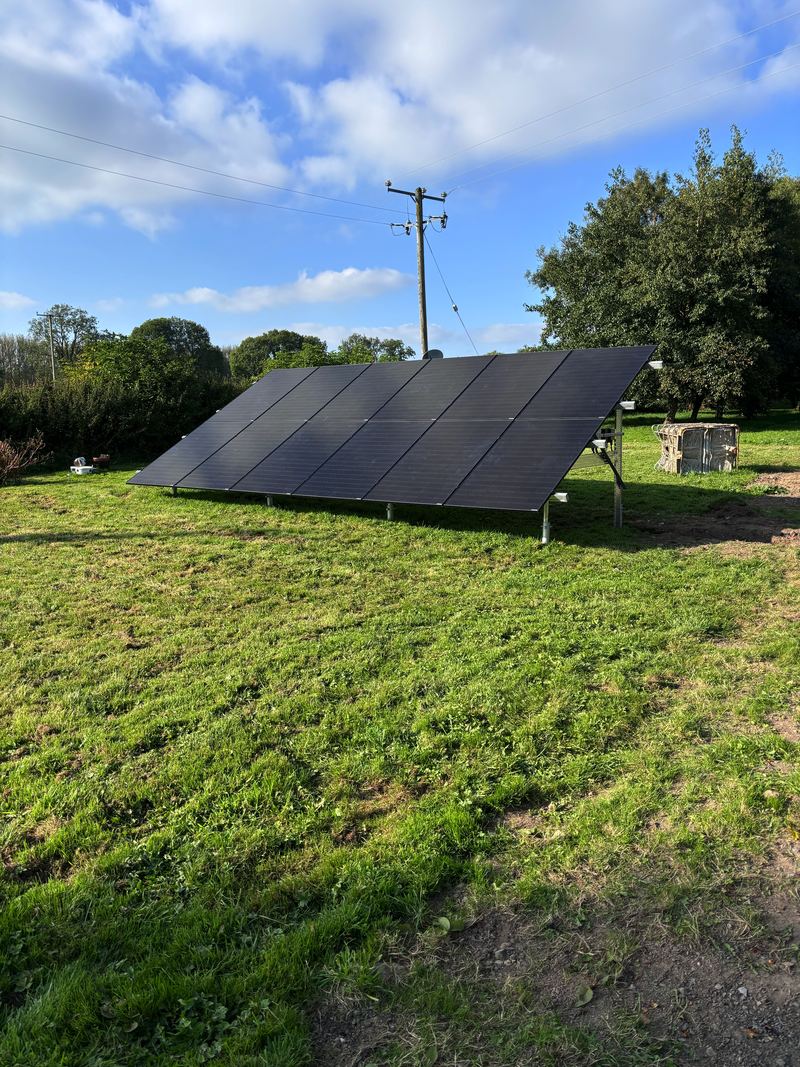
Site selection is the biggest yield lever in this county, ahead of panel brand and ahead of inverter choice. A south-facing drumlin flank is a gift. It adds tilt at no cost, it drains, and it keeps the frame out of the wet hollow at the bottom. A north-facing flank on the same holding can cost you a fifth of the annual output for identical equipment.
So we walk the whole farm, not only the field beside the house. A slightly longer cable run to a better aspect is nearly always the cheaper decision across twenty-five years of generation. Hedgerow height counts too. Cavan hedges are mature and tall, and a boundary that looks harmless in July will sit squarely across the low winter sun in December. Horizon readings get taken from the proposed array line, not from the yard gate.
Gley soils, boulder clay and holding a frame down
Under the grass, most of the county is stiff boulder clay and poorly drained gley over shale, with cutaway bog in the hollows and along the lake margins. This is not classic pile-driving ground. Water sits high for much of the winter, and a foundation designed on the strength of a dry August trial hole will be working in very different conditions by February.
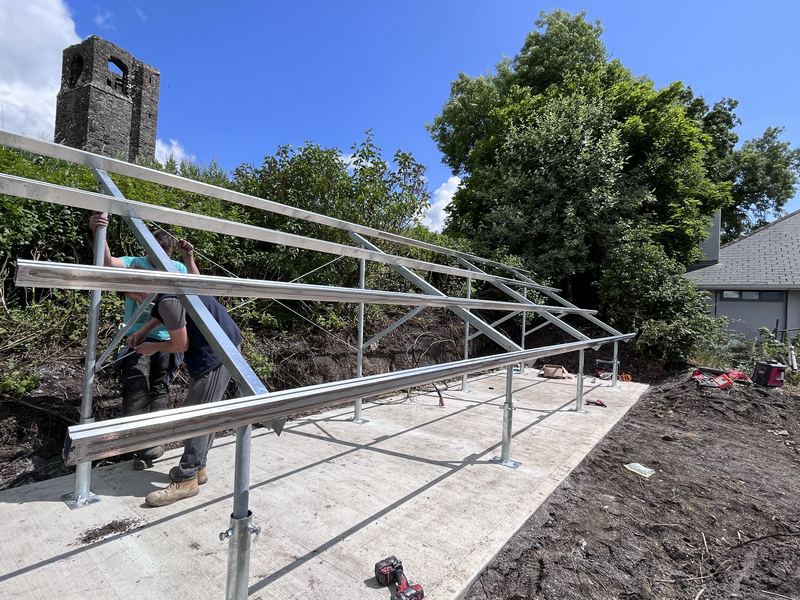
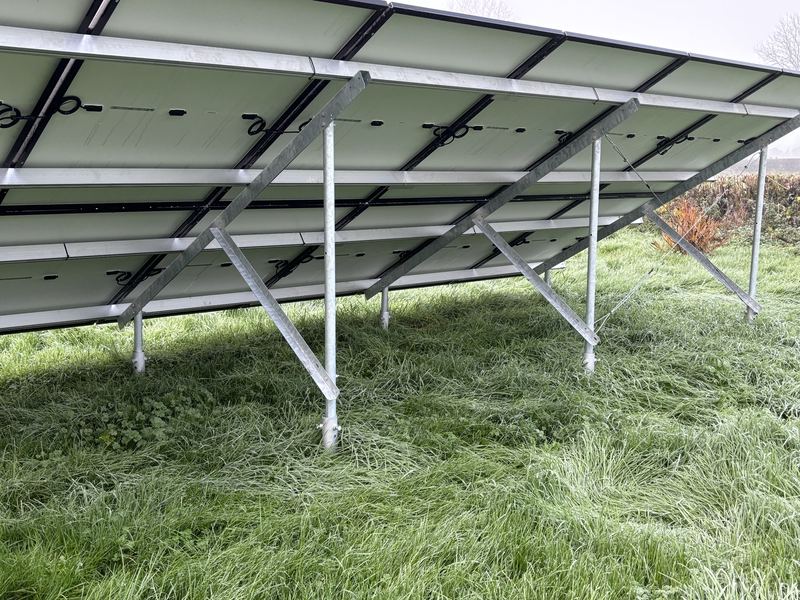
Two methods do most of the work. Long ground screws, wound down through the soft upper layer into competent material, are quick, removable and well suited to the mixed ground between drumlins. Ballasted frames weighted with cast pads or blocks take over where peat is deep or where nothing should be penetrated at all. Probing happens on a grid across the whole array footprint, and we design for the wettest month of the year rather than the driest.
Poultry sheds, parlours and daytime demand
Cavan carries a strong poultry sector alongside beef and sheep, and those units run fans, lighting, feed systems and chillers right through the middle of the day. That load profile is what makes solar pay. Units generated at noon are consumed on site at noon, so you displace the full retail price of electricity instead of exporting at a lower rate.
Farm roofs here are usually the wrong answer. Sheds were built for stock and machinery, so the ridge runs to suit the yard, the pitch is shallow and the purlins were never sized for extra load. An array in the field beside the shed sidesteps all of it. Sitting at optimum tilt and true south, it will typically give 10 to 25 per cent more than the same panels on a compromised roof, and every module stays reachable from ground level for cleaning and fault-finding.
Planning permission and Cavan County Council
In general, a free-standing array within the curtilage of a house is exempted development under the 2022 regulations (S.I. 493 of 2022), provided it stays inside the limits. Those limits include an aperture area of no more than 25 square metres for a house, a height of no more than 2.5 metres, no siting forward of the front wall, and a restriction on how much of the private open space the array may occupy.
Agricultural land and farm buildings fall under separate provisions carrying their own conditions. Protected structures and Architectural Conservation Areas are handled differently again, as are solar safeguarding zones near aerodromes. Ring Cavan County Council with your dimensions and proposed position before a frame is ordered. We prepare the layout drawing and the measurements you will be asked for, so the enquiry takes one call rather than three.
Sizing, grants and payment for exported units
Domestic systems in Cavan commonly land between 6 and 12 kWp, farm systems higher. Reckon on 8 to 10 square metres of ground for every kWp in a single row, and leave about 2.5 times the array height between banks so the front one is not throwing shade on the next. With 440 to 500 W modules in common use, 6 kWp works out at 13 or 14 panels.
Support and income come from a few directions:
- The SEAI domestic solar grant. Values step down periodically as the scheme is reviewed, so pull the live figure from seai.ie before you budget. Eligibility generally rests on the house having been built and occupied before 2021, on an SEAI-registered installer doing the work, and on a BER assessment carried out afterwards.
- TAMS III carries a Solar Capital Investment Scheme with a 60 per cent grant rate for eligible farmers, sitting on an investment ceiling of its own. Poultry and beef holdings around Cootehill and Bailieborough fit it well.
- Clean Export Guarantee payments for whatever you push back to the grid. Every supplier sets its own rate and those rates move, so compare before you switch tariff. A micro-generation income tax exemption covers the earnings.
Eligibility for a free-standing array at your particular address is established before you commit a euro.
Towns and areas we cover in Cavan
We install right across the county, from Cavan Town and Bailieborough out to Belturbet and every townland in between. There is no travel surcharge for being at the far end of the county.
Ground mounted solar in Cavan: your questions
Why does Cavan yield less than the south east?
Latitude and cloud. Cavan sees roughly 950 kWh per square metre of irradiance a year against well over 1,000 in the sunniest counties, which puts expected output near 885 kWh per kWp. Nationwide output falls between roughly 850 and 1,000 kWh per kWp, so Cavan is mid-table rather than poor, and careful siting recovers much of the difference.
Which field should the array go in?
Whichever drumlin flank faces closest to south with a clear horizon. On a typical Cavan holding the difference between the best and worst aspect is worth around a fifth of annual output, so it is worth paying for extra cable. We survey the whole farm and mark two or three candidate positions before designing anything.
The ground is wet all winter. Will a frame stay put?
Yes, with the right foundation. On heavy gley and boulder clay we use long ground screws that pass through the soft layer into competent material, or ballasted frames on cast pads where peat is deep. Probing is done on a grid, and the design assumes a winter water table rather than the level found on a dry survey day.
How long does the ESB Networks side take?
ESB Networks accepts an NC6 notification for micro-generation, with thresholds of 6 kW on a single-phase supply and 11 kW on three-phase. Above those, a full connection application is required and typically adds a few weeks. We complete the forms, submit them and chase them as part of the installation rather than leaving that with you.
Is a battery worth adding on a poultry unit?
Often less urgent than on a house. Poultry and mushroom sheds already draw heavily during daylight, so most generation is consumed as it is produced and there is little surplus to store. Where night loads are significant, or where you want backup, storage earns its place. We look at your actual half-hourly consumption before recommending it.
Can the array be moved if the farm layout changes?
Ground screws are removable, which is one reason they suit Cavan. The screws can be wound out, the frame lifted and the ground reinstated with no concrete left behind. Ballasted systems come apart just as readily. It is not a free exercise, but a ground mount is far less permanent than most people assume.