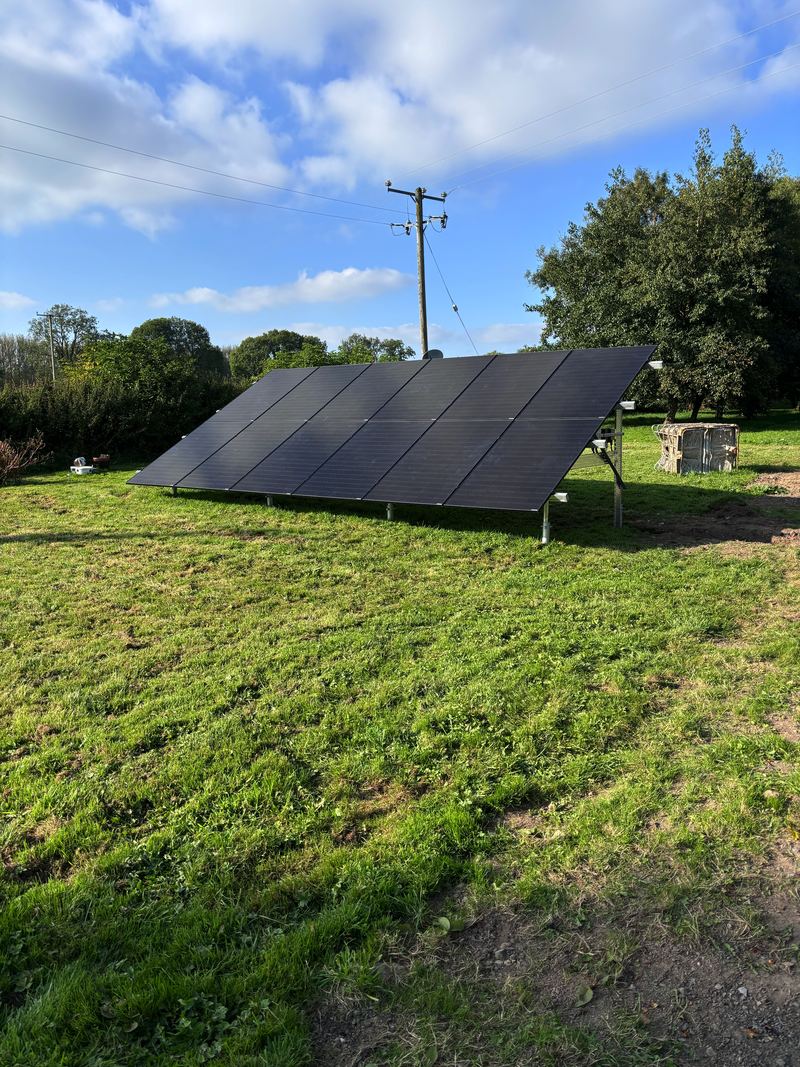
Meath averages about 1,000 kWh per square metre of irradiance a year, and a ground-mounted array here typically returns around 930 kWh per kWp. Put that beside the Irish range of roughly 850 to 1,000 and the county sits comfortably in the upper half. The land helps as well. Deep boulder clay over limestone gives predictable driving resistance and a stable water table, which is the sort of ground that keeps a foundation quote honest.
We install from the commuter belt around Ashbourne and Dunboyne through Navan and Trim to the tillage country beyond Kells, and along the coast at Laytown. Site sizes here tend to be generous, so an array rarely has to fight for space.
Roof compromise versus a frame you control
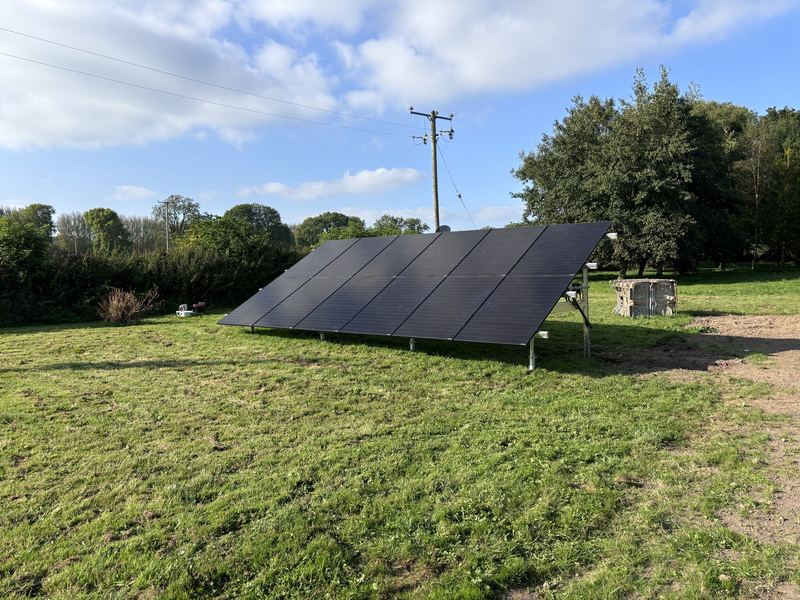
Most houses in Meath were built with a roof shape chosen for the estate, the site or the planner, not for a solar panel. East-west ridges, dormers, chimneys and mature garden trees all cut into what a roof array can deliver. A frame in the garden or the paddock removes that argument, because we choose the pitch and the bearing.
Set at optimum tilt and pointed true south, an identical set of panels usually beats a compromised roof by 10 to 25 per cent. On an equine or tillage holding the gap tends to be wider still, since the big sheds were designed to span a yard rather than to face the sun. There is a maintenance argument too. Panels at head height get cleaned, checked and, if a string ever goes down, repaired without a scaffold or a roof ladder.
Planning: what Meath County Council expects
The 2022 exempted development regulations, S.I. 493 of 2022, broadly allow a free-standing array inside the curtilage of a house without planning permission. The general limits are 25 square metres of aperture area for a house, 2.5 metres in height, nothing forward of the front wall, and a ceiling on the share of private open space the array may occupy. Half-acre sites around Ratoath and Dunboyne clear the space test easily, while tighter town plots need the numbers checked properly.
Run your layout past Meath County Council before ordering. Protected structures and Architectural Conservation Areas are treated separately, and the county has plenty of both given its archaeology and its older town centres. Anything outside the curtilage, or any array serving a farm or business at scale, is normally a planning application rather than an exemption.
The ground under a Meath array
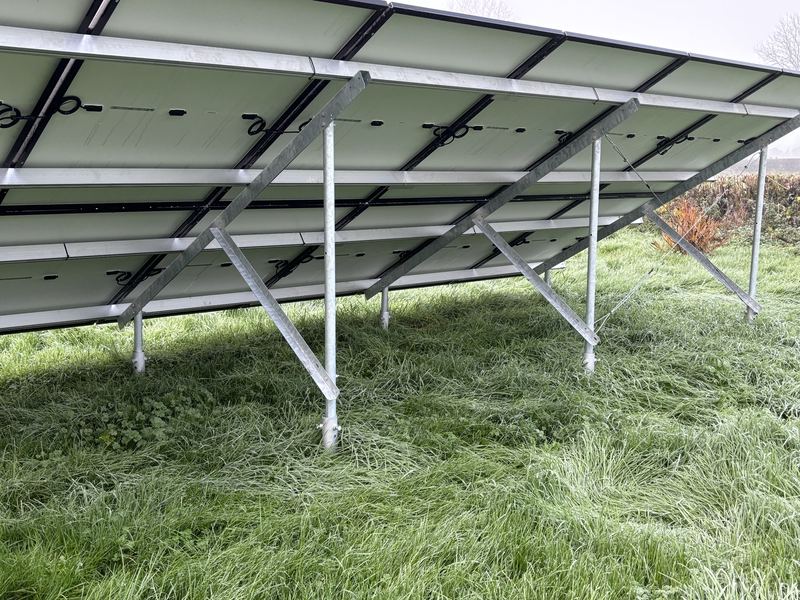
Boulder clay over limestone runs beneath most of the county, and it is about as good as Irish ground gets for a solar foundation. Resistance stays consistent, the water table behaves itself through the year, and a driven pile rig can put in a full row without drama. That keeps foundation costs down and takes the biggest variable out of the price.
Not every site follows the pattern. River flats along the Boyne and the Blackwater carry alluvium, older yards can hide made ground under the surface, and shallow rock does appear in places. We still probe, because finding out on install day is expensive. Where the probe shows something awkward we switch to screws or a ballasted frame rather than forcing a pile in.
Install day on a Meath site
Survey first. We mark the array position, walk the cable route, check the board and shoot the horizon so shading from a beech line or a neighbouring shed lands in the model instead of arriving as a surprise. Most domestic jobs in this county move from survey to commissioning with no awkward engineering in between.
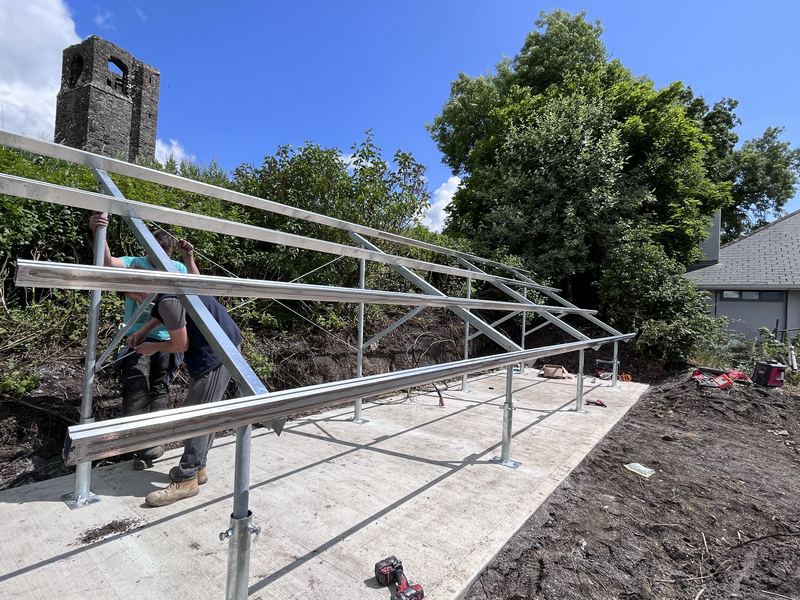
Foundations go in first, usually within a day on good clay. Frame, panels, cabling, inverter and any battery follow. Reinstatement matters on a lawn or a paddock, so the rig route is planned and sod lifted where that makes sense. ESB Networks takes an NC6 notification for micro-generation, with the ceiling at 6 kW on single-phase and 11 kW where three-phase is present. Above that, a full connection application is needed, and the paperwork usually runs to a few weeks.
Sizing, grants and getting paid for exports
Space first: budget 8 to 10 square metres of ground for every kWp in a single row. Where a second row is needed, the gap between rows is normally planned at about 2.5 times the height of the array so the front row does not throw shade on the one behind. With 440 to 500 W panels in common use, a 6 kWp array is 13 or 14 panels, and the 10 to 16 kWp domestic systems that Meath sites often take are simply longer rows of the same thing.
What size actually suits you comes down to a handful of things:
- Your annual consumption and how much of it lands in daylight hours.
- A battery, and how much capacity it needs.
- Single-phase or three-phase supply at the meter.
- Space, orientation and the exempted development limits.
On grants, the SEAI figure is reviewed and stepped down periodically, so check seai.ie for the current value. Eligibility usually rests on three things: a house built and occupied before 2021, an SEAI-registered contractor doing the work, and a BER assessment carried out afterwards. We confirm that a ground-mounted array qualifies at your address before you spend anything. Farmers have TAMS III instead, where the Solar Capital Investment Scheme is grant aided at 60 per cent for eligible applicants. Your supplier is obliged to buy exported units through the Clean Export Guarantee, at rates that sit in a range and move around, and a micro-generation income tax exemption covers that income.
Towns and areas we cover in Meath
We install right across the county, from Navan and Ashbourne out to Laytown and every townland in between. There is no travel surcharge for being at the far end of the county.
Ground mounted solar in Meath: your questions
What annual yield should I expect from a ground mount in Meath?
Around 930 kWh per kWp per year, off roughly 1,000 kWh per square metre of irradiance. That places Meath in the upper half of the Irish range of about 850 to 1,000 kWh per kWp. A 12 kWp array is therefore looking at something in the region of 11,000 kWh annually, before shading and usage patterns are considered.
Is Meath boulder clay really that good for foundations?
It is among the most consistent driving ground in the country. Deep boulder clay over limestone gives predictable resistance, so a pile rig makes steady progress and the foundation cost stops being a guessing game. The exceptions are river flats along the Boyne, made ground in old yards, and the occasional shallow rock, all of which the probe picks up.
Do I need permission for an array at a house in Trim or Ashbourne?
Usually not, if it sits within the curtilage and inside the exempted development limits on aperture area, height, position and private open space. Meath County Council is the authority to confirm it with, and that is worth doing before a frame is ordered. A protected structure, or a house standing inside an Architectural Conservation Area, is outside the exemption altogether.
How large can a domestic ground mounted system be?
Electrically, a good deal larger than most roofs allow. The practical caps are your supply type, your consumption and the 25 square metre aperture limit for exempted development. Beyond that limit you can still build, but you are into a planning application. Ten to sixteen kWp is routine on Meath sites with space and a three-phase or upgraded supply.
How long does the grid side take?
An NC6 notification covers micro-generation, and we lodge it as part of the job. The ceiling is 6 kW on a single-phase supply, 11 kW where three-phase is available, and anything beyond that becomes a full connection application with a longer lead time. Typically you are talking a few weeks rather than months for the standard domestic notification route.
Can I add a battery after the array is running?
You can, and plenty of customers do. It is cheaper to plan for it at the outset, because the inverter choice, the cable sizing and the space beside the board all change if storage is coming later. We size the array to your daytime consumption first, then look at whether storage earns its place on your usage pattern.