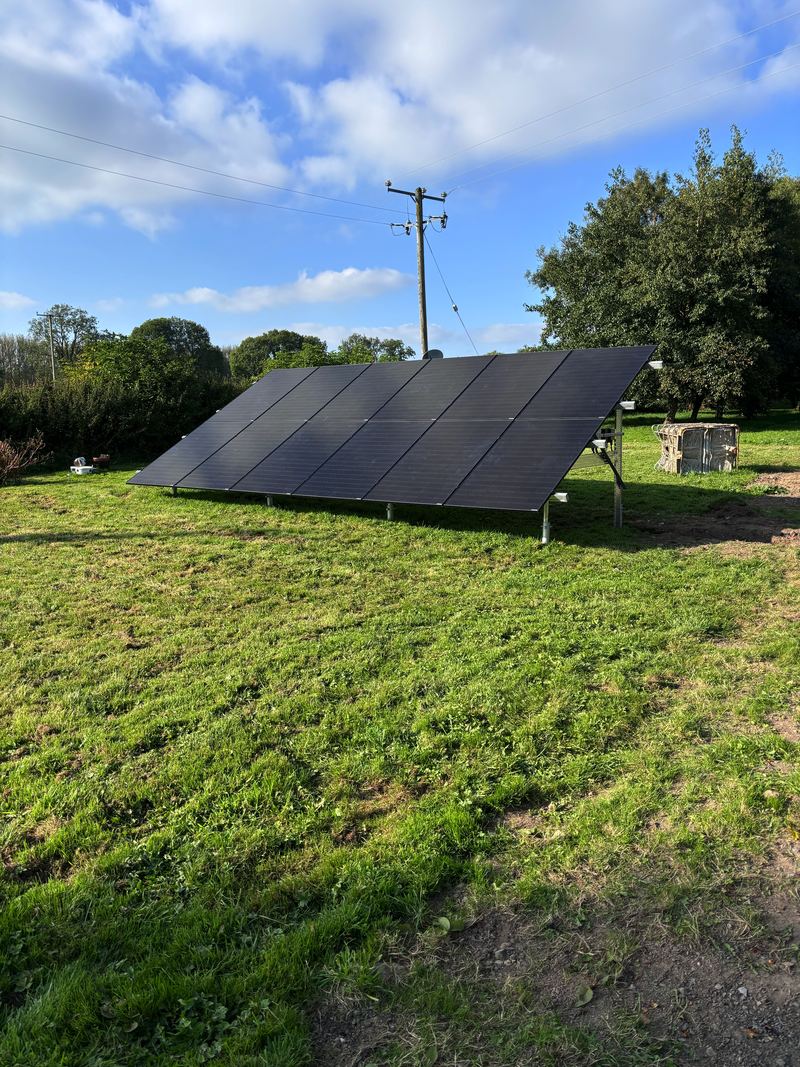
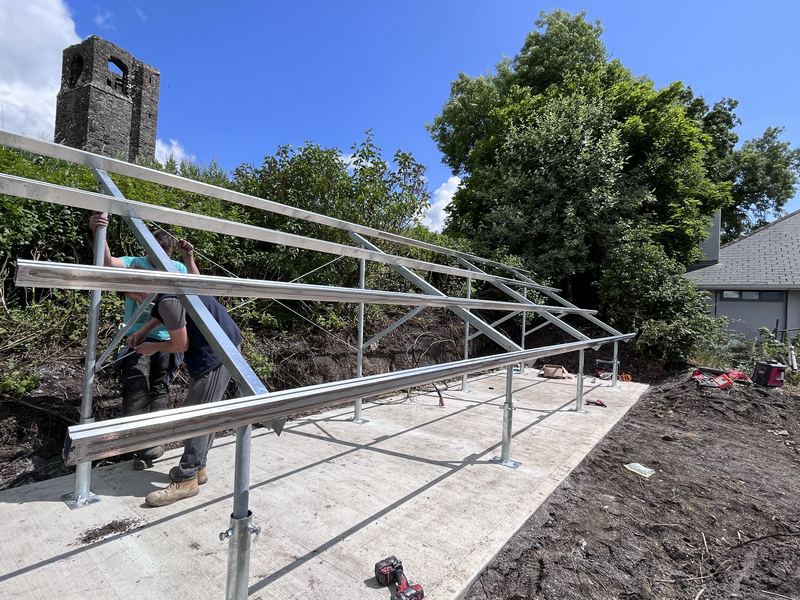
Donegal has the lowest irradiance of the twenty-six counties, at roughly 930 kWh per square metre a year, and the highest wind exposure. A ground mount here typically returns around 870 kWh per kWp annually. Ireland as a whole spans roughly 850 to 1,000 kWh per kWp, and Donegal sits near the bottom of that. We would rather state that plainly than quote you a Munster number and disappoint you later.
None of that makes solar a poor idea in this county. It makes the design different. Orientation, tilt and structural specification carry more weight here than almost anywhere else, and there is no margin in a cheap frame. Our crews work across Letterkenny, Ballybofey, Buncrana, Carndonagh, Donegal Town and Bundoran.
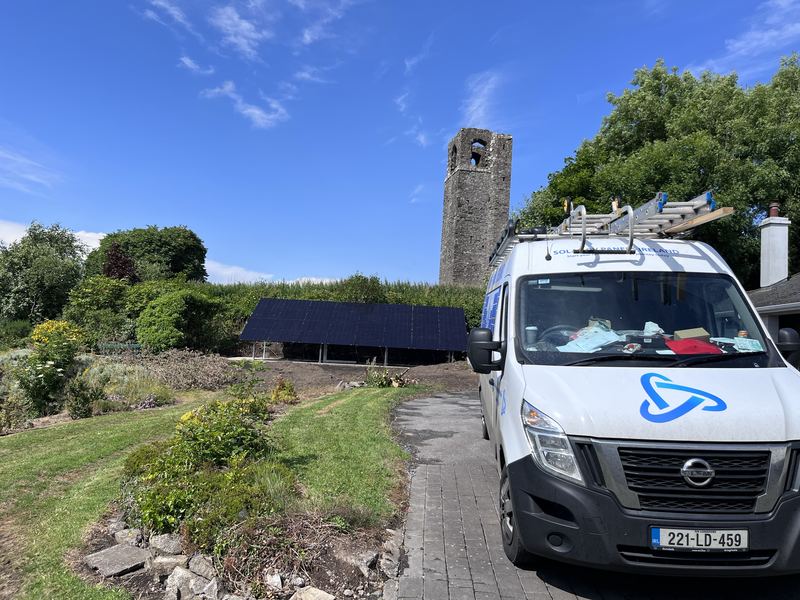
Honest numbers for a Donegal site
At about 870 kWh per kWp, a 6 kWp array in Donegal generates meaningfully less over a year than the same kit in Wexford or Waterford. That gap is real and we build it into the sizing rather than papering over it. What offsets it is that a ground mount is free to sit at the pitch and orientation you choose, which is worth 10 to 25 per cent against a house roof that faces the wrong way.
Two things then decide whether a Donegal system performs. The first is horizon. Hills, forestry and rising ground behind a site can remove an hour from a short winter day, so we model the skyline from the panel line. The second is self-consumption. Units used in the house as they are produced are worth far more than units exported, so the size of the array should follow your daytime demand.
Peat depth decides everything below the panels
Blanket peat over schist and granite covers much of the county, with far better mineral soils in the Laggan district and along the Finn and Foyle valleys. Peat depth is not uniform. It can change by a metre inside the length of an array, which is precisely why a peat probe survey is not optional on a Donegal site.
Where the Laggan gives firm mineral ground, driven piles work well and are the quickest route. On peat we go to longer ground screws that reach competent material underneath, or to spread footings and ballast that distribute the load across the surface without relying on penetration at all. A short pile in deep peat is the classic Donegal mistake. It looks fine on installation day and it does not survive a full winter.
Building for Atlantic wind and salt
Wind, not sunlight, is the design driver here. Reckon on eight to ten square metres of ground for each kWp when you are picturing the footprint, and remember that a low, tight frame is far easier to hold down than a tall one. Along Inishowen, the north coast and the Bundoran shoreline, gusts are among the strongest recorded in the country, and uplift on a tilted panel array is significant. We size for structural survival first and take nothing off the frame to reduce a price.
What that means in practice on a Donegal build:
- Design to the exposed terrain category, with the frame calculation done before the layout is fixed.
- Deeper embedment or a larger ballast footprint than an inland site would need.
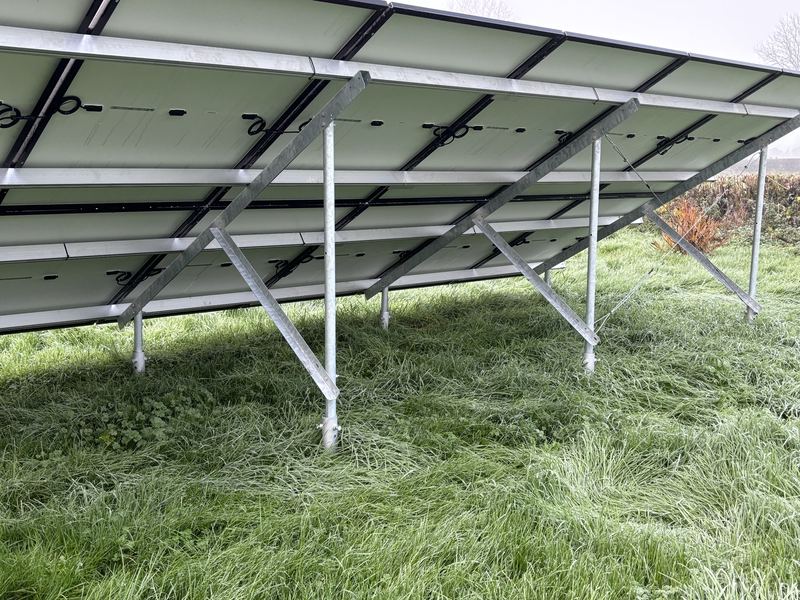
- Closer post centres, heavier rails and additional module clamps.
- Higher-grade galvanising and stainless fixings within reach of salt-laden air.
- Moderated tilt on the most exposed positions to cut sail area.
The panels are rarely the weak point. Fixings, posts and the ground they sit in are.
Planning permission and Donegal County Council
The 2022 exempted development regulations (S.I. 493 of 2022) broadly allow a free-standing solar array inside the curtilage of a house without planning permission, so long as it stays within the stated limits. For a house the conditions cover aperture area, capped at 25 square metres, overall height, capped at 2.5 metres, a bar on any part of the array standing forward of the front wall, and a limit on the share of private open space it may occupy.
Take that as a starting point rather than an answer. Architectural Conservation Areas, protected structures and aerodrome solar safeguarding zones each sit outside the general exemption, and farmland and farm buildings have provisions of their own. Confirm your specific site with Donegal County Council before a frame is ordered. We prepare the dimensioned layout so the question can be answered quickly.
Grants, export payments and install week
SEAI runs the domestic solar grant. Because the scheme is reviewed and reduced in steps, a figure quoted to you last year may no longer stand, so verify it on seai.ie. In broad terms the dwelling should predate 2021 in construction and occupation, registration with SEAI is required of the installer, and a BER assessment follows commissioning. Whether the grant will cover a free-standing array at your own address is something we establish up front, not something you discover afterwards. Farmers on the Laggan tillage ground and on the hill sheep holdings should look at TAMS III, where the Solar Capital Investment Scheme sits at a 60 per cent grant rate with an investment ceiling held apart from other measures.
Surplus units are bought under the Clean Export Guarantee. No two suppliers quote the same rate and the rates get revised, so it pays to look at what is on offer now rather than what was on offer when you signed up. The micro-generation income tax exemption applies to those earnings. On site, foundations go in first, then frame, rails, panels and the electrical work. ESB Networks handles micro-generation by NC6 notification, the ceiling being 6 kW single-phase and 11 kW three-phase, and larger systems go the full connection application route, typically adding a few weeks.
Towns and areas we cover in Donegal
We install right across the county, from Letterkenny and Buncrana out to Carndonagh and every townland in between. There is no travel surcharge for being at the far end of the county.
Ground mounted solar in Donegal: your questions
Is solar worth doing in Donegal at all?
Yes, with realistic expectations. At roughly 870 kWh per kWp against a national range of about 850 to 1,000, Donegal produces less per panel than the south east, but a ground mount at optimum pitch and true south recovers a good part of that gap compared with a poorly oriented roof. Sizing to your daytime demand matters more here than adding panels.
How do you deal with deep peat?
With a probe survey first, taken on a grid across the array footprint rather than at one corner. Where peat is deep we specify long ground screws that reach competent material below, or spread footings and ballast that carry the load on the surface. Short driven piles in peat fail, so we do not use them on that ground.
Will the frame stand up to Inishowen gales?
It is designed to. Sites around Buncrana and Carndonagh get the exposed terrain category, deeper embedment or a bigger ballast footprint, closer post centres and extra clamps. On the worst positions we also moderate the tilt to reduce sail area. The structural calculation is completed before the layout, and nothing is trimmed from it to reduce the price.
Do I need planning permission in Donegal?
Usually not for a domestic array within the limits: 25 square metres of aperture area, 2.5 metres height, nothing forward of the front wall of the house, and enough private open space retained. Protected structures and Architectural Conservation Areas are different. Confirm your own address with Donegal County Council before anything is ordered.
What about salt corrosion on coastal sites?
Anywhere within reach of Atlantic spray, from Bundoran up around the north coast, gets higher-grade galvanising and stainless fasteners as standard, along with frame detailing that sheds water instead of trapping it. Corrosion shows up at bolts and brackets long before panels are affected, so the specification is set at those points.
How far can the array be from the house?
Further than most people think, provided the cable is sized for it. On dispersed Donegal sites with long lanes we regularly run a hundred metres or more, calculating volt drop and trenching to a safe depth. Choosing better ground a field away usually beats accepting a shaded or north-tilted position close to the board.