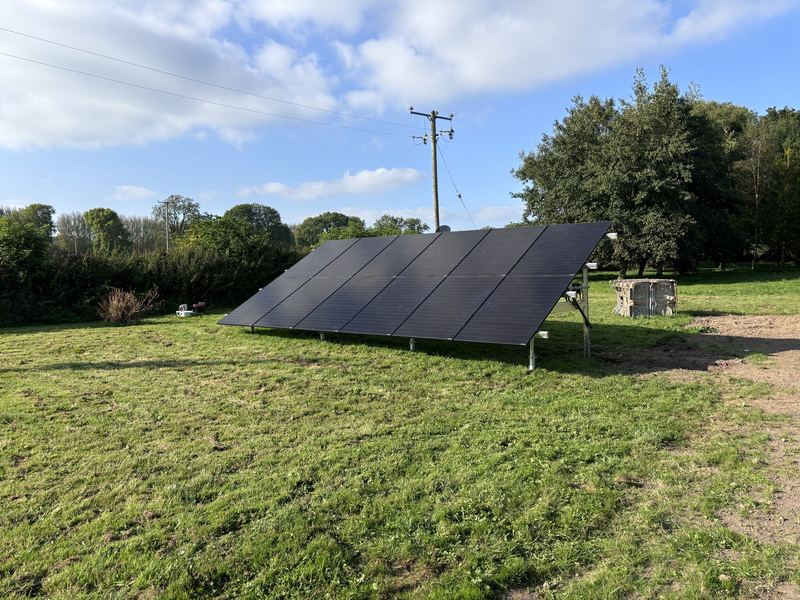
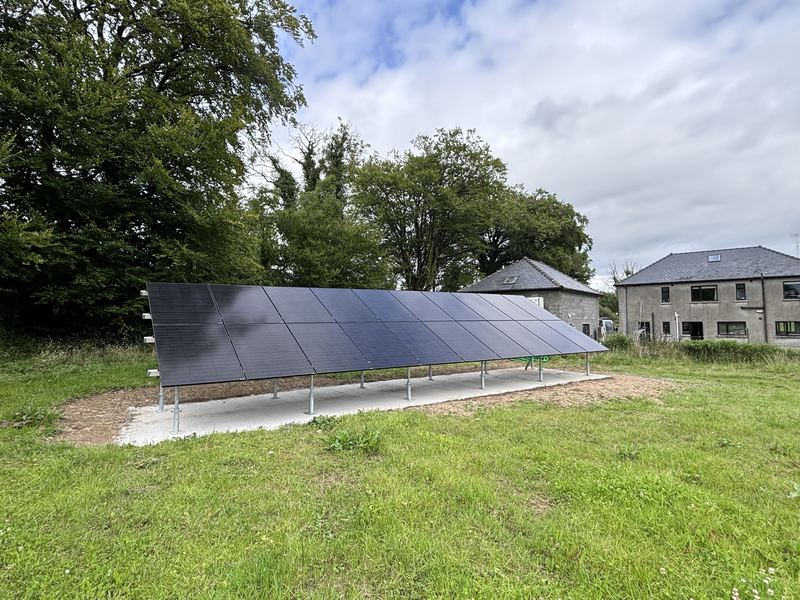
Limerick has the two things a ground mount needs: firm ground and open, well fenced fields with machinery access. Across the dairy belt from Kilmallock to Rathkeale, most farms already have a corner of a paddock that faces the right way, and a shed roof that does not. We put the panels where the sun is.
Irradiation here averages about 1,025 kWh per square metre a year and a correctly oriented ground array typically delivers around 940 kWh per kWp. Set against the Irish spread of roughly 850 to 1,000 kWh per kWp, Limerick performs strongly, and the gap over a compromised roof is often the difference that makes the numbers work.
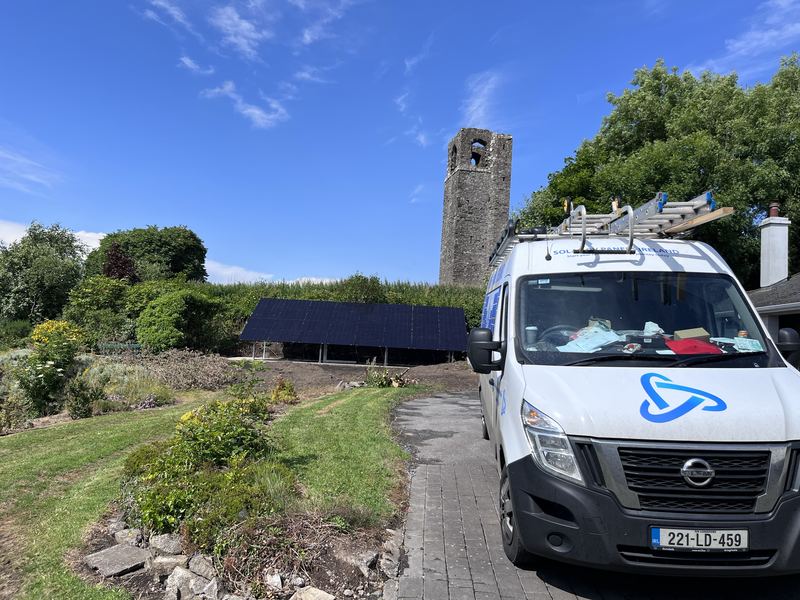
Ground or roof: how the decision usually goes in Limerick
The frame wins on angle. Panels on a ground mount are pitched at 30 to 35 degrees and turned true south, which is normally worth 10 to 25 per cent more generation than the same panels on a roof that faces south west, sits at 22 degrees or loses its afternoon to a silo.
It wins on structure too. Many Limerick milking parlours and cubicle sheds were built long before anyone considered adding several hundred kilograms of glass and rail to a roof, and older sheeting will not take the fixings without work. The ground avoids that argument entirely.
The last point is practical. Washing panels, checking connectors, replacing an optimiser or extending the array by another row are all ground level tasks. Around the commuter belt at Adare, where sites are large and gardens are screened by mature planting, the same logic applies at domestic scale.
Golden Vale soils and the different story in west Limerick
The Golden Vale limestone soils across the east and centre of the county are deep, fertile and firm, which makes for some of the most straightforward foundation work we do anywhere. Galvanised posts drive to depth cleanly, resistance is consistent along a row, and there is no concrete to pour or cure.
Head west towards Abbeyfeale and the ground changes. Peat and shale appear, cover becomes variable, and a design that suited a farm outside Kilmallock is no longer appropriate. Probing decides it, and we probe on a grid rather than at one corner of the proposed footprint.
What we typically specify in this county:
- Driven piles across the Golden Vale limestone belt
- Longer ground screws in mixed or softer west Limerick ground
- Ballasted frames where peat depth rules out penetration
- Uprated frame specification on exposed high ground
Dairy loads, three phase supply and self consumption
A dairy farm is close to the ideal customer for solar, because the load is there during daylight. Milking, plate coolers, bulk tank refrigeration, water heating and yard washing all draw hard in the morning and again in the afternoon, which is exactly when the array is producing.
Most Limerick dairy yards already have three phase supply, so a larger inverter and a bigger array are possible without upgrading the connection. That changes the sums, because every unit consumed on site displaces a unit bought at retail rates, and self consumption is worth considerably more than export. Older single phase yards around Rathkeale are worth checking early, since the supply caps how large an inverter can go in.
We size around your actual consumption, using bills and, where the meter allows, half hourly data. There is no point building an array that produces twice what the yard uses at midday unless storage or a genuine export plan sits behind it. That conversation happens before a quotation, not after.
Planning permission and Limerick City and County Council
Since S.I. 493 of 2022 came into force, most domestic ground mounts inside the curtilage of a dwelling are broadly exempt from planning permission. Four tests decide it: aperture area, capped at 25 square metres for a house; overall height, capped at 2.5 metres; position, which must be behind the front wall of the house; and the share of private open space taken up.
Different rules apply to protected structures and to sites in Architectural Conservation Areas, and solar safeguarding zones near aerodromes bring extra requirements around glint and glare. Limerick City and County Council is the authority for both the city and the county, so one office covers Adare, Newcastle West and Limerick City alike.
Farm buildings and larger agricultural arrays sit under separate provisions. Check with the council before ordering, because the cost of asking is nothing and the cost of assuming can be a great deal.
Sizing, grants and getting paid for export
As a rough planning figure, allow 8 to 10 square metres of ground per kWp for a single row, with more space where rows must be separated to avoid self shading. Panels of 440 to 500 W are standard now, so a 6 kWp domestic array is 13 or 14 panels and a farm scale system scales up from there.
On the domestic grant, values are reviewed and stepped down periodically, so take the current rate from seai.ie. The house generally must have been built and occupied before 2021, the installer must be SEAI registered, and a post works BER is required. We confirm that your ground mounted design qualifies at your address before you sign anything.
Farmers should look at the TAMS III Solar Capital Investment Scheme, which offers a 60 per cent grant rate to eligible applicants within its own investment ceiling. Exported units are paid for under the Clean Export Guarantee at supplier set rates that change, and a micro generation income tax exemption applies.
Towns and areas we cover in Limerick
We install right across the county, from Limerick City and Newcastle West out to Adare and every townland in between. There is no travel surcharge for being at the far end of the county.
Ground mounted solar in Limerick: your questions
How much will a ground mounted array produce in Limerick?
Around 940 kWh per kWp a year for a frame at proper pitch and true south, so roughly 5,600 kWh from a 6 kWp system. That sits toward the upper end of the Irish 850 to 1,000 kWh per kWp range, helped by county irradiation of about 1,025 kWh per square metre. Shading and dirt on the glass are the usual reasons for falling short.
Is my dairy farm a good candidate for solar?
Usually yes. Milking, cooling and water heating create a heavy daytime base load, which is the demand profile solar matches best, and most yards already have three phase supply. We look at your bills first and size the array around what the yard genuinely uses during daylight rather than around the space available.
What foundations do you use in the Golden Vale?
Driven galvanised piles almost always. The limestone soils around Kilmallock, Bruff and much of east Limerick are deep and firm, so posts reach depth without concrete and the frame can be built the same week. West of Newcastle West, towards Abbeyfeale, peat and shale often push us to longer ground screws or a ballasted design instead.
Do I need planning permission for a ground mount at my house?
In most cases no, provided the array stays within the exempted development limits: 25 square metres of aperture area, 2.5 metres height, behind the front wall of the house and within the private open space allowance. Limerick City and County Council handles both city and county addresses and will confirm how the rules apply to yours.
Can I install a system larger than 6 kW?
Yes, and on farms it is common. Micro generation up to 6 kW single phase or 11 kW three phase is notified to ESB Networks using an NC6 form, which typically takes a few weeks. Above that threshold a full connection application is needed, which is a longer process, so we start it early on larger projects.
What does the export payment actually work out at?
That depends entirely on your supplier. The Clean Export Guarantee obliges every supplier to pay for units you export, but rates differ between them and are revised from time to time, so check current offers before signing a contract. Using power on site is worth more than exporting it, which is why sizing matters.