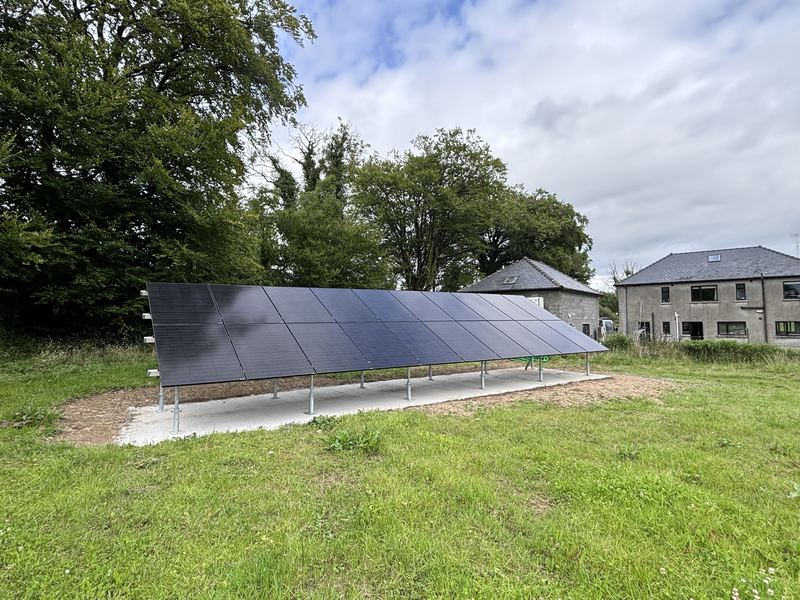
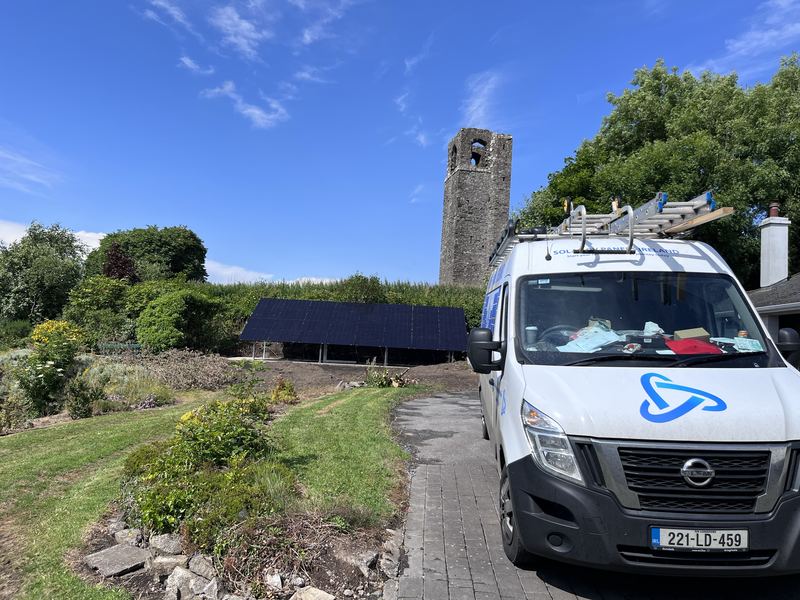
Carlow is a small county with a large amount of workable open ground, and that combination suits ground mounted solar very well. The tillage and dairy land either side of the River Barrow gives us flat, hedgerow-bounded fields where an array can be set at true south and a 30 to 35 degree pitch without arguing with a roof. Irradiance here runs at roughly 1,045 kWh per square metre a year.
A properly built ground mount in this county should return in the region of 960 kWh per kWp annually. Against the Irish spread of roughly 850 to 1,000 kWh per kWp, that is near the top end. Our crews install around Carlow Town, Tullow, Bagenalstown (Muine Bheag), Leighlinbridge, Borris and Hacketstown, on farmyards, bungalow sites and small commercial yards.
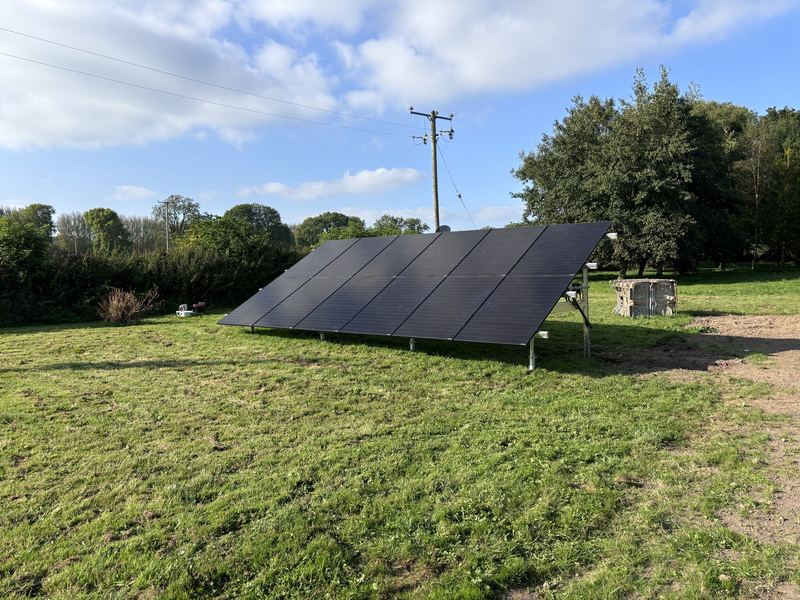
Ground conditions from the Barrow valley to the Blackstairs
Carlow soils are mostly free-draining brown earths sitting over Leinster granite and Carboniferous limestone. On the tillage ground near Carlow Town and Bagenalstown that means driven piles do the job cleanly. Galvanised steel posts go straight into firm mineral soil and boulder clay, there is no concrete and no curing time, and the field is back in use the same week.
The Barrow valley carries heavier gley soils in places, and we allow for a higher winter water table there than a dry summer trial hole would suggest. Rising towards the Blackstairs foothills above Borris and Hacketstown, granite comes close to the surface and a short pile simply refuses. Resin-fixed rock anchors, drilled into sound bedrock, are the usual answer. We probe the array footprint before anything is ordered, so the foundation type is settled at survey stage rather than on the morning the rig arrives.
Why a field beats a roof in this county
Shading is rarely the deciding factor in Carlow. The field pattern is open, hedgerows are kept low and cut, and the ground rolls gently instead of dropping into deep shaded valleys. What usually rules out a roof is pitch and orientation. Sheds were put up for machinery and grain, with the ridge running whatever way the yard happened to run.
A ground mount removes that constraint. Set at the pitch you want and facing the direction you want, it will typically out-generate the same panels on a compromised roof by 10 to 25 per cent. Cleaning, string checks and inverter work all happen at standing height, which matters on a working farm where hiring a lift is another cost and another delay. The real trade-off here is livestock and machinery, so we stock-proof the array and set the perimeter well clear of headlands.
Sizing, grants and getting paid for exported units
Domestic arrays in Carlow usually land between 6 and 16 kWp. Allow roughly 8 to 10 square metres of ground per kWp for a single row, and more where a second row has to be spaced back to avoid self-shading. A row pitch of about 2.5 times the array height is a reasonable planning figure. Panels in common use are 440 to 500 W, so a 6 kWp array is around 13 or 14 modules.
Three funding routes matter to most Carlow customers:
- The SEAI domestic solar grant, which is reviewed and stepped down periodically, so check the current value on seai.ie rather than relying on an old quote. The home generally needs to have been built and occupied before 2021, the work must be carried out by an SEAI-registered company, and a post-works BER assessment is required.
- The TAMS III Solar Capital Investment Scheme, at a 60 per cent grant rate for eligible farmers under its own separate investment ceiling. Tillage and dairy holdings around Leighlinbridge and Tullow are typical candidates.
- The Clean Export Guarantee. Suppliers are obliged to pay for units you send to the grid, rates differ between suppliers and change over time, and a micro-generation income tax exemption applies to that income.
We confirm that a ground-mounted array qualifies at your specific property before you commit to anything.
Planning permission and Carlow County Council
In general, the 2022 exempted development regulations (S.I. 493 of 2022) allow a free-standing solar array within the curtilage of a house without planning permission, subject to limits. For houses those limits include an aperture area cap of 25 square metres, a maximum height of 2.5 metres, a rule against placing the array forward of the front wall of the house, and a cap on how much of the private open space it may take up.
Broadly is the operative word. Protected structures, Architectural Conservation Areas and solar safeguarding zones near aerodromes are treated differently, and agricultural buildings and land sit under separate provisions with their own conditions. Confirm your position with Carlow County Council before a frame is ordered. We will put the array dimensions and a site layout in front of the planning section on your behalf, which is quicker than finding out afterwards.
What the install looks like on the ground
A Carlow job normally runs over two to four days on site once the survey is done. Day one is setting out and foundations. Day two is frame and rails. Panels, DC string work and the inverter follow, then the AC side, isolation and commissioning.
Cable route is the item people underestimate. On holdings around Hacketstown and Borris the best aspect often sits a hundred metres or more from the board, so we size the run to keep volt drop sensible and trench it where machinery will not find it later. For micro-generation, ESB Networks needs an NC6 notification, covering up to 6 kW single-phase or 11 kW three-phase. Anything larger takes a full connection application and typically a few weeks longer. That paperwork is part of the job, not something we hand back to you.
Towns and areas we cover in Carlow
We install right across the county, from Carlow Town and Tullow out to Borris and every townland in between. There is no travel surcharge for being at the far end of the county.
Ground mounted solar in Carlow: your questions
What will a ground mounted array actually generate in Carlow?
Carlow receives around 1,045 kWh per square metre of irradiance a year, and a correctly oriented ground mount here typically returns about 960 kWh per kWp annually. Nationally the figure spans about 850 to 1,000 kWh per kWp, which places Carlow near the top. A 6 kWp array on a clear southern aspect is a predictable performer here.
Do I need planning permission for a ground mounted array in Carlow?
Often not. The 2022 regulations broadly allow a free-standing array in the curtilage of a house, subject to a 25 square metre aperture cap, a 2.5 metre height limit, a bar on siting it forward of the front wall, and a private open space test. Protected structures are treated differently. Confirm your own position with Carlow County Council before ordering.
My land rises towards the Blackstairs. Can you still fix a frame there?
Yes. On the higher ground above Borris and Hacketstown, Leinster granite often sits close to the surface and a driven pile will refuse partway down. We switch to resin-fixed rock anchors drilled into sound bedrock, which hold extremely well in that material. Probe results at survey decide the method, and the price is settled before steel is ordered.
How much ground does an array take up?
Allow roughly 8 to 10 square metres per kWp for a single row. A 6 kWp system using 440 to 500 W panels is about 13 or 14 modules and fits into the corner of a paddock or a large garden. Where two rows are needed, the gap between them is set at about 2.5 times the array height.
Will cattle or machinery damage the array?
That is the main risk in Carlow, well ahead of shade. We site the array clear of headlands and turning circles and stock-proof the perimeter so cattle cannot rub against the frame or reach the DC cabling. On tillage ground around Bagenalstown and Leighlinbridge we agree the layout with whoever drives the sprayer before anything is set out.
Can I add a battery or an EV charger later?
Yes. We size the inverter and the board with that in mind, so adding storage such as Sigenergy, or an EV charge point, becomes a straightforward addition rather than a rebuild. A battery lets you hold midday generation for the evening instead of exporting it, which changes the value of every unit the array produces.