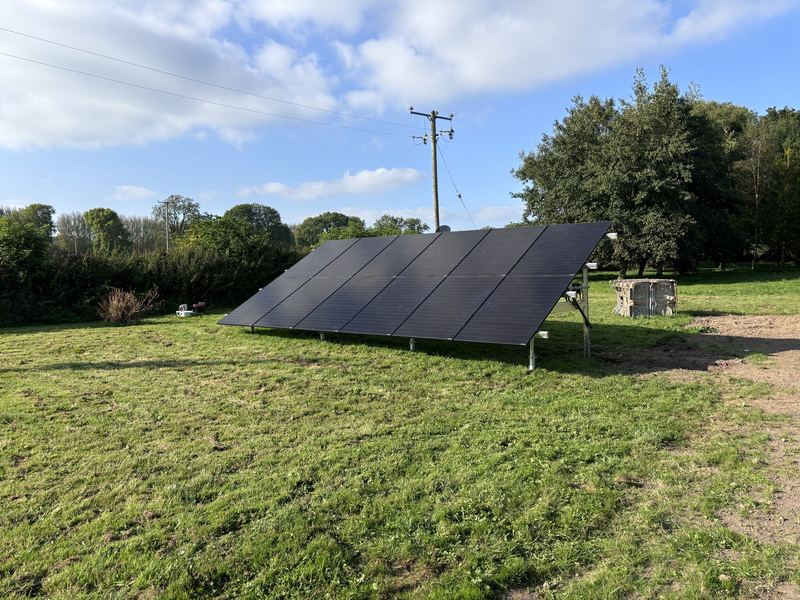
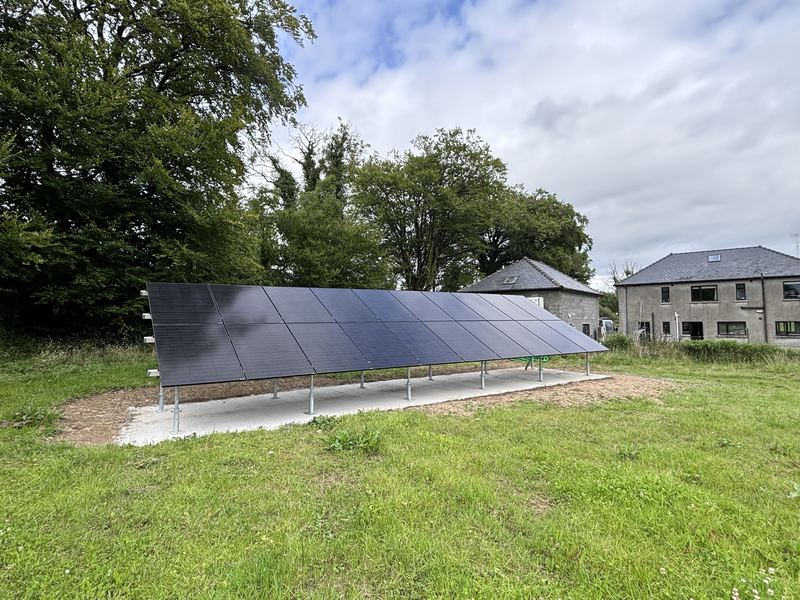
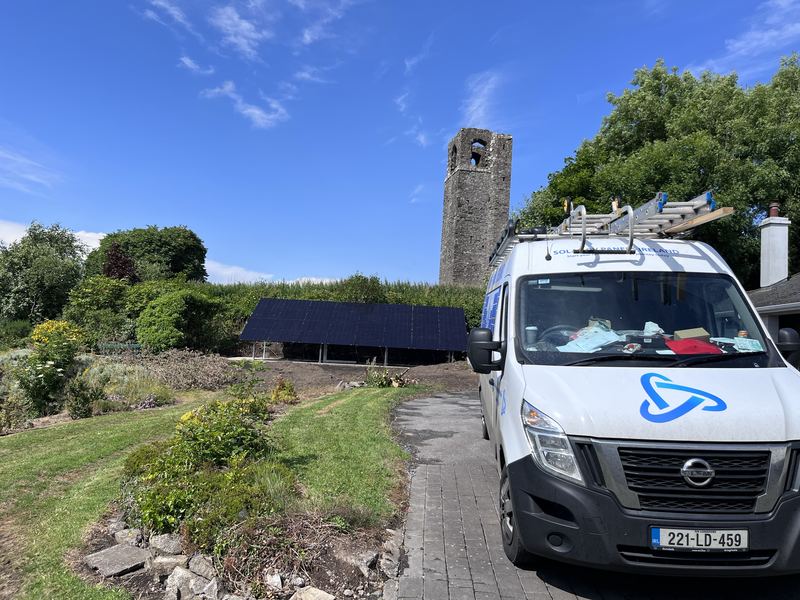
For foundation purposes Galway behaves like two separate counties. East of the city the bedrock is limestone under thin, free-draining cover, and stone can appear anywhere between 300 and 600 mm down. West towards Clifden you are into blanket peat and exposed granite, where driving a post is not on the table at all.
That single difference drives everything else. A price built on driven piles near Athenry turns into a rock-drilling job the moment the rig meets stone, and a Connemara field that feels solid in August is a different animal in February. Probing takes an hour and it keeps the quote honest.
Ground conditions from Ballinasloe out to Connemara
The eastern half of the county, taking in Ballinasloe, Loughrea, Athenry and the ground around Gort, is shallow soil over limestone. Where there is enough depth we drive short piles. Where the probe strikes rock early we drill and resin-fix anchors instead, which is a slower morning but a permanent fixing.
Connemara is another proposition. Blanket peat over granite means the load has to be spread rather than concentrated, so ballasted frames or engineered spread footings are usually the only sensible design. Long helical screws work where the peat is shallow enough to reach firm material beneath. We survey on a grid, because peat depth can change by a metre inside the length of one array.
Access counts for as much as geology out west. A driving rig, or a lorry load of ballast blocks, has to get down the lane, through the gate and into the field without wrecking ground or crossing a bridge that was never built for it. On several Connemara jobs we have staged materials at the yard and brought them in over a few trips rather than risk a soft verge in one run.
Why the field wins over the shed roof in Galway
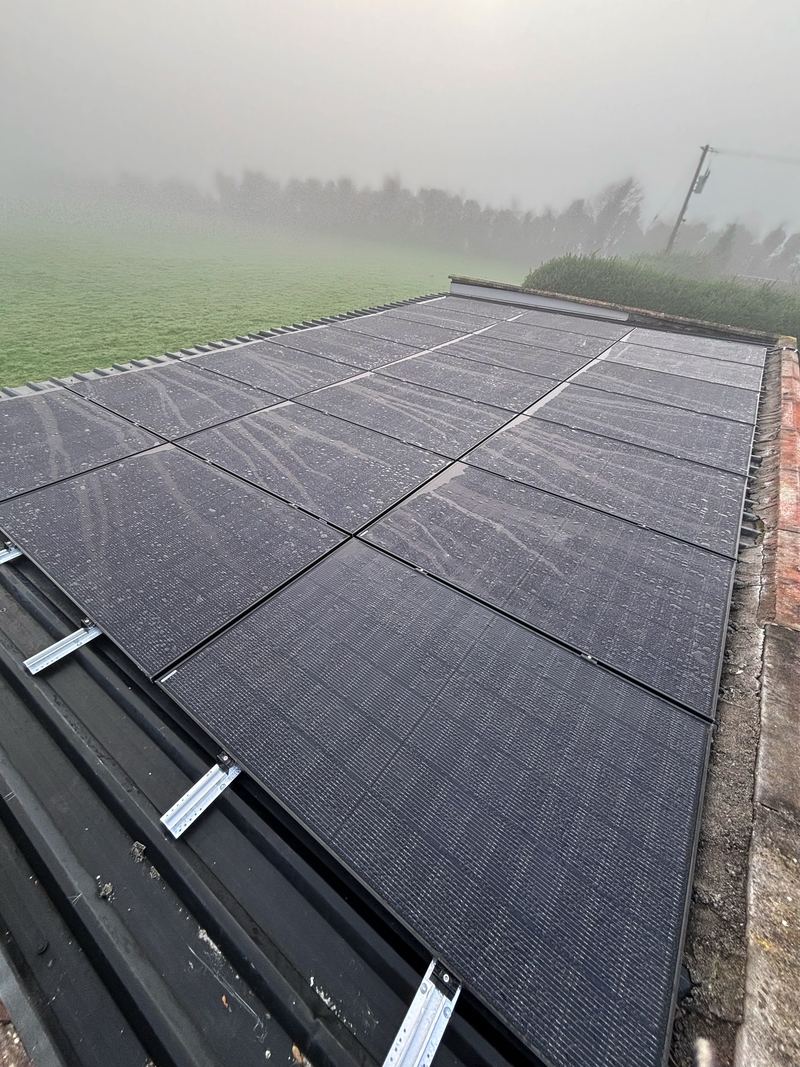
Farm buildings on suckler and sheep holdings across east Galway were put up for cattle, silage and machinery. Their roofs face whatever way the yard was laid out, the pitch is often shallow, and older sheds were never designed to carry an extra load in an Atlantic gale. Fixing panels to them is frequently the wrong call.
A frame in the corner of a field sidesteps all of it. You get true south, the pitch you actually want, and access from the ground for cleaning and any later work. Around the city commuter belt the same logic applies to houses on generous sites in Oranmore and Claregalway, where the garden faces south and the roof does not. Stock-proof fencing is the one extra we build in as standard on farm sites.
There is a practical side too. A frame standing clear of the ground can be walked around, inspected and washed down in ten minutes, whereas panels on a low shed roof in a wet yard are awkward and often unsafe to reach at all.
Output you can expect in Galway
Irradiance across Galway comes in near 970 kWh on every square metre annually, respectable for a western county and better than most people assume. A well-oriented ground mount at 30 to 35 degrees works out around 900 kWh per kWp per year. Ground-mounted systems around the country run from about 850 at the bottom of the scale to 1,000 at the top, measured per kWp, which leaves Galway mid-table: below the sunny south-east, comfortably above the north-west.
What lifts a Galway site above that average is orientation and exposure. A sheltered south-facing field near Tuam will outperform a windswept slope with a hedgerow across its southern boundary, using the exact same panels. We model the horizon during the survey so the figure we give you reflects your own ground rather than a county average.
Generation is not spread evenly across the year. The bulk of it lands between March and September, so the sensible plan is to use as much as possible in daylight hours and store or divert the rest. On farms the midday machinery load does that job on its own.
Planning permission and your local authority
Outside the city boundary you are dealing with Galway County Council, and inside it with Galway City Council. That distinction matters in places like Knocknacarra and Ballybane where suburban addresses sit close to the line, so check which side you are on before making any application or assuming an exemption.
The 2022 exempted development regulations broadly permit a free-standing domestic array without planning permission, within limits. The headline conditions are area, height and position: aperture kept to 25 square metres on a house, nothing standing over 2.5 metres, no part of the frame in front of the building line, and only a limited share of your private open space given over to it. Protected structures and Architectural Conservation Areas are treated separately, as are solar safeguarding zones near aerodromes. Confirm your case with the council before you order a frame.
Sizing, grants and payment for exports
Sizing follows your daytime load rather than your annual bill. Reckon on eight to ten square metres of ground for each kWp in one line, and more again where rows have to be spaced. With modules in the 440 to 500 W bracket, 6 kWp works out at thirteen or fourteen panels, which suits a house, while a milking parlour or a workshop usually wants a good deal more.
On the money side, there are a few things worth confirming before you commit:
- SEAI grant eligibility for your specific property, with current values checked on seai.ie
- Whether the home was built and occupied before 2021, and that a post-works BER is arranged
- TAMS III Solar Capital Investment Scheme at its 60 per cent rate if you farm and qualify
- Clean Export Guarantee rates from your own supplier, since they differ and change
- Whether NC6 notification covers you or a full connection application is needed
Towns and areas we cover in Galway
We install right across the county, from Galway City and Ballinasloe out to Athenry and every townland in between. There is no travel surcharge for being at the far end of the county.
Ground mounted solar in Galway: your questions
Can you install a ground mounted array on Connemara peat?
Yes, with the right foundation. Peat will not hold a driven pile, so we use ballasted frames, engineered spread footings, or long helical screws where firm material sits within reach. The design comes from a grid of probes rather than one hole at a corner, because depth varies enormously across a single Connemara field.
Why do quotes change when the digger arrives in east Galway?
Usually because of shallow limestone. Around Athenry, Loughrea and Gort rock frequently sits 300 to 600 mm down, and a price assuming driven piles becomes a rock-drilling job on the day. We probe before quoting for exactly that reason, so the foundation method is settled before anyone commits to a figure.
Do I apply to Galway County Council or Galway City Council?
It depends on the boundary. Addresses inside the city boundary come under Galway City Council, and everywhere else in the county comes under Galway County Council. If you are in one of the suburbs sitting close to the line, check before you assume, because the exemption limits are interpreted by whichever authority actually covers your site.
How much land does a farm-scale array take up?
Reckon on ten square metres of open ground per kWp in a single line. Multiple rows need spacing of about 2.5 times the array height to stop self-shading in winter, so the footprint grows. On most Galway holdings we can fit a substantial array into a corner that is awkward for machinery anyway.
Will an array stand up to west Galway wind?
It will if it is engineered for the exposure rather than a generic terrain category. Frame specification, post embedment depth and ballast mass all get uprated on exposed western sites. That costs a little more in steel and concrete than an inland design, and it is not something we shave to win a job.
What paperwork is involved with ESB Networks?
ESB Networks accepts an NC6 notification for micro-generation at or below 6 kW on single-phase and 11 kW on three-phase, and we file it for you. Above those limits a full connection application is required instead, which adds time, usually a few weeks. Export metering follows commissioning, and your supplier then applies its Clean Export Guarantee rate.